

Video ad testing means running controlled experiments on your video creative variants to find which asset actually drives results before you scale spend behind it. The single highest-leverage move is testing hooks first: isolate the first three seconds, run at least two variants side by side, pick one primary KPI, and let the platform's own experiment tools tell you the winner. A successful test ends with one creative you can confidently repurpose across placements and budgets.
TL;DR:
- Testing hooks first can significantly improve engagement by ensuring the first three seconds capture viewer attention; run at least two variants side by side.
- Pre-testing can identify basic creative issues cost-effectively, but in-market testing is necessary for conclusive performance data on actual conversions.
- Setting at least 1,000 impressions per variant and running tests for 3 to 7 days helps avoid noise and inaccurate results.
- Using A/B tests for live campaigns controls for timing and audience overlap, but changing only one variable per test is essential for clear insights.
- Scale winners by adapting creative formats and messaging without stretching a single master file, and monitor for early fatigue signals like rising CPM or decreasing hook rate.
Table of Contents
- What Is Video Ad Testing, and When Should You Pre-Test vs Test in Market?
- Build a Testing Hierarchy: Hooks First, Then Length, Structure, and Offer
- What Metrics Actually Tell You Whether a Video Ad Works?
- How Do A/B, Monadic, and Sequential Monadic Tests Work for Video Ads?
- What Specs and Hooks Actually Work on Each Platform?
- How Do You Set Sample Sizes, Budgets, and Timelines for a Test?
- Why Do Most Creatives Fail at Second 7, and What Fixes It?
- Which Tools Actually Help You Test Video Ads at Scale?
- What Should You Do Once a Test Declares a Winner?
- What Legal and Ethical Issues Come Up in Video Ad Testing?
- Common Testing Mistakes We See Marketing Teams Make
- How Jamesyee Keeps Your Testing Pipeline Full
- Where to Go for the Underlying Platform Documentation
- Sources
What Is Video Ad Testing, and When Should You Pre-Test vs Test in Market?
Video ad testing splits into two distinct disciplines that get confused constantly, and mixing them up wastes budget.
Pre-testing happens before a dollar hits the platform. It's qualitative and quantitative research, often using attention-tracking software or small panel surveys, to catch obvious problems: confusing messaging, an offer nobody understands, a logo that shows up too late. In-market testing runs live, using real platform traffic and real conversion data, through structured methods like Google Ads Video experiments.
Each has a clear job:
- Pre-testing catches disasters cheaply but gives you directional, not conclusive, signals. It won't tell you which hook drives lower CPA.
- In-market testing gives you conclusive performance data tied to your actual funnel, but it costs real media spend and takes days to reach a reliable sample.
- Directional results (small panels, early impressions) are useful for triage. Conclusive results require enough volume to trust the number.
Most teams should pre-test for obvious creative red flags, then move straight to in-market video ad optimization for any creative that impacts spend decisions.
Build a Testing Hierarchy: Hooks First, Then Length, Structure, and Offer
Testing every variable simultaneously produces noise, not answers. Industry playbooks consistently rank the order of impact the same way, and it's worth following that order rather than testing whatever feels interesting this week.
- Test hooks first. The first one to three seconds decide whether anyone watches the rest, so isolate this variable before anything else. Swap the opening shot, line, or question while keeping everything downstream identical.
- Test length second. Once you know your best hook, run it against a 15 second cut and a 30 second cut to see where attention actually falls off.
- Test structure third. Reorder the proof point, demo, and call to action within your winning length to see if sequencing shifts conversion.
- Test offer last. Pricing, bundling, and urgency framing matter, but they're wasted effort on a creative that never earns attention in the first place.
Start with three to five variants per test cycle according to ecommerce video testing frameworks, then apply kill rules early: if a variant's hook rate lags the control by a wide margin after the first meaningful batch of impressions, cut it rather than waiting for a "fair" sample. Scale whatever clears every stage cleanly.
What Metrics Actually Tell You Whether a Video Ad Works?
Different metrics answer different questions, and testing the wrong KPI against the wrong goal is one of the most common mistakes in video ad performance analysis.
- Hook rate (3 second view rate) is the audition metric. It measures what percentage of viewers stick around past your opening beat, and it's the fastest signal for creative video ad testing because you don't need a conversion event to read it.
- View-through rate (VTR) and completion rate show you the full retention curve, not just the opening. A steady decline is normal; a sharp cliff at a specific second points to a pacing problem, not a hook problem.
- Click-through rate (CTR) matters most when the campaign goal is traffic or direct response, and it tells you whether the message, not just the visual, is landing.
- Cost per view (CPV) and cost per mile (CPM) are efficiency signals. YouTube's ad metrics guidance notes that a rising CPV over time on a creative that was previously cheap to serve is often an early warning of creative fatigue, even before conversion metrics drop.
- Cost per acquisition (CPA) is the metric that actually pays the bills, but it's the slowest to reach statistical confidence, so pair it with hook rate and VTR for early reads.
- Brand lift matters for awareness campaigns where clicks and conversions aren't the point; it requires platform-run lift studies rather than standard reporting.
Pro Tip: Don't judge a new creative on CPA alone in its first 48 hours. Check hook rate and VTR first. A weak hook rate almost always predicts a weak CPA before the spend catches up.
Google's video analytics tools surface retention curves and top-retention segments directly inside the platform, which makes diagnosing a drop-off point far faster than pulling data manually.
How Do A/B, Monadic, and Sequential Monadic Tests Work for Video Ads?
Choosing the right experimental design determines whether your results mean anything.
A/B testing (also called split testing) shows two creative variants to separate, randomized audience segments at the same time, then compares the outcome on one predetermined metric. This is the gold standard for in-market video ad testing because it controls for timing, seasonality, and audience overlap. The rule that matters most: change one variable per test. If you swap the hook and the music track at once, you'll never know which one moved the needle.
Monadic testing shows a single creative to one audience group in isolation, without a side-by-side comparison, and is more common in pre-launch survey research than in live platforms. It's useful when you want an unbiased reaction to one asset without anchoring viewers against a competing version.
Sequential monadic testing shows the same respondent multiple creatives, one after another, usually in survey environments. It's efficient for gathering fast qualitative reactions across several concepts, but order effects (fatigue, recency bias) limit how much weight you should put on later creatives in the sequence.
On Google Ads specifically, video experiments work by duplicating your control campaign into a treatment arm, splitting traffic evenly between them, and letting you pick a primary metric to declare a winner. The platform recommends waiting for a confidence threshold, typically in the 80 to 95 percent range, before treating a result as conclusive rather than directional.
- A/B: best for live, budget-backed decisions.
- Monadic: best for early concept validation without comparison bias.
- Sequential monadic: best for fast, low-cost reaction gathering across many concepts at once.
What Specs and Hooks Actually Work on Each Platform?
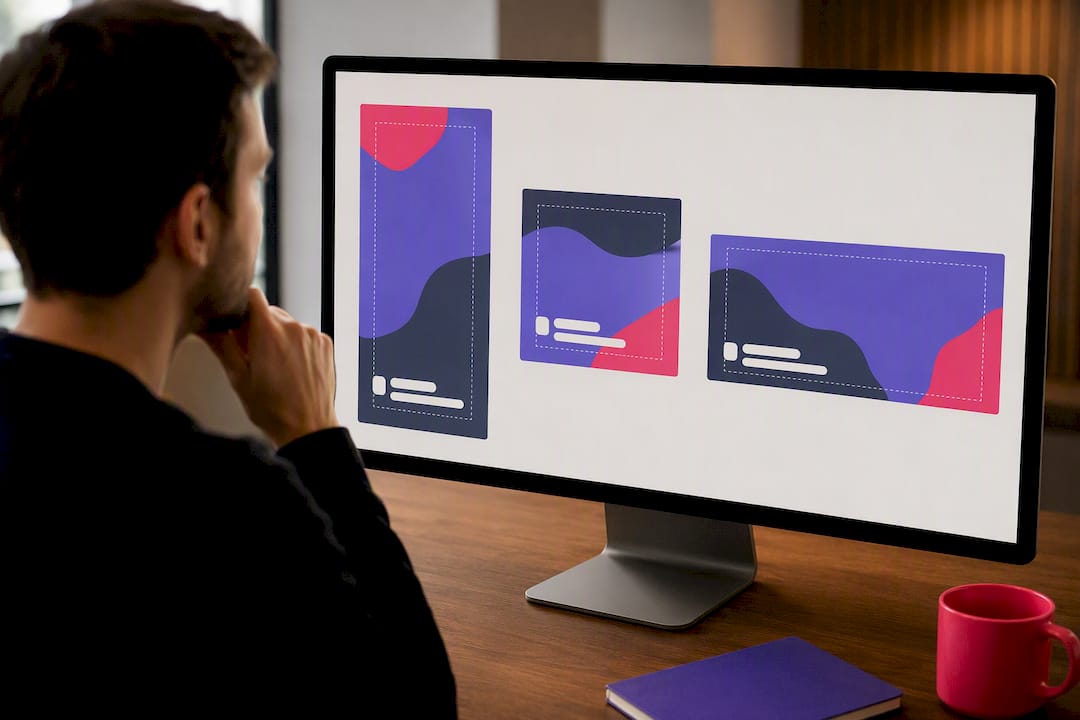
Building one master cut and shrinking it for every placement is one of the fastest ways to sabotage a test. A hook that stops the scroll on a vertical feed rarely survives being letterboxed into 16:9. Native formats consistently outperform repurposed cinematic cuts on cold social placements, because viewers read a polished, horizontal ad as an interruption rather than as content.
Caption everything. A meaningful share of feed viewers watch without sound, so audio-dependent hooks lose the audience before the message lands regardless of how strong the script is.
How Do You Set Sample Sizes, Budgets, and Timelines for a Test?
A test that ends too early gives you noise dressed up as an answer. A test that runs too long burns budget you could've redeployed to a winner two days earlier.
- Set a minimum impression floor per variant. Practical frameworks suggest at least 1,000 impressions per variant before you start trusting the hook rate or VTR numbers you're seeing.
- Budget $50 to $100 per variant minimum to reach that impression floor on most paid social and video platforms, adjusting upward for higher-CPM audiences.
- Run tests for 3 to 7 days. Shorter windows miss day-of-week effects; longer windows risk creative fatigue contaminating your read on the original variant.
- Log everything in a shared test document: hypothesis, variable changed, KPI, sample size, and outcome, so the next test cycle doesn't repeat a dead end from three months ago.
Institutional memory is the quiet difference between teams that improve every quarter and teams that keep rediscovering the same losing hook format. A spreadsheet with twenty logged tests is worth more than any single brilliant creative.
Why Do Most Creatives Fail at Second 7, and What Fixes It?
Retention curves almost always show the same shape: a drop right after the hook, then a second, sharper cliff somewhere between seconds 7 and 10. This is the second-7 problem, and it's distinct from a weak hook. A creative can post a strong 3-second hold rate and still bleed viewers a moment later because nothing new happens on screen once the initial curiosity is satisfied.
The fix is pacing, not a new opening line. Cut frequency in the 1.5 to 2.5 second range through the middle of the video, whether that's a new camera angle, a text reveals, or an audio shift, keeps reintroducing information before attention lapses. Google's own scene-level analysis of YouTube ads shows that machine learning models can extract features like logo timing, text overlay placement, and audio cues, then estimate how each one independently affects view-through rate. That's a more precise diagnostic than eyeballing a retention graph.
Four hook archetypes cover most winning ads:
- Curiosity-gap ("You're probably doing this wrong") tends to post the highest cold hook rates but can suffer weaker completion if the payoff underdelivers.
- Problem-state (showing the pain point directly) performs well for direct-response offers with a clear before-and-after.
- Testimonial hooks build trust faster on retargeting audiences than on cold traffic.
- Tutorial hooks work when the product itself is the demonstration.
Pro Tip: When a retention curve cliffs at second 8, don't touch the hook. Re-edit the cut frequency in seconds 5 through 12 first. Teams that "fix" the hook after a second-7 drop usually end up solving a problem that was never there.
Which Tools Actually Help You Test Video Ads at Scale?
No single tool covers every stage of a testing program, and picking the wrong one for the job wastes both time and budget.
- Platform-native experiments (Google Ads video experiments, Meta's built-in A/B testing) are free, fast, and tied directly to your real conversion data, but they only test within one platform's ecosystem.
- Attention and eye-tracking vendors give you pre-launch signal on where eyes actually land in the first few seconds, useful for catching a bad hook before spend goes live, though the sample sizes are usually small.
- Creative automation tools generate cutdowns, aspect ratio variants, and caption overlays quickly, which matters because most testing bottlenecks are production speed, not strategy.
- Analytics suites (beyond platform dashboards) help you compare performance across channels in one view, which matters once you're running tests on more than one platform simultaneously.
When evaluating any vendor, weigh turnaround time, whether they give you access to raw creative variants rather than just summary scores, and whether their measurement methodology holds up against a real conversion outcome, not just an attention proxy. Teams stretched thin on production often bring in a managed creative partner or automation assistant specifically to keep the variant pipeline full, since a testing program is only as good as the number of fresh creatives feeding it.
What Should You Do Once a Test Declares a Winner?
A winning creative is a starting point, not a finish line. The work now shifts to scaling it without letting it burn out.
- Re-cut the winning hook into every aspect ratio your placements require instead of stretching one master file.
- Test small messaging tweaks around the winning structure rather than starting a new concept from scratch.
- Watch frequency and CPM as you scale spend behind a winner; both are early fatigue signals before CPA actually moves.
- Feed the winning hook archetype and pacing pattern into your next production brief as a template, not a one-off.
| Signal | Action |
|---|---|
| Hook rate holds, CPA rising | Refresh supporting creative, keep the hook |
| Hook rate dropping over time | Retire the hook, test a new archetype |
| CPV climbing on a stable audience | Early fatigue warning, prep replacement variants now |
What Legal and Ethical Issues Come Up in Video Ad Testing?
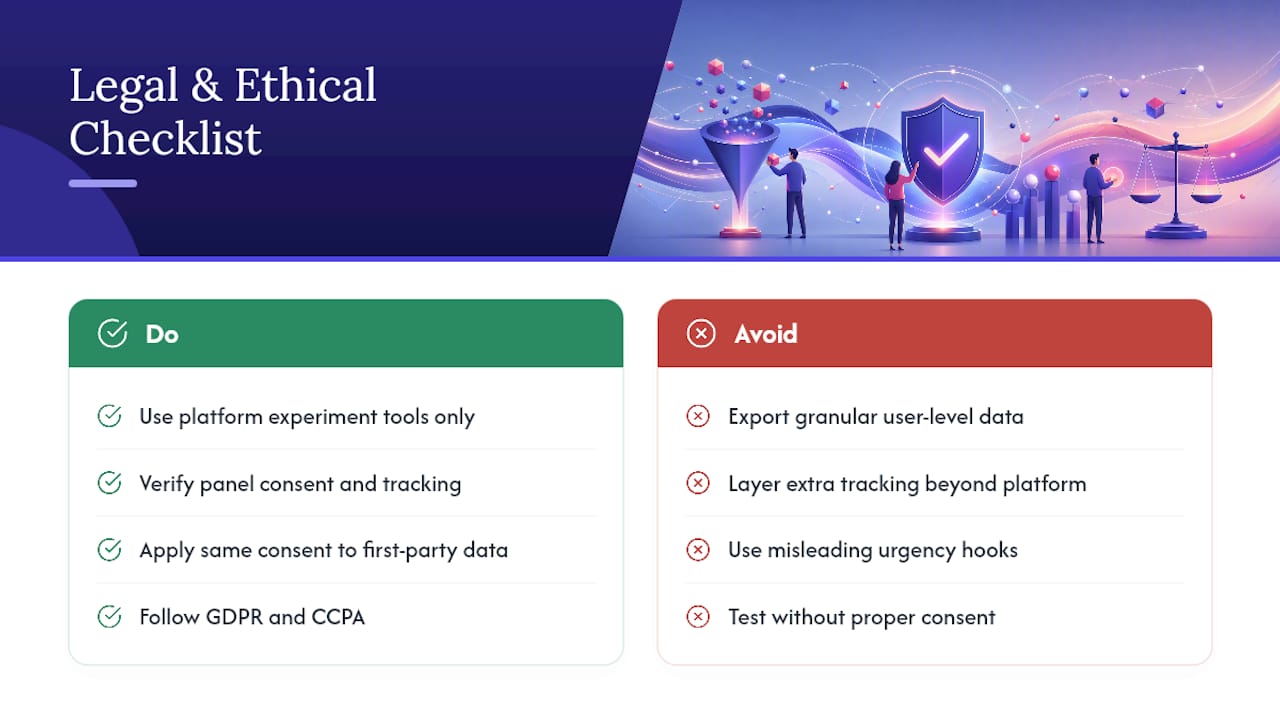
Testing video creative touches user data the moment you segment audiences, track view-through behavior, or run any lift study, so privacy compliance isn't optional paperwork. It's a design constraint on the test itself.
Platforms like Google Ads and Meta already anonymize and aggregate the audience data used in experiments, but marketers still carry responsibility for how they use segment-level insights. If you're layering first-party data (email lists, CRM segments) into an audience split for a sequential monadic survey, that data needs to be collected and used under the same consent standards as any other marketing activity, governed by regulations like the GDPR in the EU or the CCPA in California depending on where your audience sits.
There's also a subtler ethical layer specific to video: hook archetypes built around manufactured urgency or exaggerated problem-states can shade into misleading advertising if the product doesn't actually deliver on the implied claim. A curiosity-gap hook that promises a result the offer can't back up might win the test on hook rate while damaging brand trust and, in some jurisdictions, exposing the advertiser to false-advertising liability.
Brand lift studies deserve particular caution. They often rely on survey panels recruited through the platform, and reputable platforms disclose panel consent terms, but advertisers should confirm they're not layering additional tracking beyond what the platform default provides. When in doubt, keep test audiences within the platform's own experiment tools rather than exporting granular user-level data into third-party systems you can't fully audit.
Common Testing Mistakes We See Marketing Teams Make
Testing five variables at once and blaming the hook for a pacing problem are the two mistakes that waste the most budget. Run one variable per cycle, tie every test to a single primary KPI, and ship new creative weekly rather than monthly. Automation or a managed creative assistant earns its cost the moment production speed, not strategy, becomes the bottleneck.
— James
How Jamesyee Keeps Your Testing Pipeline Full
Every testing framework above assumes you have enough fresh creative to actually run it, and that's where most in-house teams stall out. A rigorous hook-first testing hierarchy needs three to five new variants a week, and cutting those by hand through a traditional agency usually means days of turnaround and an invoice that makes weekly testing impractical.
A dedicated virtual assistant team can turn one raw video into a full batch of testable ad variations with rapid turnaround, built specifically for hook-first testing hierarchies rather than one polished master cut. If your team has the testing framework down but keeps hitting a production wall, see how the process works and get your next batch of testable hooks moving this week.
Where to Go for the Underlying Platform Documentation
For the platform mechanics referenced throughout this guide, start with Google's video experiments guide for A/B setup, video analytics documentation for retention diagnostics, and scene-level creative analysis for feature extraction methods. For visual production planning, Dock Street Studio's guide to editorial photography offers useful groundwork on creative planning that extends to video composition.
Sources
- Create and run video experiments - Google Ads Help
- Introducing discovery ad performance analysis - Google Developers Blog