

TikTok guarantees uploads up to 3 minutes for all creators, and some accounts can push to 5 to 10 minutes, but that's not the number that matters for ad performance. For actual In-Feed ad placements, the TikTok Ads Help Center commonly lists a 5 to 60 second window, and most operators recommend landing in the 9 to 15 second range for engagement-driven campaigns. A few isolated tests have allowed uploads as long as 60 minutes, but those are limited experiments, not a documented spec you should plan around.
Here's the quick breakdown before you get into format specifics:
- Documented ceiling: 3 minutes guaranteed for all creators; some accounts see 5 to 10 minutes; API access tops out around 10 minutes.
- Practical ad ceiling: 5 to 60 seconds for standard In-Feed/Auction placements.
- Performance sweet spot: 9 to 15 seconds for awareness and virality, per Hootsuite's TikTok advertising benchmarks and Statista's engagement-rate data across platforms.
- Monetization note: the Creator Rewards Program requires organic content to be at least a minute long for eligibility, a rule that does not affect ad duration limits.
Key Takeaways
The best TikTok ad length depends on your objective, but 9 to 15 seconds wins for awareness while 15 to 30 seconds wins for consideration and conversion testing.
| Point | Details |
|---|---|
| Official ad ceiling | In-Feed/Auction ads commonly run 5 to 60 seconds; uploads guarantee 3 minutes platform-wide. |
| Performance sweet spot | Target 9 to 15 seconds for awareness, 15 to 30 seconds for consideration and conversion goals. |
| Technical floor | Keep files under 500MB, use 9:16 at 1080p, and export in .mp4 for the most reliable delivery. |
| Test in structured rounds | Run three length variants simultaneously for 3 to 5 days before judging results by objective-specific metrics. |
| Scale variant production | Jamesyee's managed workflow turns one shoot into multiple tested lengths within 24 to 48 hours, reporting a 31% CPA reduction. |
Table of Contents
- What Are TikTok's Official Ad Length Limits By Placement?
- Technical Specs: File Types, Resolution, and Size Limits
- How Long Should Your TikTok Ad Actually Be?
- Producing Multiple Length Variants From One Shoot
- How Do You Test Which Ad Length Works Best?
- Scaling Creative Output Without Triggering Ad Fatigue
- Pitfalls That Get TikTok Ads Rejected or Underdelivered
- Scale Your TikTok Ad Variants Without the Agency Wait
- Frequently Asked Questions
- Sources
What Are TikTok's Official Ad Length Limits By Placement?
The honest answer is that TikTok's own documentation is looser than most marketers assume, and it varies by placement type. Some sources put the practical ceiling closer to 60 seconds flat for standard delivery, which lines up with what Shopify's TikTok Ads guide reports for merchant campaigns.
Spark Ads work differently because they amplify an existing organic post rather than starting from a fresh upload. That means the underlying video can carry whatever duration the original organic post had, including durations well beyond the standard 60-second Auction ceiling, since you're sparking a video that already lived on someone's profile. TopView and other premium branded placements typically cap around 60 seconds too, though premium formats occasionally get bespoke allowances TikTok negotiates directly with larger advertisers.
| Placement type | Common documented range | Notes |
|---|---|---|
| In-Feed/Auction ads | 5 to 60 seconds | Standard performance format; some accounts see minor variance |
| Spark Ads | Inherits organic video length | Can exceed 60s since it boosts an existing post |
| TopView/Branded | Up to 60 seconds | Premium placement, occasional custom terms |
| Creator Rewards eligibility | 1-minute minimum | Not an ad spec, applies to organic monetization only |
A few caveats worth flagging directly:
- TikTok has never published a universal minimum ad length. Sub-5-second ads are technically possible on some accounts but rarely recommended.
- Claims of a 60-minute upload ceiling come from limited platform tests in select markets, not a global spec you can rely on.
- API-based uploads and third-party scheduling tools sometimes carry different ceilings than the in-app uploader, so confirm your account's actual limit before assuming a documented range applies to you.
Technical Specs: File Types, Resolution, and Size Limits
Before you obsess over duration, make sure your file itself won't get rejected. TikTok's Ads Policy covers format and functionality requirements that trip up more advertisers than duration ever does.
- File formats: .mp4, .mov, .mpeg, .3gp, and .avi are all accepted, with .mp4 the most reliable across devices.
- File size: 500MB is the common cap for ad uploads, per Hootsuite's spec breakdown.
- Aspect ratio: 9:16 (vertical, full-screen) performs best and is TikTok's preferred format; 1:1 and 16:9 are accepted but tend to lose reach because they don't fill the native feed view.
- Resolution: aim for at least 720p, though 1080p is the safer floor if you want your text overlays to stay crisp on larger phones.
- Frame rate: 24, 25, or 30 frames per second is standard; higher frame rates rarely add value for feed ads.
- Bitrate: higher bitrate improves clarity but inflates file size fast, so it's a balancing act against that 500MB ceiling.
Pro Tip: Export at 1080x1920 with a moderate bitrate (around 5 to 8 Mbps) instead of maxing out quality settings. You'll stay well under the 500MB cap while keeping text overlays and product shots sharp on the small screen where most viewers actually watch.
How Long Should Your TikTok Ad Actually Be?
Duration limits tell you what's allowed. They don't tell you what works, and that's a different question entirely, one that depends almost entirely on what you're trying to accomplish with the ad.
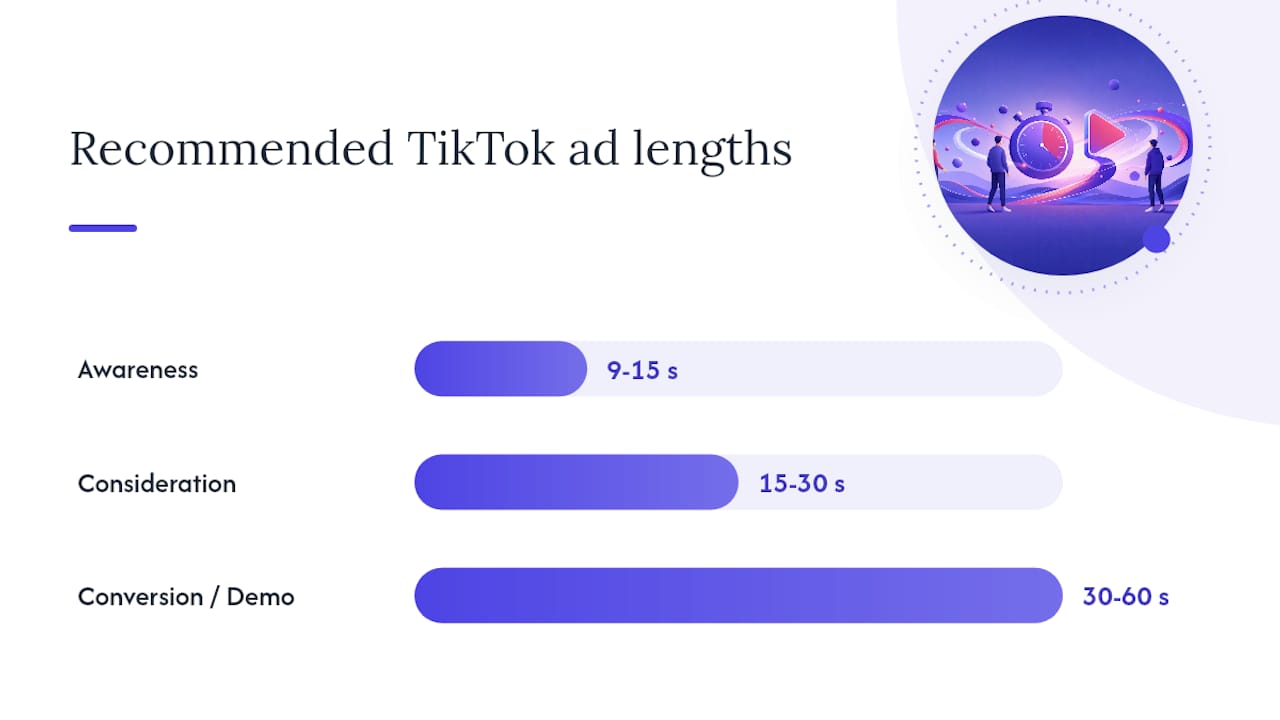
For pure awareness and virality plays, Vidulk's analysis of use-case durations lands on 11 to 18 seconds as the range that maximizes shareability and completion. Ad-Stack's 2026 benchmarks push the performance sweet spot slightly wider, recommending 15 to 30 seconds for consideration-stage campaigns where you need room to build a case, not just grab attention. Demos, storytelling, and edutainment content justify 30 to 60 seconds, since Vidulk notes that edutainment specifically holds attention in that window when the content earns it. Anything past 60 seconds should be reserved for genuinely high-consideration products where viewers want depth, not brevity.

Here's the trade-off nobody explains clearly enough: shorter ads tend to win on completion rate, and completion rate feeds TikTok's distribution algorithm directly. Longer ads can rack up more total watch time and depth of engagement, but only if the content justifies the ask. Ad-Stack warns that reach gets capped for clips under 9 seconds, so going ultra-short isn't automatically the safe play either.
The 3-second hook rule isn't a TikTok spec. It's a creative discipline: whatever your total length, the first 3 seconds need a visual hook and an early hint of value, or viewers scroll past before your message lands. A quick objective-to-structure map:
- Awareness: 9 to 15s → hook → punchline → logo/CTA
- Consideration: 15 to 30s → hook → proof point → soft CTA
- Conversion/demo: 30 to 60s → hook → problem/solution → hard CTA
Pro Tip: Deliberately exceed the sweet spot when you're selling something that requires trust or explanation, like a financial product or a multi-step service. A rushed 15-second pitch for a complex offer often converts worse than a clear 45-second one.
Producing Multiple Length Variants From One Shoot
Reshooting for every duration test is expensive and slow. The smarter move is shooting once with enough coverage to cut several lengths from the same footage.
- Storyboard your raw footage with distinct beats: hook, problem, proof, CTA.
- Cut a 11 to 15 second version keeping only the hook and CTA.
- Cut a 15 to 30 second version adding one proof beat.
- Cut a 30 to 60 second version that keeps the full narrative arc.
A simple beat map keeps this consistent across variants:
- Hook (0 to 3s): kept in every version, no exceptions.
- Proof/demo beat: compressed in short cuts, expanded in long cuts.
- CTA: repositioned earlier in short cuts, held for the close in long cuts.
- Captions/pinned text: adjust placement and timing per length so overlays don't collide with UI elements at different cut points.
Loop-friendly short cuts benefit from a clean final frame that echoes the opening shot, so a viewer who watches twice barely notices the seam.
How Do You Test Which Ad Length Works Best?
Testing length without a structure just burns budget. Set it up like this:
- Run at least three length variants (short, medium, long) against the same audience and creative concept simultaneously.
- Hold budget allocation equal across variants for the first testing window, typically 3 to 5 days or until each variant clears a meaningful impression threshold.
- Let the test run long enough to exit the learning phase before pulling any variant.
- Compare results against your stated objective, not against every metric equally.
Match the metric to the goal:
- Awareness campaigns: prioritize completion rate and reach, since Statista's engagement benchmarks show completion strongly correlates with algorithmic distribution.
- Consideration campaigns: watch-through rate and click-through rate matter more than raw impressions.
- Conversion campaigns: cost per acquisition and return on ad spend are the only numbers that should decide a winner.
When results conflict, let the objective-specific metric win, not the vanity number that looks best in a screenshot.
Scaling Creative Output Without Triggering Ad Fatigue
Testing length variants is only useful if you can produce them fast enough to keep pace with ad fatigue, which typically sets in within days on TikTok's fast-moving feed. Wing Assistant's variant-production workflow turns one raw video into multiple length and hook variations within a 24 to 48 hour turnaround, which is the difference between testing weekly and testing daily.
Brands running consistent variant rotation through this kind of managed workflow report a 31% reduction in cost per acquisition, driven by fresh creative replacing fatigued ads before performance decays.
Practical steps to build this into your own rotation:
- Produce your 3 to 4 priority length variants (short, mid, long) from every new shoot.
- Set a rotation rule: refresh underperforming variants every 5 to 7 days regardless of total spend.
- Track fatigue signals (rising CPA, falling CTR) as your trigger to swap creative, not a fixed calendar date.
Pitfalls That Get TikTok Ads Rejected or Underdelivered
Most rejections come down to a handful of repeat offenders: wrong aspect ratio, files over the 500MB ceiling, a missing HTTPS landing page URL, or caption overlays violating text policy. Spark Ads add a wrinkle, since you need explicit rights to the organic content you're boosting, and caption edits are more restricted than on standard uploads.
Run this before every submission:
- Confirm aspect ratio is 9:16 and file size is under 500MB.
- Verify the landing URL uses HTTPS and loads correctly on mobile.
- Keep key text and logos inside the safe zone, away from UI buttons and captions.
- Preview on an actual device, since in-app previews sometimes render overlays differently than live delivery.
A practitioner's take on length versus clarity
Tight hooks win attention, but a rushed message loses the sale. Test short first for reach, then let winning concepts stretch longer once you know the hook actually works.
Scale Your TikTok Ad Variants Without the Agency Wait
Testing five length variants a week sounds great until you're the one editing them at midnight. Jamesyee's managed creative service turns one raw TikTok video into a full set of length and hook variations within 24 to 48 hours, so your testing cadence isn't limited by your editing bandwidth.
That speed compounds. Brands running this kind of rotation report a 31% drop in cost per acquisition, since fresh creative keeps replacing fatigued ads before performance slides. Instead of choosing between a slow agency retainer and doing every cut yourself, you get dedicated editors producing your prioritized variants on a fixed monthly plan. If ad fatigue is costing you conversions right now, see how the variant workflow works and get your next batch of test-ready cuts moving this week.
Frequently Asked Questions
What is the maximum length for a TikTok ad? Standard In-Feed/Auction ads commonly max out around 60 seconds, though TikTok's underlying upload ceiling guarantees 3 minutes for all creators and some accounts see 5 to 10 minutes.
What is the best TikTok ad length for engagement? Most operator data points to 9 to 15 seconds for awareness-driven campaigns, with 15 to 30 seconds performing better for consideration and conversion-focused ads.
Is there a minimum length for TikTok ads? TikTok hasn't published a universal minimum. Sub-5-second ads are technically possible but rarely recommended for performance.
Do Spark Ads follow the same length rules as regular ads? No. Spark Ads boost an existing organic post, so the video inherits that post's original length, which can exceed the standard 60-second Auction ceiling.
How long should I run a length test before picking a winner? Run each variant for 3 to 5 days at equal budget, and let each clear the learning phase before comparing results against your specific campaign objective.
Sources
For exact specs, start with the TikTok Ads Help Center and TikTok's Ads Policy documentation, both platform-owned and authoritative. For practical benchmarks and operator experience, Hootsuite, Ad-Stack, Shopify, and Vidulk offer third-party analysis worth cross-checking against your own account's performance.
- The only TikTok advertising guide you’ll ever need
- TikTok Ads Specs and Benchmarks for 2026
- Best TikTok Video Length in 2026: What Is Documented and What Is Folklore
- Best TikTok Video Length 2026: Proven Durations & Tips