
Start by testing demo-first, problem-first, and social proof hooks against each other before you touch a single word of copy. Run a structural test with three or four hook types, hold everything else constant, and measure 3-second view rate first. That number tells you whether your opening survives the scroll; click-through and cost per acquisition only matter once the hook already works.
TL;DR:
- Demo-first, problem-first, and social proof hooks perform best on cold TikTok traffic because they require no prior brand context and capture attention quickly.
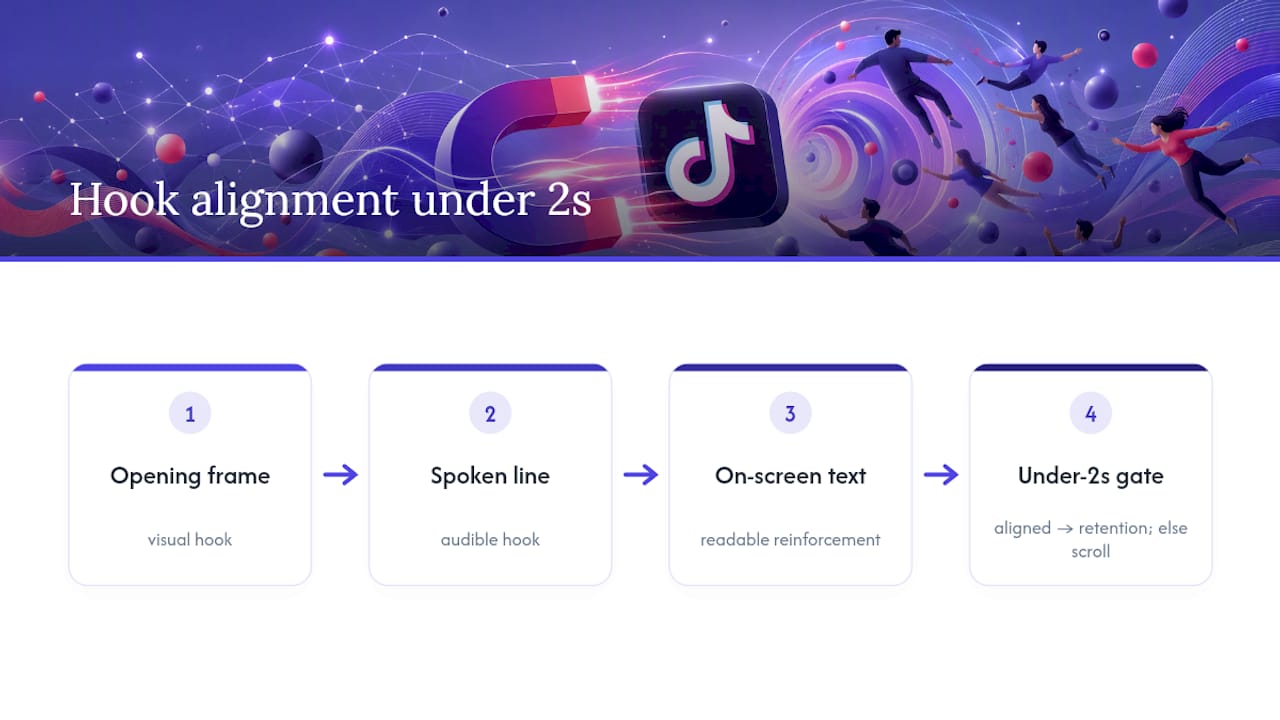
- The optimal hook timing is under two seconds, with clear visual, spoken, and text messages aligned to ensure viewers understand the message even when muted.
- Testing three to four structural hook types simultaneously yields the most insight, with a target hook rate of 30% and immediate action on rates below 20%.
- Creative briefs should specify a single hook type, clear opening lines, and specific visual instructions to prevent weak or logo-first openings that kill engagement.
- Halting a hook's performance decline involves swapping it out within 7 to 14 days of observed fatigue signals, prioritizing creative refresh over targeting or offer changes.
Table of Contents
- What Makes a TikTok Ad Hook Actually Work?
- What Are the Best Hook Types for TikTok Ads?
- 40+ Hook Templates You Can Film Today
- The Three-Layer Check Every Hook Needs Before It Ships
- How Do You Test TikTok Ad Hooks Systematically?
- How Do You Brief a Creator to Film a Hook That Works?
- When Should You Retire a Hook and Replace It?
- What Do Advertisers Get Wrong About TikTok Hooks?
- The Hook Matters More Than the Rest of the Script Combined
- Keep Your Hooks Fresh Without Hiring a Full Creative Team
- Where These Benchmarks and Formulas Come From
- Sources
- FAQ
What Makes a TikTok Ad Hook Actually Work?
A TikTok ad hook is the first one to three seconds of a video ad, the window where a viewer decides to keep watching or flick their thumb to the next clip. That window has gotten shorter, no longer. A 2026 cohort analysis of 700 ads by SaliencyLab found the median scroll-stop decision now happens in under two seconds, with a quarter of viewers bailing quickly. If your hook is still setting up context at second two, you've already lost a chunk of your audience.
The standard industry term for this is "hook rate" or "3-second view rate," the percentage of impressions that watch past the three-second mark. It's the single clearest signal of whether your opening frame, your spoken line, and your on-screen text are doing their job together. Everything downstream, including cost per acquisition, depends on getting more people through that gate.
Here's the part most advertisers skip: a hook isn't one thing. It's three layers stacked on top of each other, and they need to agree with each other in under two seconds. Get that alignment right and you're not just making better TikTok ads. The same structural logic carries over to Facebook ad hooks, LinkedIn ad hooks, and Instagram Reels, even though the pacing and tone shift slightly by platform.
What Are the Best Hook Types for TikTok Ads?
Not every hook type fits every offer. A skincare brand chasing cold traffic needs a different opening than a B2B software company retargeting warm leads. Here are the eleven structural categories worth testing, with a quick read on when each one earns its keep.
- Demo-first: Open mid-action, product already in use, no setup. Best for visually obvious products (beauty tools, kitchen gadgets, apps with a clear UI moment). Wins hardest on cold traffic because it needs zero context.
- Problem-first: State the pain point the viewer already has, often as a direct address ("If your skin does this every winter..."). Works across nearly every category because it requires the viewer to self-identify.
- Social proof/UGC: Lead with a reaction, a review screen grab, or a "everyone's asking me about this" framing. Performs especially well with a creator's face on camera; native-style creative drives noticeably higher recall than polished brand-first ads according to industry teardowns.
- Question/curiosity: Open with a question the viewer can't resist answering in their head. Strong for warm audiences who already know your category.
- Bold claim: A specific, almost unbelievable number or outcome stated flat. Needs to be true and provable, or your comment section will say so.
- Pattern interrupt: A visual or audio anomaly, an unexpected object, a jump cut, a sound effect that doesn't match the scene. Good for breaking through feed fatigue in saturated categories.
- POV/scene: Drops the viewer into a first-person moment ("POV: you just found out..."). Feels native to the platform and rarely reads as an ad.
- List tease: "3 things nobody tells you about..." Sets an expectation of value delivered across the video, good for retention past the hook.
- Proof-first/results: Opens with the after, then rewinds to the before. Strong for transformation-based offers.
- Contrarian: Challenges a widely held belief in your category. Works only if you can back it up fast.
- Direct CTA: States the offer immediately, no story. Best reserved for retargeting, where the audience already trusts the brand.
Demo-first, problem-first, and social proof consistently outperform the others on cold TikTok traffic because they need no prior brand context. On LinkedIn, direct CTA and contrarian hooks tend to travel better since the audience expects less entertainment and more information. Keep TikTok hooks tighter than Reels or Shorts scripts. TikTok's algorithm and audience behavior tend to reward brevity more aggressively than many competing platforms.
40+ Hook Templates You Can Film Today
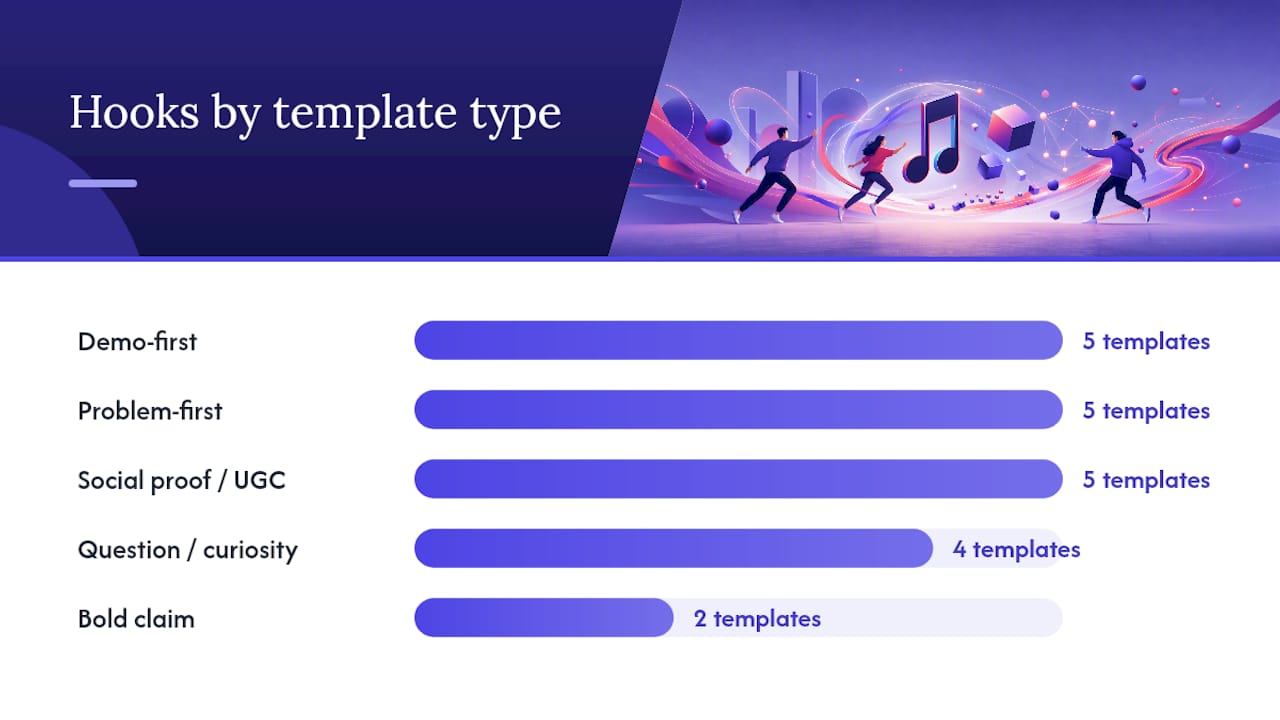
These are fill-in-the-blank starting points, not finished scripts. Swap the bracketed language for your product, then batch film three or four variants back to back while your set, lighting, and creator are already in place. That single production session can generate a week of testable hooks.
Demo-first templates
- "Watch what happens when I [action] with [product]." Visual cue: start the camera already mid-motion, no intro shot.
- "This is what [product] does in real time." Visual cue: tight shot on the result, zoom in during the first second.
- "I didn't believe this would work until I saw it." Visual cue: split screen, before on the left, live demo on the right.
- "[Product] in one shot, no cuts." Visual cue: single continuous take, handheld for authenticity.
- "Here's what [common tool] can't do that [product] can." Visual cue: physically place both items in frame together.
Problem-first templates
- "If your [problem] looks like this, keep watching." Visual cue: show the problem close-up before any branding appears.
- "Nobody talks about [problem] until it's too late." Visual cue: direct to camera, serious tone, no smile.
- "I used to deal with [problem] every single [timeframe]." Visual cue: talking head with problem visible in the background.
- "This is the real reason [problem] keeps happening." Visual cue: text overlay reveals the reason as it's spoken.
- "Stop doing [common mistake] if you have [problem]." Visual cue: shake head or hand gesture on "stop."
Social proof/UGC templates
- "My [audience, e.g. clients/followers] keep asking me about this." Visual cue: show phone screen with real messages blurred for privacy.
- "I wasn't paid to say this, but [product] changed [outcome]." Visual cue: unbranded setting, casual clothing, natural light.
- "[Number] people asked me this week, so here's my honest answer." Visual cue: counting on fingers or a tally on screen.
- "Everyone in my [group] is using this right now." Visual cue: quick group or friend cutaway.
- "Read the comments before you scroll past this." Visual cue: overlay a genuine review screenshot for 1 second.
Question/curiosity templates
- "Why does nobody talk about [surprising fact]?" Visual cue: raised eyebrow, direct eye contact with lens.
- "What if [common belief] was actually wrong?" Visual cue: text overlay flips the statement as it's spoken.
- "Guess what this actually does." Visual cue: hold product up, out of focus, then snap into focus.
- "Would you try this if I told you [surprising benefit]?" Visual cue: pause after the question for a full beat.
Bold claim templates
- "This [product] replaced [number] items in my routine." Visual cue: lay out the replaced items, then sweep them away.
- "[Specific number] result in [specific timeframe]." Visual cue: large text overlay with the number, hold for 1 second.
- "This is the fastest way to [desired outcome] I've found." Visual cue: speed ramp or quick cut to reinforce "fastest."
Pattern interrupt templates
- "Wait, don't scroll. This is different." Visual cue: sudden zoom or whip pan on "wait."
- "[Unexpected object] has nothing to do with what I'm about to show you." Visual cue: hold an unrelated object in frame, then drop it.
- "This sound means something's about to change." Visual cue: sync a distinct sound effect to the cut.
POV/scene templates
- "POV: you just found the [product] everyone's hiding from you." Visual cue: first-person camera angle, product enters frame from below.
- "POV: it's [time of day] and your [problem] just started again." Visual cue: dim lighting or messy setting to match the scenario.
List tease templates
- "3 things I wish I knew before buying [category]." Visual cue: hold up three fingers, drop one per point.
- "5 signs you need to switch your [category]." Visual cue: quick numbered text overlays synced to cuts.
Proof-first/results templates
- "This is [number] days later." Visual cue: open on the after result, then flash back to day one.
- "Before you judge, look at where this started." Visual cue: side-by-side before/after held for the full hook.
Contrarian templates
- "Everyone tells you to [common advice]. Here's why that's wrong." Visual cue: shake head no while the common advice is stated.
- "Stop buying [popular category item]. Do this instead." Visual cue: hold up the popular item, then set it down.
Direct CTA templates
- "If you're already thinking about [product], this is your sign." Visual cue: point directly at camera lens.
- "This is back in stock and it won't stay that way." Visual cue: overlay "back in stock" text immediately.
Additional cross-category fillers
- "I tested [number] [category] products so you don't have to." 37. "This is not sponsored, I just need people to know." 38. "The math on this doesn't make sense until you see it." 39. "I almost didn't post this because it works too well." 40. "This is the one thing that actually changed my [routine/results]." 41. "Screenshot this before it gets taken down." 42. "I got so many questions I had to make a video."
The Three-Layer Check Every Hook Needs Before It Ships
A hook lives or dies on whether its visual frame, spoken line, and on-screen text agree with each other inside the first two seconds. Because a meaningful share of viewers watch muted, the visual and text layers need to carry the message on their own, with sound as reinforcement rather than the only channel. Tugan of 15 hook formulas found that ads pairing all three layers consistently held attention longer than ads relying on voice alone.
Run these checks before you approve any cut:
- Top-third text is readable in under 600 milliseconds, since that's roughly how long a scrolling thumb gives it.
- The spoken line runs 8 to 12 words. Longer and it won't finish before the decision window closes.
- One focal point per frame. Two products, two faces, or a busy background splits attention exactly when you need it locked.
- A brand or product cue appears somewhere between 1.0 and 1.5 seconds in, so skippers still register what they saw.
Avoid these three production habits, all of which cost you the opening: logo-first intros (nobody watches a slate), drone-style establishing shots (gorgeous, useless in a 1.9-second window), and story-delay openings that save the payoff for the middle of the video. TikTok viewers don't owe you patience.
Pro Tip: Write your on-screen caption before you write the spoken line. If the caption alone can't carry the point, the hook is too dependent on sound.
How Do You Test TikTok Ad Hooks Systematically?
Test the shape of the hook before you test the wording inside it. Running three or four structural types head-to-head, demo-first against problem-first against social proof, gives you a broader signal than tweaking five versions of the same opening line. Imagine.art's testing framework recommends exactly this sequencing: structure first, wording second, because structural wins generalize across products while wording wins often don't.
A workable experiment plan looks like this:
- Round one: 3 to 4 distinct hook types, same offer, same CTA, same landing page. Hold spend even across variants.
- Round two: Take the winning structural type and build 5 to 6 wording variations inside it.
- Primary metric: 3-second view rate (hook rate). This tells you what's stopping the scroll before you spend money finding out whether it converts.
- Secondary metrics: click-through rate and cost per acquisition, read only after hook rate separates the field.
- Budget and duration: enough daily spend to hit statistical volume in your account, typically 3 to 7 days depending on traffic level. Low-traffic accounts need the longer end of that window.
- Kill/scale rule: cut anything under 20% hook rate immediately. Scale anything clearing 30% into a wider audience test.
TikAdSuite's benchmark analysis sets 30% 3-second view rate as the practical floor for a working hook, with anything under 20% flagged as a failing open that needs replacement, not a tweak.
Once a structural type wins for one SKU, don't assume it wins for all of them. Problem-first often carries across an entire catalog because pain points repeat, but demo-first needs a visually distinct product to work. Test the winning structure against your next two or three SKUs before calling it a universal formula.
How Do You Brief a Creator to Film a Hook That Works?
Most hook failures trace back to a bad brief, not a bad creator. A vague ask like "make it engaging" produces a logo-first intro every time, because the creator has nothing concrete to grab onto.
A one-page brief should include:
- Goal: awareness, conversion, or retargeting, stated plainly.
- Audience: one sentence describing who's scrolling past this, not a full persona document.
- Hook type: pick one from the eleven categories above, don't leave it open-ended.
- Opening lines: give 3 to 4 exact scripted options, not a general direction.
- Visual framing: describe the first shot specifically (mid-action, POV angle, split screen).
- Text overlay copy: write the exact on-screen words, don't leave them to guesswork on set.
- Deliverables: how many variants, what aspect ratio, what length.
Correct the two most common briefing mistakes directly: cut any brief that says "make it feel natural" without a scripted line, and ban logo-first openings in the brief itself, not just in review.
Pro Tip: Have the creator film two full hook variants per product setup. The lighting and location cost is already sunk, so the marginal cost of a second hook is nearly zero.
When Should You Retire a Hook and Replace It?
Watch four numbers on every active hook: 3-second view rate, click-through rate, CPM, and CPA. A dropping hook rate paired with a rising CPM is the earliest fatigue signal, usually showing up before CPA visibly worsens.
Fatigue typically sets in within 7 to 14 days once a hook has scaled to meaningful spend, faster in competitive categories.
- When hook rate drops, swap the hook first. Don't touch audience or offer until you've isolated whether the creative is the problem.
- Only adjust targeting or offer after a fresh hook has run for a few days and the decline persists.
- A 24 to 48 hour turnaround on new creative keeps the rotation ahead of fatigue instead of reacting to it after CPA has already climbed.
What Do Advertisers Get Wrong About TikTok Hooks?
The most common execution mistake isn't a weak hook idea. It's shipping one version of a good idea and calling the test done. A single hook, no matter how sharp, tells you almost nothing on its own; you need the head-to-head comparison to know if it's actually the type that wins for your offer.
A short checklist for in-house teams: confirm you're testing hook type, not just wording, before you spend real budget. Confirm your top-third text passes the 600-millisecond readability check. And confirm someone is watching hook rate daily, not weekly, once a campaign is live.
Managed creative workflows that keep hook variety fresh instead of running the same open for weeks can reduce cost per acquisition by a noticeable margin for advertisers.
The practical move to make this week: pick three hook types from your product category, brief one creator or VA to film all three from a single shoot, and run them as a structural test before you write a single new ad from scratch.
The Hook Matters More Than the Rest of the Script Combined
Most advice on TikTok ad creative spends its energy on the middle of the video: pacing, storytelling arcs, call-to-action placement. All of that matters, but none of it matters if the viewer never gets past the first two seconds. The industry has quietly shifted its center of gravity toward the open, and a lot of advertisers haven't caught up.
Here's where the conventional wisdom falls short: it treats hook writing as a creative exercise instead of a testable, structural decision. Teams spend hours polishing a clever line when the bigger lever is testing demo-first against problem-first against social proof and letting the data pick the winner. Wording refinement is a second-round activity, not a first-round one.
If you take one thing from this, prioritize structural testing over copywriting instinct. Your gut will tell you which hook sounds cleverest. The scroll-stop data will tell you which one actually works, and those two answers disagree more often than most advertisers expect.
— James
Keep Your Hooks Fresh Without Hiring a Full Creative Team
Building 40 templates is one problem. Turning them into finished, tested video ads every week without burning out your creative team is another. Dedicated virtual assistants can take your raw footage and produce multiple ad variations in 24 to 48 hours, batching hook variants the same way this article recommends testing them.
Performance marketers running the structural test outlined above benefit most from workflows built to output the volume that kind of testing demands, not just one polished cut. If your current bottleneck is turning winning hook types into enough variants to actually scale, see how rapid hook refresh workflows work and check whether they fit your current production setup.
Where These Benchmarks and Formulas Come From
The timing thresholds and hook rate benchmarks in this article aren't arbitrary. They come from a small set of sources worth checking directly if you want to dig into the methodology.
- SaliencyLab's 2026 cohort analyzed 700 ads to establish the 1.9-second median scroll-stop, the timing baseline this entire framework builds on.
- Tugan sets the production standards for the three-layer approach and caption legibility.
- TikAdSuite's benchmark guide supplies the 30%/20% hook rate thresholds used throughout the testing and fatigue sections.
- Pew Research's social media usage data grounds the audience and platform-behavior context.
Sources
- TikTok Hooks 2026 · Industry Research | SaliencyLab
- How to Write TikTok Hooks: 15 Formulas (2026)
- How to Write TikTok Ad Hooks That Stop the Scroll (2026)
- 57+ TikTok Ad Hooks That Stop the Scroll in 2026 - TikAdSuite
FAQ
What Are Some Catchy Hooks for TikTok?
Strong openers include problem-first lines like "If your skin does this every winter, keep watching" and demo-first cold opens that start mid-action with no setup. The templates in the swipe file above cover 40-plus variations across eleven structural categories.
What Are Some Effective Ad Hooks?
The most effective ad hooks align a visual frame, a spoken line, and on-screen text within the first one to three seconds, since that's the window before most viewers decide to scroll. Demo-first, problem-first, and social proof formats consistently test well on cold traffic.
What Are Good Hook Examples?
A good hook example states a specific outcome or problem instantly, like "This is what [product] does in real time" or "Nobody talks about [problem] until it's too late." The best examples work with sound off, thanks to readable text overlays.
What Is a Viral Hook?
A viral hook is an opening line or frame that breaks a pattern viewers expect, often through curiosity, a bold claim, or a POV scene that feels native rather than produced. Virality isn't guaranteed by format alone. It depends on hitting the 3-second attention window with something the specific audience wasn't expecting to see.
How Many Hook Types Should I Test at Once?
Start with three to four structural hook types tested head-to-head before narrowing into wording variations within the winning type. This sequencing, structure first, wording second, produces faster and more generalizable results than testing minor copy tweaks alone.