

The highest-converting testimonial video ads follow one structure: a short customer story that names a specific problem, states a measurable result, and shows visual proof of both. This format wins on paid social and landing pages alike. Shoot one solid interview, then cut it into multiple lengths for each platform. The examples, production steps, and testing plan below show exactly how.
TL;DR:
- Testimonial ads should be highly specific, including measurable results and real customer numbers to enhance credibility and persuasion.
- Use platform-native formats like vertical videos with captions, matching the content length and style to the audience's buying stage.
- Capture multiple ad variants from a single interview, with clear consent and a structured workflow, to maximize content reuse and time efficiency.
- Ongoing testing of formats, claim specificity, and hook sequences helps optimize conversion and ROI over multiple campaigns.
- Building a continuous testimonial pipeline with regular collection and versioning prevents fatigue and sustains ad performance over time.
Table of Contents
- What Makes Testimonial Video Ads Actually Convert?
- Testimonial Video Examples That Show, Not Tell
- Core Elements Every Effective Testimonial Video Ad Needs
- How to Shoot Testimonial Footage That Edits Into Multiple Ads
- Which Formats Fit Which Platforms and Funnel Stages?
- How Do You Test and Optimize Testimonial Video Ads?
- From One Interview to a Month of Ad Creative
- What Actually Matters When You're Scaling This Past One Campaign
- Turn One Testimonial Into a Month of Fresh Ad Creative
- Sources
- FAQ
What Makes Testimonial Video Ads Actually Convert?
Start with the numbers, because they settle the argument fast. Video convinces buyers. 85% of people say a video has convinced them to buy something, and testimonial formats carry more weight than brand-produced ads because a real customer is doing the talking instead of a copywriter. Shopify's research backs this from another angle: 96% of customers say ratings and reviews influence their purchase decisions, which means the "customer review video" format isn't a nice add-on to your media mix. It's closer to a baseline expectation for cold-audience ads in 2026.
Here's what separates a testimonial ad that performs from one that just sits in your ad account burning budget:
- Specific over vague. "This changed my business" says nothing. "I cut my onboarding time from three weeks to four days" says everything.
- The customer's own words, not a script you wrote for them. Authentic phrasing, including the awkward pauses, reads as more credible than a polished monologue.
- Tight cuts for social, longer cuts for retargeting. Aim for 30 to 90 seconds on TikTok and Meta feed placements; save the 2 to 3 minute version for landing pages and email sequences where the viewer already opted in.
- Platform-native formatting. Burned-in captions, vertical crop, and a thumbnail that hints at the result before anyone hits play.
- Written consent before a single dollar of ad spend touches that footage. No exceptions, no verbal "sure, go ahead" over text.
- At least one trust layer baked into the testimonial itself: a timeframe ("in six weeks"), a number ("47% fewer support tickets"), or a role ("as the ops manager at a 40-person team"). Vague praise reads as fake even when it's genuine; specifics read as credible even when the results are modest.
Pro Tip: If a customer gives you a great quote but no number, ask a follow-up question on the spot: "Roughly how long did that take?" or "About how many hours a week did that save you?" You'll rarely get a perfect statistic unprompted, but a rough estimate said out loud on camera still beats no number at all.
Testimonial Video Examples That Show, Not Tell
Every example below solves a different creative problem. Match the technique to your product, not the other way around.
-
The before/after transformation clip. A skincare or fitness brand shows the same person at day zero and day 60, with the "after" flashed in the opening frame before any narration starts. PreTestAds recommends teasing the payoff within the first one to two seconds so scroll-happy viewers know a reveal is coming and stick around for it. This format dominates cold-audience prospecting because the visual proof does the persuading before the customer says a single word. Adapt it: If your product's transformation isn't visual (software, services), substitute a "before" screen recording of the old, painful workflow against an "after" recording of the new one.
-
The talking-head case study. One customer, one chair, one clear arc: what was broken, what they tried, what finally worked. B2B software brands lean on this heavily because a specific role and company size ("I run ops for a 12-location retail chain") does more credibility work than any slide deck. The production tip here is deceptively simple: ask your subject to state their result twice, once early and once at the end, because editors need that redundancy to build the 15 second putdown later. Adapt it: Shoot in the customer's actual workspace, not a studio. The messy desk and the real monitor with your dashboard open are the proof.
-
The first-reaction, native-feel TikTok clip. Unscripted, handheld, filmed on a phone, often shot by the customer themselves. It works because it doesn't look like an ad. Shopify's guidance on UGC formats notes that testimonial content performs best when it matches the platform's native texture, meaning a heavily lit, professionally shot testimonial can actually underperform a shaky phone clip on TikTok or Reels. Adapt it: Resist the urge to "fix" the lighting or audio too much in post. Some grain is a feature here, not a bug.
-
The long-form retargeting testimonial. Two to four minutes, full story arc, usually placed on a landing page or sent via email to warm leads who already clicked once. ConversionStudio's data on format performance shows long-form testimonials tend to work best in bottom-funnel and B2B contexts, where the viewer is already qualifying themselves by choosing to watch something that long. Adapt it: Structure it in three visible chapters (problem, decision, result) with on-screen chapter markers, because most viewers will skim rather than watch straight through.
-
The hybrid demo-plus-testimonial. Half product walkthrough, half customer voice-over praising the same feature they're watching on screen. This format bridges the gap between "here's what it does" and "here's why it matters," and it's particularly strong for SaaS products where the feature itself is hard to visualize without seeing it in action. Adapt it: Record the product demo footage separately from the interview audio, then marry them in editing. You get more flexibility to trim dead air without losing the visual thread.
-
The B2B customer story with named metrics. A named company, a named role, and a number that a procurement team would actually care about: cost per lead, hours saved per week, headcount avoided. These read less like ads and more like case studies, which is exactly the point when your buyer is a committee, not an impulse shopper. Adapt it: Get the customer's title and company logo cleared for use in writing before you film. Legal delays kill more B2B testimonial campaigns than bad footage ever does.
-
The problem-first cold opener. Instead of introducing the customer, the ad opens mid-complaint: "I was losing four hours a day just formatting spreadsheets." No context, no name, just the pain. It works as a scroll-stopper because it mirrors the exact frustration your target audience is currently feeling, and curiosity about who's talking and how it resolved pulls them into the next ten seconds. Adapt it: Pull the single most relatable complaint line from your interview footage and test it as the opening frame across three or four different ad variations.
-
The peer-comparison testimonial. The customer explicitly compares your product to what they used before, naming the friction points of the old way. This is riskier since it invites a "well, that's just your opinion" reaction, but when paired with a specific number, it's one of the more persuasive video testimonials for brands competing in a crowded category. Adapt it: Keep the comparison focused on outcomes ("I used to spend six hours a week on this, now it's forty minutes") rather than trashing a competitor by name.
Core Elements Every Effective Testimonial Video Ad Needs
Strip away the platform and the polish, and every testimonial ad that actually converts shares the same skeleton underneath.
The hook lands in the first one to three seconds. That's the entire window you get before someone's thumb moves. Open on the result, a striking visual, or a blunt statement of the problem, never on a slow "Hi, I'm going to tell you about my experience with..."
The structure follows problem, turning point, result, then a call to action. Skip the turning point and the story falls flat, because the moment where things shifted (a decision made, a product discovered, a switch flipped) is what makes the outcome feel earned rather than lucky.
Evidence layers stack on top of the story. A timeframe, an exact metric, the customer's role or company, and a corroborating visual (a screenshot, a dashboard, the product mid-use) each do separate persuasive work. Research on persuasion principles from Harvard Business Review points out that ethos, pathos, and logos operate together, not separately: the authentic voice earns trust, the emotional arc earns attention, and the hard number earns belief. A testimonial missing any one of the three tends to underperform.
Production signals matter more than production budget. A few non-negotiables:
- Burn in captions. Most viewers watch muted, especially on mobile.
- Choose a thumbnail or opening frame that hints at the result, not just a still of someone mid-sentence.
- Keep the audio clean even if the video is rough. Bad audio kills credibility faster than bad lighting.
- Match run time to funnel stage: 15 to 30 seconds for cold prospecting, 60 to 90 for warm retargeting, two-plus minutes for a dedicated landing page.
Pro Tip: Shoot your opening frame last, after the interview. You'll know by then which single line is the strongest, so you can film a clean "to camera" restatement of that exact line to use as your text overlay hook.
How to Shoot Testimonial Footage That Edits Into Multiple Ads
One good interview should yield five or six usable ad cuts, not one. Getting there starts before you ever hit record.
Pre-shoot checklist:
- Send a written consent form in advance, specifying paid media reuse, not just a verbal okay.
- Confirm a quiet location with decent natural light. A window facing the subject beats any ring light you'll improvise on-site.
- Test audio levels before the interview starts, and use an external mic if you have one. Phone-mounted mics pick up too much room noise for anything beyond native TikTok content.
- Build a shot list for cutaways: product in use, hands on a keyboard, a screen recording, packaging, whatever visually supports the claims you expect to hear.
Interview prompts that get you usable footage:
- "Walk me through what wasn't working before you found us."
- "How long did it take before you saw a real difference?"
- "Can you put a number on that? Time saved, money saved, whatever you tracked."
- "What was the moment you knew this was actually working?"
- "If a friend asked whether this was worth it, what would you tell them?"
That last question routinely produces the most quotable, ad-ready line of the entire interview, because it forces a direct, casual recommendation instead of a rehearsed pitch.
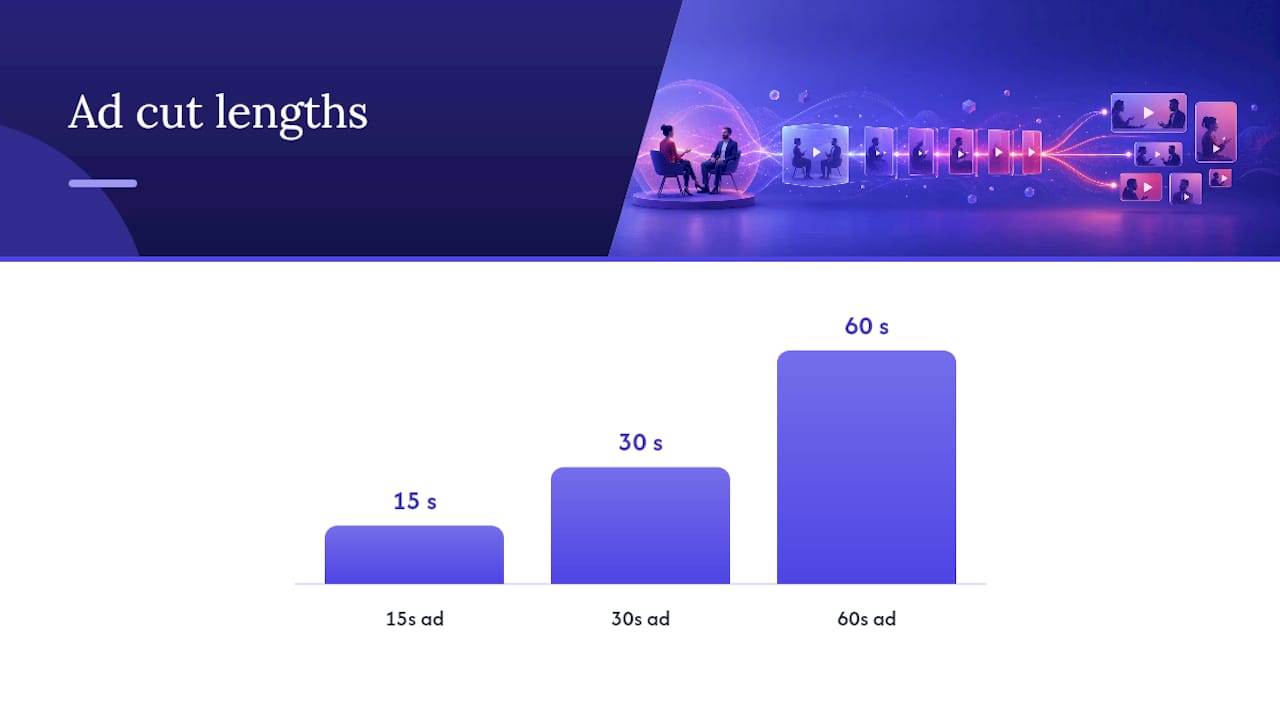
Editing plan for one interview: cut a 15 second version leading with the strongest number, a 30 second version with a light problem setup, a 60 second version with the full arc, and one long-form cut for retargeting or the landing page. Generate three thumbnail options and a caption file for each length, since caption phrasing that works for a cold audience often needs softening for a warm retargeting cut.
Rights and consent, non-negotiable: platform tags or organic mentions do not grant commercial usage rights. A customer tagging your brand in a Story is not the same as giving you permission to run that clip as a paid ad. Get it in writing, every time, before a dollar of media spend goes near that footage.
Pro Tip: Keep a standing folder of raw testimonial footage even after a campaign ends. The clips that didn't make the first cut often become the perfect raw material for a fresh angle six months later when your original ads start fatiguing.
Which Formats Fit Which Platforms and Funnel Stages?
Match the shape of the testimonial to where the viewer actually is in their buying decision.
- Cold audience, paid social (TikTok, Reels, Meta feed): vertical, 15 to 30 seconds, native-feeling, before/after or problem-first hook. Skip the polish.
- Mid-funnel, retargeting on Meta or YouTube: 45 to 90 seconds, fuller story arc, still captioned, slightly more polished than the cold-audience version.
- Bottom-funnel, landing pages and sales sequences: two to four minutes, full case-study structure, ideal for B2B or higher-consideration purchases where the buyer wants depth before committing.
- Email and sales follow-up: the same long-form cut, embedded or linked, reinforcing a decision the prospect is already close to making.
CTA guidance should match the format's job. A cold-audience clip should point to a simple, low-friction action ("Shop now," "See the results"), while a bottom-funnel case study can afford a heavier ask ("Book a demo," "Talk to sales"). First-frame text should preview the outcome, not the brand name; nobody stops scrolling because they recognize your logo. Combine placements deliberately: a 30 second before/after clip on paid social feeding into a landing page with the full two-minute version, followed by an email retargeting sequence using the same footage cut differently, gets more mileage out of one shoot than most teams realize.
How Do You Test and Optimize Testimonial Video Ads?
Run a staged testing sequence rather than throwing five variables at once and hoping something sticks.
- Test format first. Run before/after against straight talking-head against native UGC-style footage, holding the audience and offer constant.
- Test the testimonial-giver next. Different customer, same script structure, same format. Some people are simply more persuasive on camera, and you won't know who until you test it.
- Test claim specificity. Run a version with a hard number against a version with softer language, same footage otherwise. ConversionStudio's testing framework recommends isolating format, giver, and claim in that order rather than changing everything at once, because mixed variables make it impossible to know what actually moved the result.
- Test hook sequencing last. Same core video, different opening three seconds, to see which entry point earns the most watch-through.
Give each test enough room to breathe before calling a winner. A rough rule of thumb: don't make a decision until you've got a meaningful conversion count on each variant, not just impressions. Watching CTR alone is the most common mistake in testimonial ad testing, because the most-clicked creative is not always the highest-purchasing one. Prioritize CPA and ROAS, use landing page conversion rate as your secondary signal, and treat video completion rate as a qualifier, not a goal in itself. Never change your audience targeting mid-test. If you touch the audience and the creative at the same time, you've lost the ability to tell which one caused the shift.
From One Interview to a Month of Ad Creative
Most teams treat testimonial gathering as a one-off event tied to a single campaign. A better model treats it as an ongoing pipeline: capture footage regularly, hand it to an editing workflow, and get multiple platform-specific variants out the other end on a predictable schedule.
Here's what that workflow looks like when it's running well: a raw testimonial or UGC batch comes in, gets edited into platform-specific cuts (vertical for TikTok, square or landscape for Meta, longer form for landing pages), and ships back out within a tight turnaround window instead of sitting in an editor's queue for two weeks.
This is the exact workflow Jamesyee built around. That speed matters because ad fatigue sets in faster than most teams plan for.
What you can borrow from this model even without hiring anyone:
- Batch your capture sessions instead of shooting one testimonial at a time.
- Build two or three reusable hook templates so new footage slots into a known structure.
- Treat every interview as five to six ad variants, not one finished video.
- Set a standing cadence for fresh cuts rather than waiting until an ad's performance already drops.
What Actually Matters When You're Scaling This Past One Campaign
The mistake most marketing teams make with testimonial video ads isn't the creative itself. It's treating each testimonial as a one-time asset instead of building a pipeline that produces them continuously. A great customer story shot once and run for six months will fatigue exactly like any other creative, and by the time performance drops, most teams scramble to find a replacement instead of already having one ready.
Build a steady capture habit before you need it. Every customer support win, every renewal call, every case study interview is raw material, whether or not you're currently running ads. Treat that footage as inventory, not as a one-off deliverable tied to a single campaign brief.
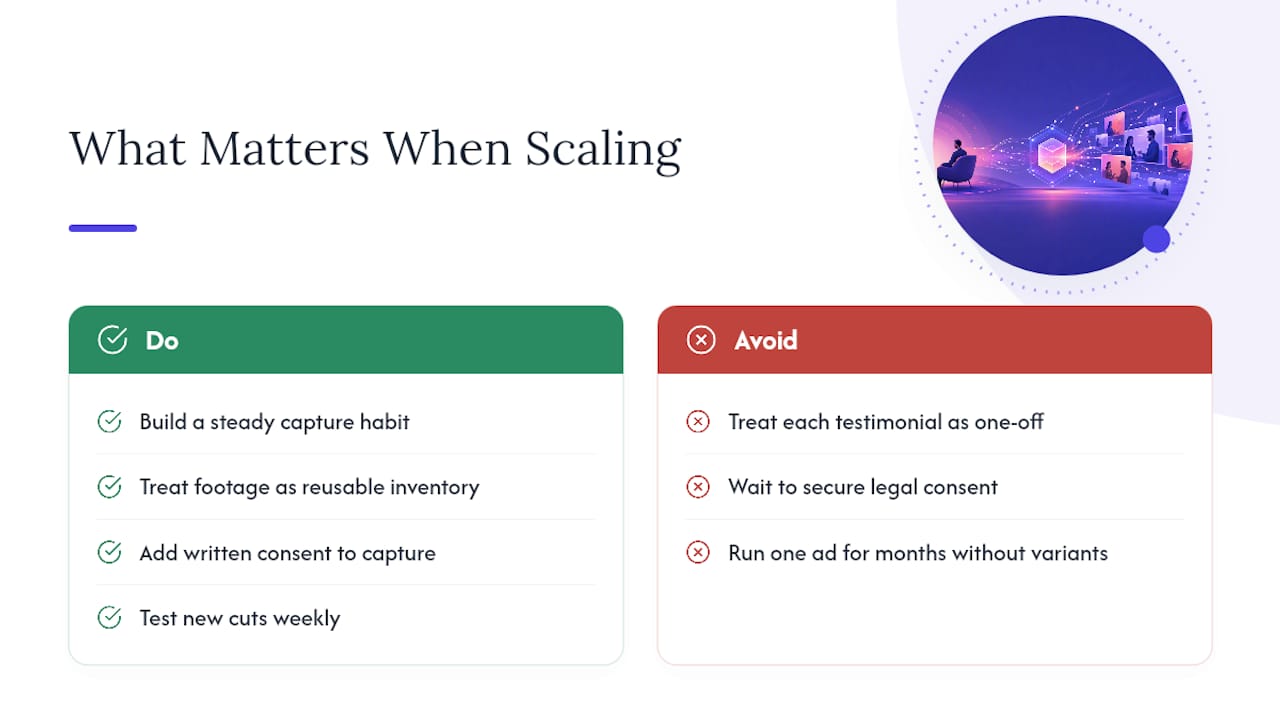
The legal side deserves more attention than most teams give it. Consent workflows feel like paperwork until a customer objects to seeing their face in a paid ad they never agreed to run in, at which point it becomes a real problem. Build the written consent step into your capture process from day one, not as an afterthought once legal asks.
And testing needs to be routine, not a special project. The teams getting the most out of testimonial video ads treat new cuts as a weekly cadence, not a quarterly overhaul. A steady drip of fresh variants against a stable core message will outperform one perfect testimonial ad run into the ground.
— James
Turn One Testimonial Into a Month of Fresh Ad Creative
There are services that act as practical alternatives to hiring an in-house editor or paying agency rates for a handful of testimonial cuts a month. Instead of waiting days for one polished video, virtual assistants can take a single raw interview or UGC batch and turn it into multiple platform-ready ad variations, often delivered quickly.
Before your next consultation, gather one solid customer interview or a folder of tagged UGC clips with consent already secured. That's enough raw material to see how many usable ad variants come back. Check availability for Jamesyee's managed creative service and get your next batch of testimonial ad cuts moving this week.
Sources
For deeper reading on the data behind this guide, Lemonlight's breakdown of testimonial video performance covers the persuasion statistics in more detail, while Shopify's guide to UGC ad types walks through collection and consent workflows. PreTestAds' before-and-after timing research is worth reviewing before you shoot any transformation-style ad, and ConversionStudio's testimonial ad breakdown has real examples mapped to funnel stage.
For gathering reviews you can later turn into video testimonials, ScanKit's guide to QR codes for Google reviews covers a compliant collection setup, and The Mindset Motivator's short-form video AI workflow is a useful reference for repurposing raw footage at scale.
- 7 Powerful Customer Testimonial Videos Done Right (2026) - Lemonlight
- 4 Types of UGC Ads and How To Collaborate on UGC Ads (2026) - Shopify
- The Before-and-After Ad Format: Timing the Reveal for Attention | PreTestAds
- Testimonial Ad Examples: 12 Real Ads That Convert | ConversionStudio
FAQ
Can You Give Examples of Testimonial Video Ads That Work?
Strong examples include before/after transformation clips, talking-head case studies with a named metric, and native-feeling first-reaction TikTok clips filmed on a phone. Each works differently: before/after relies on visual proof, while talking-head testimonials lean on a specific, verifiable result stated in the customer's own words.
What Does a Good Testimonial Video Example Look Like?
A strong example opens on the result or a striking visual within the first few seconds, then walks through the customer's problem, the turning point, and a concrete outcome tied to a number or timeframe. Video convinces the majority of buyers, but the format only works when the story is specific rather than generic praise.
What Counts as a Testimonial in Advertising?
A testimonial in advertising is a real customer's statement about their experience with a product or service, used to build trust with prospective buyers. In video form, it typically pairs the customer's own words with visual proof, such as a before/after shot or the product in use, and requires explicit written consent when used in paid media.
What Are Some Common Examples of Customer Testimonials?
Common formats include written reviews, star ratings, quote graphics, and video testimonials, with video testimonials for brands generally outperforming static formats because they combine voice, emotion, and visual evidence. Managed services like Jamesyee focus specifically on turning raw customer video into multiple polished ad-ready cuts rather than a single static testimonial.
How Long Should a Testimonial Video Ad Be?
Keep cold-audience social cuts between 15 and 90 seconds, and reserve longer, two-to-four-minute versions for retargeting, landing pages, or email sequences where the viewer has already shown interest. Matching length to funnel stage matters more than any single "ideal" run time.