
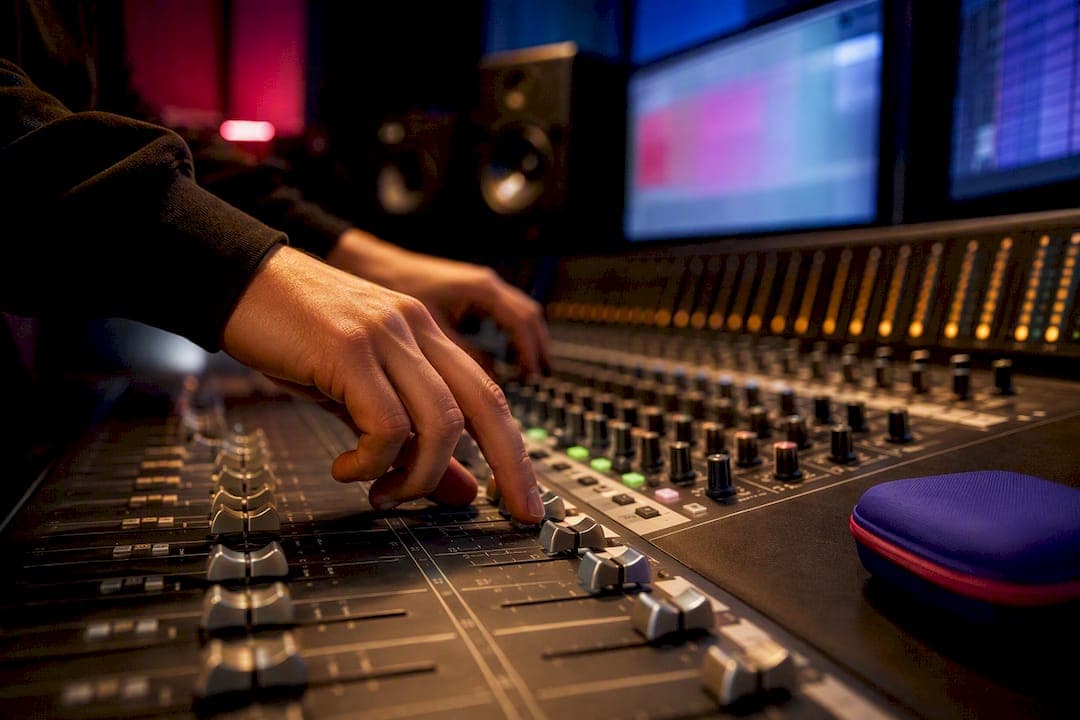
Sound design for ads is the deliberate construction of every audio element in a commercial: Foley, sound effects, music, voiceover, and mix, built to serve a specific brand and campaign goal. The single strategic move that separates forgettable spots from ones that convert is treating audio as a multichannel brand asset tied directly to KPIs, not a finishing touch bolted on in the final review. Start there: add a sonic brief line item to your creative brief before the shoot, not after the edit.
TL;DR:
- A well-crafted sonic identity should be recognizable within three seconds by someone with their eyes closed to ensure distinctiveness across all touchpoints.
- Sound design in ads involves building a system of repeated, deliberate elements like a sonic logo, sound palette, and signature textures, not just individual effects.
- Testing audio as early as the script stage and across various formats ensures consistency and maximizes campaign effectiveness, especially on audio-only platforms.
- Cost varies widely based on ambition, from a few hundred dollars for a quick temp to five figures for a full identity with original music and Foley.
- Using sound as a measurable variable can boost brand recall, recognition, and engagement, with proven lifts such as 38% in aided brand recall.
Table of Contents
- What Sound Actually Does to an Audience's Brain and Wallet
- Crafting a Sonic Identity: Strategy Before Software
- Key Elements and Techniques of Sound Design for Ads
- From Brief to Delivery: Workflow and Format Realities
- How to Prove Sound Design Actually Moves the Numbers
- Budgets, Timelines, and Who to Hire
- Legal and Copyright Considerations in Sound Design for Ads
- Adapting Sound Design for Different Cultural and Regional Markets
- What Working Sound Designers Know That Briefs Never Say
- Scale Your Ad Creative Without the Agency Wait
- Sources
- FAQ
What Sound Actually Does to an Audience's Brain and Wallet
Sound reaches the brain through a different pathway than image. Visual attention is voluntary. You choose where to look. Auditory attention is largely involuntary, which is why a phone buzzing across the room pulls focus even when you're staring at a screen. Advertisers who understand this stop treating audio as decoration and start treating it as a second, parallel storytelling channel that works even when the viewer looks away.
Industry research backs this up in ways that should change how creative teams brief projects. A global effectiveness study found that treating audio as a system deployed across touchpoints, rather than a jingle stapled to the end of a spot, correlates with stronger campaign performance overall. Separately, analysis from the Advertising Council Australia points out that a large share of ad exposure isn't visually attributable at all: people hear ads on podcasts, in cars, and through smart speakers, without ever looking at a screen. If your sonic identity only exists in the video cut, you're invisible in every one of those moments.
A few sonic identities have earned genuine cultural memory:
- Intel's five-note chime, recognized worldwide without a single visual cue attached.
- Netflix's "ta-dum," which now functions as a Pavlovian cue for "settle in."
- McDonald's "I'm lovin' it" melodic hook, which survives translation into dozens of markets because the melody carries the meaning, not the lyric.
Pro Tip: Test your sonic identity with your eyes closed. If you can't identify the brand from audio alone within three seconds, the identity isn't distinct enough yet.
None of this works by accident. Every one of those examples came from a deliberate system: a defined palette of sounds, rules for when to use them, and enough repetition across channels to build the association. That system has a name in the industry, and it's worth learning the vocabulary even if "sound design for ads" is the phrase that brought you here: audio branding, or sonic identity design, is the discipline. Sound design for ads is the execution layer that puts it into a specific commercial.
Crafting a Sonic Identity: Strategy Before Software
A sonic identity is a system, not a sound effect. It typically includes five components: a sonic logo (a short, ownable mnemonic), a sound palette (the recurring tones, instruments, or textures that feel "on brand"), functional cues (transition sounds, notification tones, UI feedback), signature textures (a specific reverb, saturation, or recording technique used consistently), and a defined voice (literal casting, plus tone and pacing rules for any VO). Miss any one of these and the system falls apart the moment a junior editor cuts a new spot without the original team in the room.
Kroger's approach is a useful reference point. The retailer worked with Made Music Studio to build a sonic ecosystem designed to stretch across ads, in-store audio, hold music, and internal communications, not just broadcast spots. That's the difference between a sonic identity and a jingle: a jingle lives in one commercial; an identity lives everywhere the brand makes a sound.
Before any composer or sound designer touches a session, build a short audio brief. It should answer:
- Audience and context: Where will this play? Earbuds, car speakers, a silent autoplay feed?
- Desired emotional arc: What should the listener feel at second 2 versus second 28?
- Delivery formats: Which cutdowns, and in what order of priority?
- Loudness targets: What platform specs govern the final mix (broadcast, streaming, social)?
- Usage boundaries: What can the sonic logo NOT be used for, so it doesn't get diluted?
LBBOnline's reporting on strategic sound design makes a point that's easy to skip past: audio needs to enter the brief at the planning stage, not the edit suite. Bring the sound designer in when the script is still a draft, and you get options that a post-production afterthought never allows, like writing dialogue pauses specifically to leave room for a sonic cue.
Once you have a sonic identity, reuse it aggressively. The palette that works in a 30-second spot should show up, in a simplified form, in your app's notification sounds, your on-hold music, and your retail environment. Consistency across those touchpoints is what turns a sound into a recognized asset instead of a one-off flourish.
Key Elements and Techniques of Sound Design for Ads
Every commercial soundtrack is built from the same raw materials, assembled differently depending on budget, timeline, and creative ambition. Here's how experienced sound designers actually work through them.
- Foley versus library sourcing. Custom Foley (footsteps, cloth movement, hand props recorded to picture) gives you exact sync and a bespoke texture, but it costs studio time and a performer. Library sourcing is faster and often indistinguishable to the average viewer for anything that isn't a hero action beat. The rule of thumb: record Foley for anything the camera lingers on; pull from a library for anything in the background. Maintaining a deep personal library speeds up every future job, which is why practitioners recommend building a broad general effects collection you can reuse and reshape across projects rather than starting from zero every time.
- Synthesis and processing for texture. Ad-friendly synthetic textures usually come from layering, not single patches: a low sine sweep under a bright transient gives you weight and clarity at once. Pitched-down whooshes, granular stretches of everyday sounds, and subtle bit-crushing on transitions are common tricks for making a 15-second cutdown feel more expensive than it was.
- Music editing, stems, and rights. Composed scores should arrive as stems (at minimum: melody, harmony, rhythm, low end) so editors can rebalance for a 6-second bumper without going back to the composer. Confirm sync licensing and buyout terms before the first cut locks, not after a client falls in love with a track you can't afford.
- Voiceover direction and timing. The best VO direction in advertising isn't about a "nice voice." It's about controlling breath placement and pace against picture. A pause a half second longer than feels natural in isolation often reads as confident once it's cut against a visual beat. Direct for intent ("sell this like you already trust it") rather than line readings, and you'll get more usable takes per session.
- Session organization and stems for mixing. Standard practice groups elements into "food-group" stems: backgrounds, Foley, hard effects, and design elements, each as its own stem. This lets a mixer rebalance or cut down a 60-second master into a 15-second version without reopening the full session, which is the difference between a same-day turnaround and a two-day one.
For voice work specifically, AI-generated voiceover tools have gotten good enough to use for scratch tracks and even some finished lower-tier deliverables. AmmarAI's guide to producing natural-sounding AI voiceovers is a solid primer if your team is testing that workflow for time-sensitive social cuts.
From Brief to Delivery: Workflow and Format Realities
A sound design project for advertising typically moves through four stages: brief and temp, first pass, revision rounds, and final mix and delivery. According to an interview with sound designer Joseph Fraioli, a first pass can come together in as little as 3 to 4 days once scripts and treatments are in hand, with 3 to 5 days being typical for most projects. Spots requiring original recording sessions, custom Foley, or a from-scratch composed score take considerably longer, sometimes several weeks when talent scheduling and client approval rounds stack up.
Deliverables have multiplied along with ad formats. A single campaign now often needs a 60, 30, 15, and 6-second cut, plus vertical versions for TikTok and Reels that may need entirely different sound choices, not just a crop. LBBOnline's coverage of strategic sound design notes that short-form social often calls for sharper, more attention-grabbing sound choices than broadcast, precisely because the goal is stopping a thumb mid-scroll rather than holding attention that's already been earned by a TV context.
A practical deliverable checklist for a modern campaign:
- Stems labeled clearly by food group (backgrounds, Foley, hard effects, design, dialogue, music)
- Loudness-normalized masters per platform spec (broadcast, YouTube, Meta, TikTok each have different targets)
- File formats matching each platform's ingestion requirements, not just one universal WAV
- Metadata tags identifying spot length, market, and version number
- A silent-autoplay-safe cut where the story still reads without sound, since a large share of social video plays muted by default
Pro Tip: Send stakeholders a rough "temp" mix with placeholder music early, even an imperfect one. It's far easier to get useful feedback on a temp track than to explain in words what a finished mix will feel like.
Before locking picture, run a final QC pass: check phase and polarity across stereo elements (a quick mono fold reveals cancellation issues instantly), confirm loudness meets each platform's target, and verify metadata is attached to every exported file. Skipping this step is how a spot ends up rejected by a platform's automated audio compliance check the day before a launch.
How to Prove Sound Design Actually Moves the Numbers
Marketers who treat audio as a testable variable, not an aesthetic preference, get better ammunition for next year's budget conversation. The KPIs that matter most for audio specifically: aided brand recall, aided recognition of the sonic logo in isolation, cost per acquisition, click-through rate for audio-triggered formats, and listen-through rate for audio-only placements.
The clearest proof point in the data comes from a programmatic audio campaign that deployed a full sonic identity and measured a 38% lift in aided brand recall alongside a 95% listen-through rate across 6.2 million impressions. Numbers like that make the case to a CFO far better than an appeal to craft.
Testing audio doesn't require a massive budget. A workable design:
- Run two audio variants against an identical visual cut, split by geography or ad set, and compare recall lift.
- Hold one arm of the test with no distinct sonic identity as a true control, not just a different melody.
- Track listen-through rate on audio-first placements (podcast pre-roll, streaming audio) separately from video completion rate, since they measure different behaviors.
- Rotate winning variants into heavier frequency once a lift is confirmed, and retire underperforming cues before they dilute the identity through overexposure.
Kroger validated its sonic ecosystem with outside researchers before full rollout, a step that's worth borrowing even at a smaller scale: a modest recall study before a national spend commitment catches a weak sonic logo while it's still cheap to fix.
Budgets, Timelines, and Who to Hire
Sound design cost scales with ambition, not runtime. A quick temp pass using library music and stock effects can run a few hundred dollars and turn around in a day. A bespoke sonic identity, original composition, custom Foley, and full mix across multiple deliverables is a different order of spend entirely, often stretching into five figures once you include composer fees, licensing, and mix revisions.
Your hiring options break down roughly like this:
- Freelance sound designers offer flexibility and lower overhead but limited bandwidth during crunch weeks.
- Music houses bring composition depth and strong original scoring, usually at a premium price and longer lead time.
- Full-service agencies handle everything under one roof but often carry the highest markup and slowest turnaround for anything outside a standard package.
- Managed VA-style production services handle repeatable cutdowns and variant production at volume, at a lower cost per asset than an agency retainer, though they're better suited to iteration and scale than originating a brand-new sonic identity from scratch.
Before signing anything, ask for a sample turnaround time in writing and a clear stem-delivery policy. A vague quote that doesn't specify the number of revision rounds included is the most common source of scope creep on audio projects.
Legal and Copyright Considerations in Sound Design for Ads
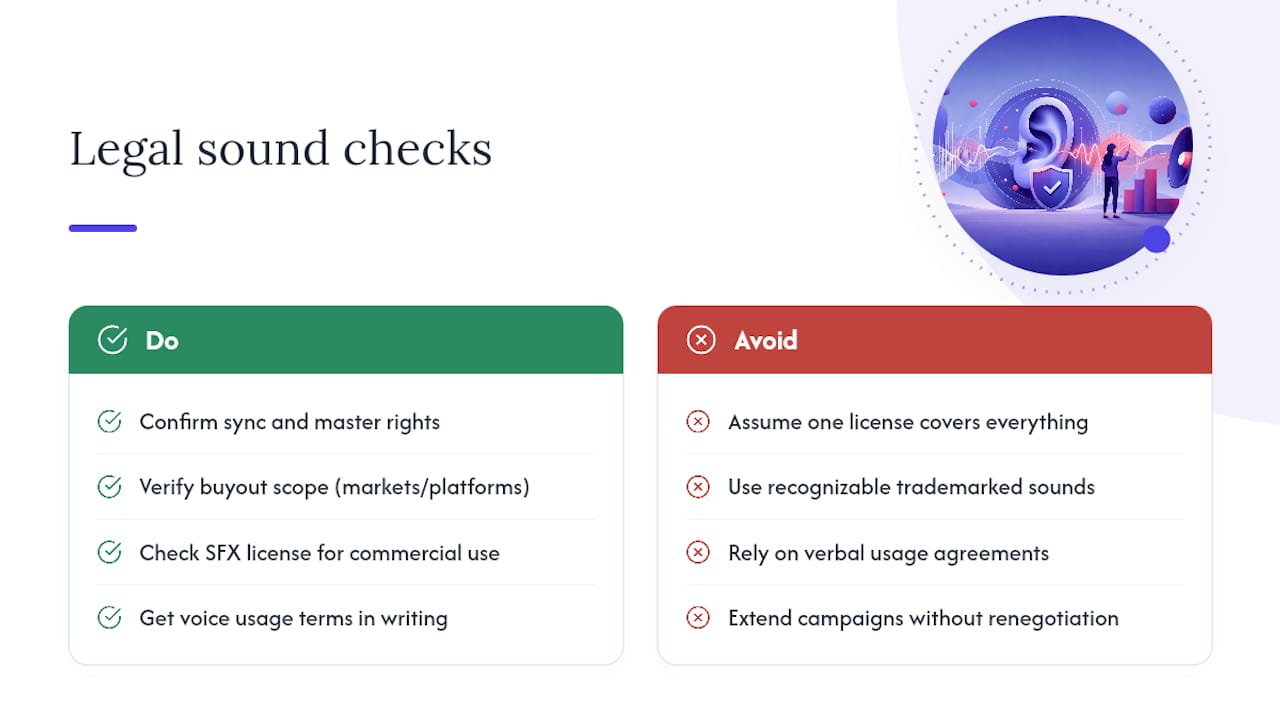
Every element in a commercial's soundtrack needs a clean chain of rights, and the two most common failure points are music licensing and sample clearance. Sync licenses cover the right to pair a piece of music with visual media, and they're separate from the master recording rights, which means a single song can require two different licenses from two different rights holders before it's legally usable in a spot. Buyout terms vary wildly: some libraries sell a flat rate for unlimited use, others charge per market, per platform, or per year of use, so confirm the scope before a client approves a cut that turns out to require a renegotiation.
Sound effects carry lighter legal weight than music in most cases, but not zero. A recognizable trademarked sound (a specific car engine note, a branded jingle from another company) can trigger a claim even inside a sound effects library, so verify a library's licensing terms cover commercial advertising use specifically, not just personal or editorial use.
Voice talent contracts need explicit language covering usage duration and geography. A voiceover recorded for a six-month regional campaign that later gets extended nationally, or run for another year, is a common source of disputes if the original contract didn't anticipate it. Get usage terms in writing before the session, not after the client asks to extend the flight dates.
Finally, if your sonic logo becomes distinct enough to have real brand value, consider a trademark filing for the sound itself. Audio trademarks are harder to register than visual ones in many jurisdictions, but a genuinely novel and consistently used sonic logo can qualify, and it's worth a conversation with counsel once the identity has been in market long enough to build recognition.
Adapting Sound Design for Different Cultural and Regional Markets
A sonic identity that works in one market can misfire in another, and the failure is rarely obvious until it's already live. Musical scales, rhythmic conventions, and even the emotional connotation of specific instruments vary by region. A minor key that reads as "moody and premium" in one culture can read as simply sad or off-putting in another, and a percussion pattern that feels energetic in one market can feel chaotic in a culture with different rhythmic norms.
Voiceover casting is where this shows up most visibly. Accent, pacing, and vocal tone carry different trust signals across regions. A brisk, high-energy VO style common in some markets can come across as pushy or insincere in cultures that associate a slower, more measured delivery with credibility. Translating a script word for word without re-timing the VO delivery for local speech rhythm is one of the most common and avoidable mistakes in global campaign rollouts.
Sound effects need a cultural pass too. A doorbell chime, a phone ringtone style, or even a cash register sound can differ enough between regions that using a home-market recording abroad creates a subtle sense that the ad wasn't made for that audience. The fix isn't always a full re-record. Often it's a targeted swap: keep the sonic logo and musical bed consistent for brand recognition, but localize the incidental sound effects and VO casting to match regional expectations.
Budget for a regional adaptation pass separately from the original production. Treating localization as a late-stage translation task, rather than a real creative pass with its own review cycle, is how global campaigns end up with a sonic identity that only really lands in the market it was built for.
What Working Sound Designers Know That Briefs Never Say
The best sound designers in advertising describe their job less as decoration and more as narrative repair. Joseph Fraioli's account of the process makes this explicit: sound can mask a visual shortcoming, control the pacing a director couldn't fully achieve in the edit, and amplify an emotional beat that the picture only gestures toward. That's a different job description than "add whooshes and finish the mix."
That framing changes how a production pipeline should be staffed. If sound is doing narrative repair work, the sound designer needs to be looped in while the edit is still flexible, not handed a locked cut and told to make it feel finished. Iteration works best when it happens in temp passes: a rough mix early, feedback fast, another pass, repeat. Projects that skip the temp stage and go straight to "final" tend to produce technically competent but emotionally flat spots.
This is also where a managed production model earns its place. Teams running high cutdown volume for TikTok, Meta, and LinkedIn need the same iterative discipline applied across dozens of variants a month, which is closer to a repeatable pipeline than a single bespoke composition project.
— James
Scale Your Ad Creative Without the Agency Wait
Building one great sonic identity is a craft project. Producing many fresh ad variations weekly to fight creative fatigue is a volume problem, often addressed by dedicated virtual assistants. Instead of waiting days for an agency to turn around a handful of cuts at agency rates, some providers take a single raw video and produce multiple ad variations, sound design and all, often within a short turnaround time.
Marketers running this model report a notable reduction in cost per acquisition, largely because fresh creative keeps ad fatigue from eroding performance the way a stale, unchanging spot does. That frees your team to focus on strategy and testing instead of babysitting an edit timeline. If your current pipeline can't keep pace with how fast TikTok, Meta, and LinkedIn audiences burn through creative, check the 4-day ad fatigue fix and see what a dedicated production team can produce for your next batch of variants.
Sources
- Translating Emotion: Sound design for advertising with Joseph Fraioli — Pro Sound Effects (2017-10-16)
- +38% Brand Recall via Audio Ads — Kalithea Media
- Don’t mute your brand: why sound design can be strategic — LBBOnline
- How Kroger built a sonic ecosystem into its multichannel brand platform — Grocery Dive
FAQ
Can you give me an example of sound design in advertising?
Intel's five-note chime and Netflix's "ta-dum" are widely recognized sonic logos, and Kroger's multichannel sonic ecosystem shows how a full sound palette gets deployed across ads, retail, and hold music.
How much does a sound designer cost for a commercial?
Costs range from a few hundred dollars for a quick temp pass with library assets to five figures for a bespoke sonic identity with original composition and custom Foley; managed production services typically price per asset rather than per project for high-volume variant work.
What are some good sound effects for commercials?
The right effects depend on the brand and moment, but common tools include layered synthetic whooshes for transitions, custom Foley for hero product moments, and a consistent processing style (a signature reverb or saturation) applied across every spot to reinforce brand identity.
How do you create sound design for an ad from scratch?
Start with an audio brief covering audience, emotional arc, delivery formats, and loudness targets, then build a first pass in stems (backgrounds, Foley, hard effects, design, dialogue, music) so revisions and platform cutdowns stay fast, following a workflow that typically delivers a first pass within 3 to 5 days.
How is sound design different for TikTok versus broadcast TV?
Short-form social often needs sharper, more attention-grabbing sound choices to interrupt a scroll, while broadcast can rely on a viewer's already-committed attention, so the restraint that works on TV doesn't always translate to vertical social formats.