

You can scale ad creative predictably by treating it as an operational system, not a talent problem: discover several distinct angles, batch-generate assets against a format pack, fund each pilot at a reasonably sized test budget, promote winners without resetting the learning phase, then rotate on a fixed cadence. Size pilots so the numbers actually mean something. Managed services like Wing Assistant exist specifically to run this loop for teams that don't want to build it themselves.
TL;DR:
- Having a clear naming convention and a single source of truth ensures accurate tracking, quick iteration, and prevents chaos as creative volume increases.
- Building a structured creative matrix based on personas, desires, and awareness stages provides distinct angles that improve algorithm learning and creative diversity.
- Testing should run for at least a week with separate variable adjustments to accurately identify winners without resetting the platform’s learning phase.
- Automated batch generation and AI-assisted scaling systems are essential to produce multiple platform-specific variations quickly, but require conversion validation before full spend.
- Wing Assistant offers a managed service that turns raw videos into multiple ad variations within 24 to 48 hours, reducing production bottlenecks and improving campaign scaling.
Table of Contents
- Why Scaling Ad Creative Is an Infrastructure Problem, Not a Headcount Problem
- The Modular Creative System: Angles, Format Packs, and a Naming Standard
- How Do You Test and Scale Ad Creative Without Resetting Learning?
- Operational Infrastructure: The Single Source of Truth and QA Gates
- Where Automation and AI Fit Into the Creative Loop
- Who Owns What: Roles and a Weekly Cadence for Scaling Creative
- What Actually Breaks Creative Scaling Programs
- Wing Assistant Runs This Exact Loop for You
- Curated Resources for Going Deeper
- Sources
- FAQ
Why Scaling Ad Creative Is an Infrastructure Problem, Not a Headcount Problem
Hiring more designers rarely fixes a stalled creative pipeline. The bottleneck is almost always the workflow around production, not the production itself, which is why operator playbooks consistently point to process fixes before headcount fixes when scaling ad creative production. Add three more editors to a system with no naming convention, no angle framework, and no testing calendar, and you get more files, not more signal.
Modern ad platforms reward creative diversity over raw volume. An algorithm shown ten variations of the same hook learns almost nothing new after the third one. Ten variations built on genuinely different psychological angles give the delivery system real signal to optimize against.
Before touching creative at all, diagnose what actually broke. A weak conversion rate usually means the landing page or the offer is the problem, not the ad, so check the fundamentals first:
- CPM spiking — audience or placement issue, not a creative problem.
- CTR dropping while CPM holds steady — the hook or thumbnail has likely gone stale.
- CTR healthy but conversion rate falling — look at the landing page and offer before touching a single ad, a distinction Influencer Marketing Hub's Meta creative research flags as the most common misdiagnosis in the industry.
The other trap is stacking changes. Teams that adjust budget, targeting, and creative in the same 48 hours can't tell which lever moved the number. Change one variable, hold everything else steady, and let the data resolve before touching anything else.
The Modular Creative System: Angles, Format Packs, and a Naming Standard
Random variant multiplication produces noise. A creative matrix produces winners, because structure precedes volume, according to AdManage's operator playbook on scaling ad creation across social platforms. The framework worth building around is Persona × Desire × Awareness, or PDA: map who the ad targets, what desire it taps, and where that person sits on the awareness spectrum (unaware, problem aware, solution aware, product aware).
- List 3 to 4 personas who buy the product for meaningfully different reasons.
- Attach 2 to 3 core desires to each persona (status, relief, savings, identity).
- Cross them against awareness stage to land on several distinct angles total.
That range isn't arbitrary. Systems built around AI-assisted creative scaling find several psychologically distinct angles is roughly the floor for giving an algorithm enough contrast to learn from, while staying below the point where testing budget gets spread too thin to read any single cell.
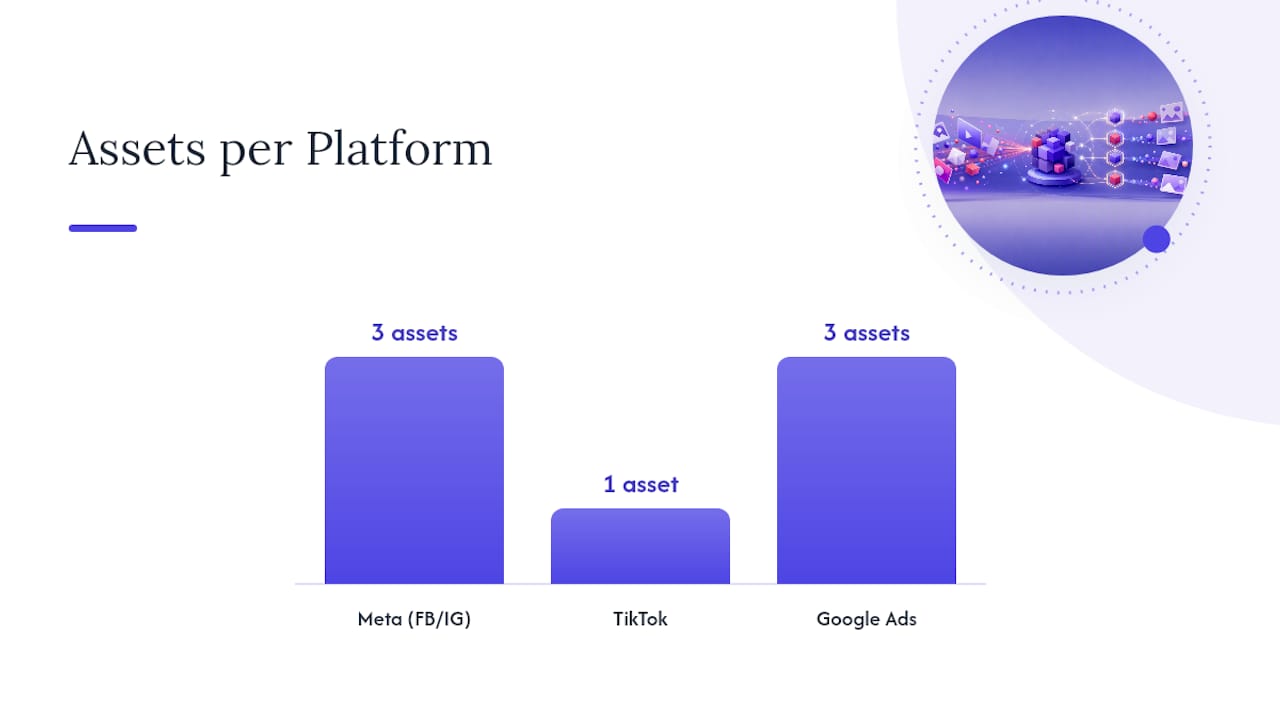
Once you have angles, build a format pack per channel rather than one asset stretched across placements. Meta wants a 4:5 feed cut, a 9:16 Story/Reels cut, and a static fallback. TikTok wants native-feeling 9:16 with on-screen captions and a hook inside the first second. Google's asset groups want a wider spread of headlines, descriptions, and images, since the Google Ads Performance Max system actively recombines whatever assets you feed it, so thin or inaccurate inputs produce thin, inaccurate outputs.
Every asset needs a name that tells you what it is without opening the file: something like Angle03_ProblemAware_Meta_9x16_HookB_v2. Track at minimum: concept ID, angle, platform, format, hook variant, and launch date.
Pro Tip: Build your naming convention before your first batch, not after your tenth. Renaming forty live assets mid campaign is how tracking breaks.
How Do You Test and Scale Ad Creative Without Resetting Learning?
Fund each pilot enough to produce a real signal. A common rule of thumb is a modest daily budget per angle sufficient to test against your breakeven customer acquisition cost per pilot cell, sized so the platform's delivery algorithm has enough spend to exit the learning phase cleanly.
Timing matters as much as budget. Days 1 through 3 are mostly noise as the algorithm figures out delivery. Real signal starts showing around day 4, and a stable read usually needs the full week, which is why Go Fish Digital's paid social testing framework advises against killing anything before day 7 unless click-through rate sits under 0.5% for several consecutive days.
- Day 1 to 3: Let it run. Resist the urge to react.
- Day 4 to 7: Watch for a clear separation between winners and laggards.
- Day 7: Kill anything with CTR under 0.5% sustained for multiple days. Everything else earns another week.
- Day 8 to 14: Confirm the stable winners are still winning before you touch budget.
Sequencing rule: promote the winning ad, then wait a few days before increasing budget or broadening the audience. Stack those changes together and you reset the platform's learning phase, which erases the exact signal you just spent a week earning.
Rotation is where most teams quietly fail. Waiting for CPA to visibly climb before rotating means you're already a week behind.
Operational Infrastructure: The Single Source of Truth and QA Gates
Six infrastructure components separate teams that scale creative cleanly from teams that scale creative chaos: a test architecture, format packs, a single source of truth, a naming standard, UTM discipline, and modular copy, according to the same AdManage scaling framework. Skip any one of them and volume starts working against you instead of for you.
Your single source of truth, whether it's a spreadsheet or a lightweight database, needs these fields at minimum for every asset:
- Concept ID — links every variant back to its parent angle.
- Asset ID — unique per file, matches the naming convention.
- Platform and format — Meta feed, TikTok Reels, Google Display, and so on.
- Hook and CTA text — what's actually said in the first three seconds and the close.
- UTM parameters — so downstream analytics can attribute performance correctly.
- Approval status — draft, in QA, approved, live, killed.
Bulk-launch templates matter more once volume climbs past a handful of assets per week. Preview every asset in-platform before it goes live. A caption cut off on mobile or a CTA button hidden behind a UI element wastes an entire test cycle on a bug, not a creative problem. Export asset IDs into your reporting tool so performance rolls up by concept, not just by ad, which is the only way to know which angle is actually winning versus which single asset got lucky.
Launch new tests paused, review the preview and metadata one more time, then flip live. It costs thirty seconds and catches the naming typos and cropped creative that eat a full day of test budget before anyone notices.
Where Automation and AI Fit Into the Creative Loop
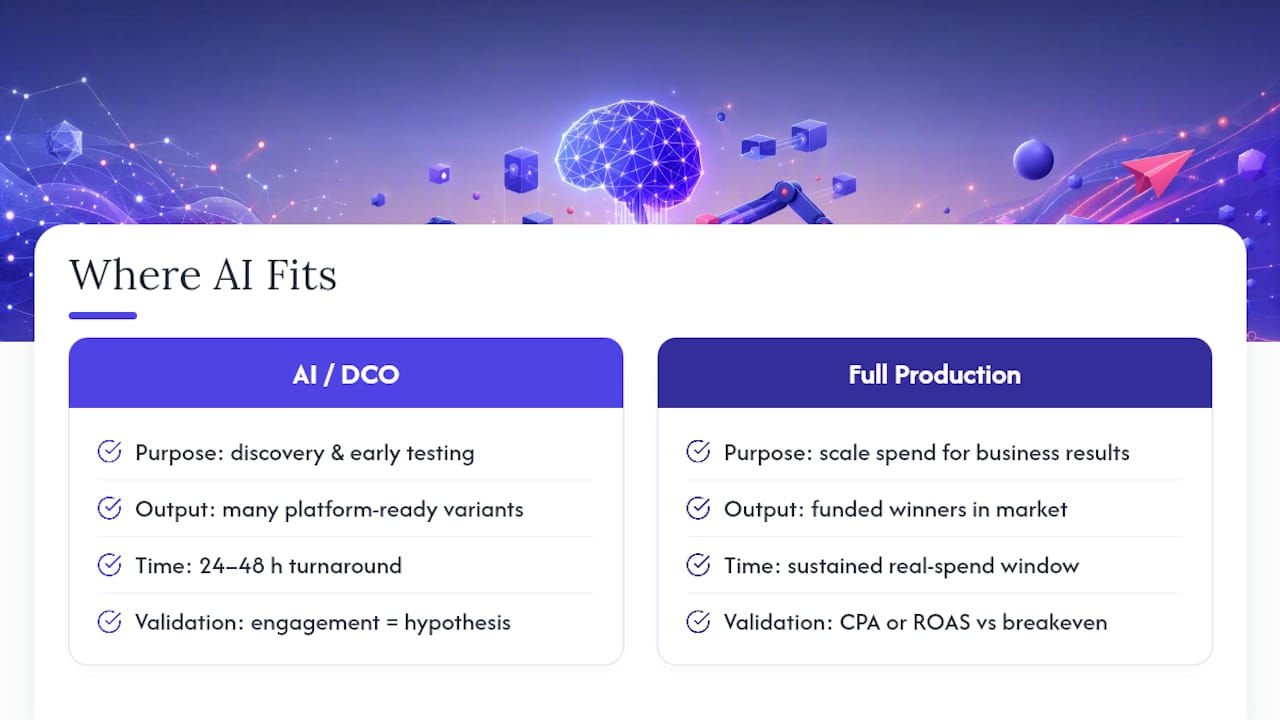
Batch generation and dynamic creative optimization (DCO) solve the production bottleneck. A single raw video or product shot can become a dozen platform-ready variants without a dozen separate shoots, and AI-assisted scaling systems now handle most of that recombination automatically. The risk isn't the automation itself. It's letting an engagement metric stand in for a business result.
Treat DCO output as leads worth investigating, not conclusions worth acting on. An angle that wins on click-through rate but never converts is a false positive dressed up as a winner, and over-indexing on engagement without checking conversion is one of the most common ways AI-driven testing quietly burns budget.
Use AI and DCO for discovery and early-stage scale, where the goal is finding which angles even deserve a real budget. Require conversion validation, CPA or ROAS against your actual breakeven, before any AI-surfaced winner graduates into full production spend.
This is precisely the layer Wing Assistant's virtual assistants operate in: converting one raw video into multiple platform-ready ad variations with a 24 to 48 hour turnaround, so the batch-generation step stops being the reason your testing calendar stalls.
Pro Tip: Set a hard rule that no AI-surfaced winner gets performance budget until it has cleared your standard kill-rule window on real spend. Engagement is a hypothesis, not a verdict.
Who Owns What: Roles and a Weekly Cadence for Scaling Creative
Scaling creative output without adding chaos means assigning ownership clearly, even on a small team. Five roles cover most of the work: a creative lead who owns the angle matrix, a VA or editor who builds the format pack, an ad ops person who launches and tags everything correctly, an analyst who reads results against CPA and ROAS, and a launch owner who has final say on what goes live.
A repeatable weekly rhythm keeps the loop from drifting:
- Monday — Define the week's batch: which angles need fresh creative, which format packs need filling.
- Wednesday — Midweek check. Kill anything showing clear fatigue signals early; don't wait for Friday if the data is obvious.
- Friday morning — Promote confirmed winners into performance campaigns, following the 48 to 72 hour stabilization rule before scaling budget further.
- Friday afternoon — Refresh the backlog with new angle ideas for next week's batch, informed by what just worked and what didn't.
Split budget so a minority portion goes to testing new angles and the majority funds proven performance campaigns, a ratio Go Fish Digital's testing framework and similar operator guides converge on to protect month-over-month results while still generating new winners. As volume grows, scale VA or editor capacity before adding a full-time creative hire. Production throughput is usually the constraint long before strategic judgment is.
What Actually Breaks Creative Scaling Programs
The failure pattern I see most often has nothing to do with creative talent. It's mixing test budget with performance budget until nobody can tell if a "winner" actually won or just inherited spend from a campaign that was already working. Close behind that: no naming convention until month three, by which point renaming a hundred live assets is its own project. And no single source of truth, so three people are quietly running three different versions of the truth about what's live.
A tight checklist prevents most of it:
- Map 8 to 12 angles using the PDA framework before producing a single asset.
- Build one format pack per platform, not a single asset stretched across all of them.
- Set a real pilot budget per angle. Underfunded tests just produce noise dressed up as data.
- Lock a naming convention and metadata fields before the first batch goes live.
- Launch the full batch together so results are comparable on the same timeline.
- Prune at the midweek check. Don't wait for Friday if an angle is clearly dead.
- Promote winners, wait 48 to 72 hours, then scale. Never stack that move with a targeting change.
The teams that scale creative well aren't the ones with the biggest budgets or the flashiest editors. They're the ones who run this loop the same way every single week.
— James
Wing Assistant Runs This Exact Loop for You
Most agencies quote days per video and a per-asset fee that punishes exactly the volume this system requires. A managed service uses dedicated virtual assistants to take one raw video and turn it into multiple platform-ready ad variations for social platforms, aiming for a 24 to 48 hour turnaround instead of a multi-day agency queue.
Marketers using this managed approach report a reduction in cost per acquisition, largely because fresh, angle-diverse creative keeps arriving fast enough to outrun fatigue instead of reacting to it after CTR has already dropped. That frees you to spend your week on strategy, angle selection, and budget decisions instead of chasing edits.
If your current bottleneck is production, not strategy, see how Wing Assistant tackles ad fatigue and get a look at how quickly a fresh batch of platform-ready variations can hit your ad account.
Curated Resources for Going Deeper
- Go Fish Digital's testing playbook for exact test-window sequencing.
- Google's Performance Max asset guidance for platform-native input requirements.
- Sona for angle and idea discovery across channels.
- AdManage's operator framework for the six infrastructure components.
Sources
- How to Test and Scale Paid Social Ad Creative - Go Fish Digital
- The Paid Social Creative Playbook 2026: What Actually Drives Performance on Meta
- Google Ads guidance on asset generation and Performance Max
FAQ
What Does It Mean to Scale Ad Creative?
Scaling ad creative means systematically producing enough distinct angles and format variations that your testing and delivery algorithms always have fresh, diverse assets to learn from, rather than manually producing one-off ads reactively.
How Much Does Ad Creative Cost?
Costs vary widely by production method, from thousands of dollars per video at a traditional agency over several days to a managed VA service like Wing Assistant delivering multiple variations from one raw asset within 24 to 48 hours at a flat monthly rate.
Is $20 a Day a Reasonable Test Budget?
It's on the low end but workable for a single angle pilot; most operator playbooks recommend a modest daily budget per angle sufficient to test against your breakeven customer acquisition cost per pilot cell, sized so the platform's delivery algorithm has enough spend to exit the learning phase cleanly.