

The fastest ways to lower CPA are sharpening creative and offer, lifting landing-page conversion rate, cleaning up targeting waste, and fixing measurement and bidding hygiene. Creative refreshes and negative keyword cleanup can show results in days, while bidding retraining and UX rebuilds take weeks. Push CPA targets down too aggressively, though, and you risk losing volume before you gain efficiency.
TL;DR:
- Making quick creative and targeting adjustments can reduce CPA within days, while bidding adjustments or landing page fixes take several weeks to show effects.
- Creative fatigue often causes rising CPA, which can be addressed by rotating multiple fresh ad variations weekly and aligning offers with landing page promises.
- Cleaning up audience segments and building recency buckets help eliminate wasted spend and target high-intent users more effectively.
- Improving landing page load times, relevance, and trust signals directly boosts conversion rates, lowering CPA without changing ad spend.
- Gradually lowering Target CPA by 10-15% every 1-2 weeks prevents volume shocks, and accurate measurement setup is critical before implementing bid or tracking changes.
- ✓Multiple ad variations from one raw video
- ✓Rapid 24 to 48 hour turnaround
- ✓Dedicated virtual assistants
- ✓Consistent advertising content
Table of Contents
- Priority checklist: tactical steps to implement in the next 1-14 days
- Creative and offer: diagnosing ad fatigue and scaling fresh variants
- Targeting and audience structure: prune waste and sequence high-intent users
- Landing pages and conversion funnel: CRO fixes that directly lower CPA
- Bidding and measurement: how Target CPA behaves and how to change targets safely
- Testing cadence and optimization workflow: prioritized experiments and decision rules
- How managed creative scale reduces CPA: when outsourcing makes sense
- Competitor analysis and benchmarking
- Seasonality and timing adjustments
- Multi-channel attribution and cross-device tracking
- Author perspective: allocating team effort between creative, CRO, and bids
- Wing Assistant: a managed option to stop ad fatigue fast
- FAQ
- Sources
Priority checklist: tactical steps to implement in the next 1-14 days
Start with the levers that move fastest. Creative and targeting fixes show up in days, while measurement checks protect everything you do afterward.
- Refresh your top-performing creatives with new hooks and calls to action: expect a CTR lift within 1 to 7 days.
- Run quick landing-page fixes like trimming form fields and improving mobile load speed, completed within 1 to 14 days.
- Tighten audience lists and add negative keywords to cut wasted clicks immediately.
- Verify your tracking setup and conversion deduplication, and run a short holdout test if your volume allows it.
- If you use Target CPA bidding, lower targets gradually, around 10 to 15% every 1 to 2 weeks, instead of cutting all at once.
That last point matters more than it sounds. A sudden target cut can shock the bidding algorithm into throttling volume rather than finding cheaper conversions.
Pro Tip: Before touching bids, spend one day auditing your conversion tracking. A bidding algorithm optimizing against bad data will make every other fix harder to measure.
Creative and offer: diagnosing ad fatigue and scaling fresh variants
Creative fatigue is often the real reason CPA climbs even when nothing else in the account changed. You can spot it through a few consistent signals.
- Click-through rate falls while impression share stays stable.
- CPA rises even though the audience size has not shrunk.
- Frequency climbs while conversion rate drops, meaning the same people are seeing the ad too often without acting.
Once you see these patterns, the fix is volume and variety, not a single new ad. A fast creative playbook: pull 6 to 12 different hooks from one raw video asset, test several thumbnail or front-frame variations, and rotate creative on a weekly cadence rather than waiting for performance to collapse. Creative and offer weaknesses are frequently the real driver of rising CPA, more often than bidding strategy itself.
Offer clarity matters as much as the creative wrapper. Make the primary value proposition obvious in the first three seconds, test a limited-time offer against your evergreen version, and make sure the promise in the ad matches the headline on the landing page word for word.
Pro Tip: When CTR drops but CPC stays flat, suspect fatigue before you suspect audience saturation. Swap the creative before you touch the targeting.
Targeting and audience structure: prune waste and sequence high-intent users
Audience cleanup is one of the cheapest ways to protect your CPA because it removes spend that was never going to convert. Start by auditing every active segment against its actual CPA and conversion rate, then pause or tighten anything underperforming the account average.
- Build recency by intent buckets, such as 7-day engaged users, 30-day site visitors, and past purchasers, and write messaging specific to each.
- Treat lookalike audiences as an expansion step, not a starting point: build them only after you have a high-quality seed audience with real conversion history.
- Avoid broad interest targeting without frequency caps or exclusion controls, since it tends to reintroduce the same wasted spend you just removed.
Sequencing matters here. A past purchaser sees a different message than a cold visitor, and treating them the same wastes impressions on people who need a different nudge to convert. Pruning poor segments usually shows up in your CPA within a reporting cycle, while lookalike expansion takes longer to prove itself and should be judged over a full testing window.
Landing pages and conversion funnel: CRO fixes that directly lower CPA
Conversion rate and CPA move in direct opposition when CPC and traffic quality hold steady. A landing page that converts better turns the same spend into more conversions, which lowers your cost per acquisition without touching the ad account at all.
- Get page load time under three seconds, especially on mobile, where most paid traffic lands.
- Match the headline to the exact promise made in the ad, so there is no gap between click and page.
- Keep a single, visible call to action instead of competing buttons or links.
- Cut form fields down to only what you need to qualify or convert the lead.
- Add visible trust signals, such as reviews, guarantees, or recognizable logos, near the conversion point.
Landing-page experience and relevance are frequently the highest-leverage fix available to an account, often ahead of bidding changes.
Bidding and measurement: how Target CPA behaves and how to change targets safely
Target CPA bidding sets bids automatically using historical account data and real-time auction signals, aiming to hit your target on average rather than on every single conversion. Google recommends watching your average target CPA against actual CPA rather than expecting an exact match on any given day, and suggests having at least roughly 30 conversions in the optimization window for stable signals.
- Lower CPA targets by about 10 to 15% every 1 to 2 weeks rather than making one large cut.
- Expect a short learning period after any target change, during which volume and CPA can be unstable.
- Confirm your pixels and tags fire correctly across every landing page and device.
- Use server-side or enhanced conversions where available to reduce signal loss from browser tracking restrictions.
- Deduplicate conversions across platforms so you are not double-counting the same action.
When changing which conversion action Smart Bidding optimizes toward, plan for 1 to 2 full conversion cycles before judging the new target's performance, since the algorithm needs that window to re-train on the new signal.
Testing cadence and optimization workflow: prioritized experiments and decision rules
Run tests against a simple rubric: effort, impact, and how clearly you can detect a winner. Put most of your testing budget toward experiments that score high on all three, rather than spreading effort evenly across every idea that comes up in a meeting.
- Set a minimum sample size and a test window of 7 to 14 days for display and social campaigns before calling a result.
- Wait for a meaningful conversion threshold in each variant before declaring a winner, not just an early lead in clicks.
- Run creative rotations weekly, landing-page tests every two weeks, and audience structure tests monthly, so each layer gets attention without tests colliding.
Pro Tip: Never run a creative test and a bidding target change in the same week. You will not know which one caused the result.
How managed creative scale reduces CPA: when outsourcing makes sense
Creative refresh frequency is often the bottleneck, not strategy. Dedicated virtual assistants can convert a single raw video into multiple ad variations, producing the hook and format variety that fatigue diagnosis calls for without pulling a marketer off strategic work. That approach directly supports the weekly rotation cadence covered earlier: fresh hooks delivered on a predictable schedule rather than whenever internal bandwidth allows.

Outsourcing creative production makes sense specifically when your required refresh frequency outpaces what your internal team can produce, a common gap once an account scales past a handful of active campaigns. Teams juggling strategy, reporting, and creative production tend to let refresh cadence slip first, which is exactly the metric tied to rising CPA.
Competitor analysis and benchmarking
Your CPA only means something in context. A $40 CPA might be excellent in one category and poor in another, so benchmarking against comparable accounts and industry data tells you whether you have a real problem or a realistic number.
Start with platform-level benchmarks for your industry rather than guessing at a target. Industry benchmark data for 2026 shows automation features like Performance Max and AI-driven bidding are increasingly standard. However, these tools only perform well when paired with accurate measurement, so benchmarking your tracking setup matters as much as benchmarking your CPA number.
Competitor analysis works best as a directional check, not a copy exercise. Look at the ad formats, hooks, and offers that competitors are actively running, especially ones that have been live for weeks, since sustained creative usually signals it is working. Compare your Quality Score and landing page experience against category norms, since Quality Score differences can swing CPC dramatically, with a jump from a Quality Score of 5 to 8 cutting CPC by close to 37% and a top score of 10 saving roughly half versus a weak baseline.
Use this analysis to set realistic internal targets rather than chasing a number pulled from a different industry or business model. A B2B software account and a direct-to-consumer apparel brand will never share a reasonable CPA benchmark, even if they spend similar budgets.
Seasonality and timing adjustments
CPA fluctuates with the calendar in ways that have nothing to do with how well your campaign is built. Auction competition rises during high-demand periods like major holidays or industry-specific peak seasons, pushing CPC up and CPA with it, regardless of your targeting or creative quality.
Plan your target changes around known seasonal patterns instead of reacting to them after the fact. If you know a peak period is coming, avoid lowering your Target CPA in the weeks leading into it, since reduced bids during rising competition can cost you volume right when demand is highest. Conversely, slower periods are often the right window to test more aggressive targets, since competition eases and your account has more room to find efficient conversions.
Build a simple timing calendar that flags your historical peak and trough periods by week, then review bidding and budget decisions against that calendar before making changes. A target cut that looks reasonable in isolation can look very different once you account for a seasonal spike arriving the same week.
Day-of-week and time-of-day patterns matter at a smaller scale too. Many accounts see conversion rates and CPA vary meaningfully between weekdays and weekends, or between business hours and evenings, depending on the purchase decision involved. Reviewing performance by hour and day before setting budget pacing rules can surface windows where you are overspending for low-quality traffic or underspending during your best-converting hours.
Multi-channel attribution and cross-device tracking
CPA numbers can mislead you when conversions happen across multiple devices or channels before a final purchase. A user who clicks a Facebook ad on mobile, researches on desktop, and converts through a direct visit a day later complicates any single-channel view of what actually drove that sale.

Cross-device tracking through logged-in signals, where available, helps reconnect these fragmented journeys so you are not crediting the wrong channel or, worse, no channel at all. Without it, last-click attribution tends to overweight whichever channel happens to catch the final touch, which usually skews credit toward search and away from upper-funnel channels like social or display that actually introduced the customer.
A simple fix many accounts skip is checking for duplicate conversion counting across platforms. If both your ad platform and an analytics tool are reporting the same conversion independently, your blended CPA will look artificially low in one place and artificially high in another, depending on which numbers you compare. Reconciling conversion counts between your ad accounts and your core analytics or CRM system on a regular basis catches this before it distorts a bidding decision.
Attribution models themselves matter less than consistency. Whether you use last-click, data-driven, or a custom model, switching between them without updating your CPA targets accordingly creates the illusion of a performance change that is really just a reporting change. Pick a model, document it, and give any new conversion goal a full measurement cycle before you trust the resulting CPA for bidding decisions.
Author perspective: allocating team effort between creative, CRO, and bids
If your conversion rate is weak, fix creative and the landing page before you touch bids: a struggling funnel will undermine even a well-tuned Target CPA strategy. High-volume accounts have enough data to justify more aggressive bidding experiments, while low-volume accounts should put nearly all their effort into funnel quality instead. Whatever you change, verify your tracking first. A CPA shift built on broken measurement is not a result worth acting on.
— James
Wing Assistant: a managed option to stop ad fatigue fast
Most CPA problems trace back to creative that stops working faster than a team can replace it, and that gap is where a dedicated production system earns its keep. We built our managed virtual assistant service around exactly that problem: dedicated VAs turn a single raw video into multiple ad variations and a steady stream of new hooks every week, so your rotation cadence never depends on whoever has a free afternoon.
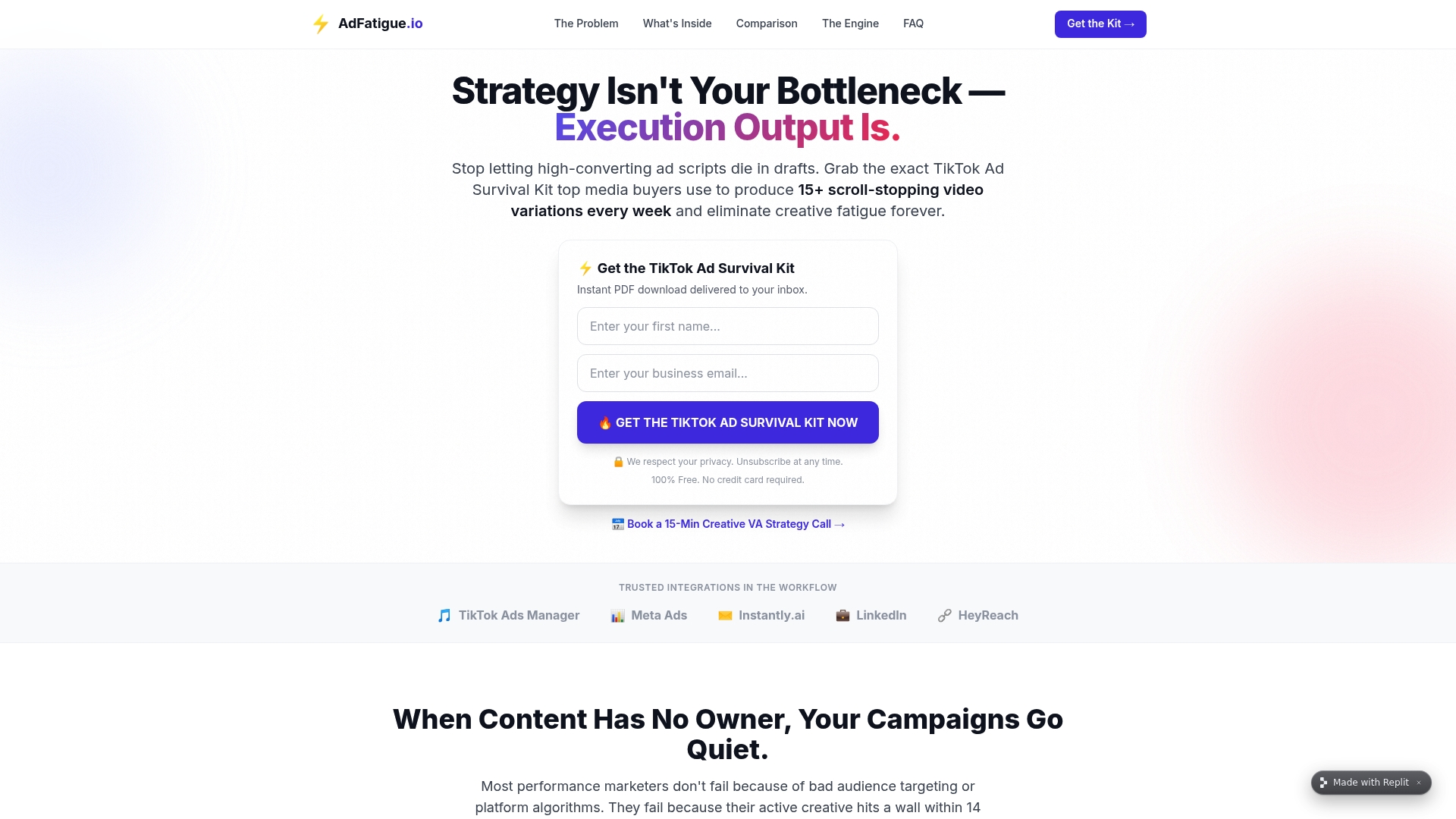
- We convert one raw video into several ad variations with fresh hooks, built for weekly rotation.
- Clients using our service have reported reductions in cost per acquisition.
- Typical turnaround is fast to support quick ad refresh cycles.
If your internal team's output has fallen behind your required refresh rate, that is the clearest sign to bring in managed support. See how the TikTok ad fatigue service works and check whether it fits your current creative cadence.
FAQ
Why is my CPC so high on Google Ads?
High CPC usually comes down to low Quality Score, weak landing page experience, or competing in a high-demand auction window. Quality Score has a large direct effect on CPC, with a move from a score of 5 to 8 cutting CPC by close to 37%. Improving ad relevance and landing page experience is usually the fastest way to bring CPC down.
How do I get a lower CPC on Facebook ads?
Lower CPC on Facebook typically comes from stronger creative relevance and tighter audience targeting, since the platform's auction rewards ads that get strong early engagement. Rotating fresh creative weekly and narrowing your audience to high-intent segments both tend to improve the relevance signals the auction uses to set your cost.
Why is my CPC so high on Facebook?
A high CPC on Facebook is often a sign of creative fatigue, where the same ad has run too long and engagement has dropped, or an audience that is too broad and matching poorly to your offer. Refreshing hooks and tightening your audience to a defined intent bucket usually brings cost back down within a short testing window.
Is it better to have a lower CPC?
A lower CPC is generally good, but only if conversion rate holds steady, since CPA depends on both numbers together. A cheaper click that converts poorly can produce a worse CPA than a more expensive click that converts well, so CPC should always be read alongside conversion rate rather than on its own.
How often should I change my Target CPA bid?
Change Target CPA gradually, around 10 to 15% every 1 to 2 weeks, rather than making large jumps. This pacing gives the bidding algorithm time to adjust without losing volume, and Google recommends having roughly 30 conversions in the measurement window for stable Target CPA signals.