

A pattern interrupt ad is a deliberately surprising opening, usually the first 0.5 to 1.5 seconds, that breaks a viewer's expectation and stalls their scroll long enough to register your message. That hesitation is the whole game: it buys the processing time an ad needs to work, and stronger thumbstop rates typically translate into lower CPMs and cheaper delivery across Meta and TikTok.
TL;DR:
- High-performing pattern interrupts rely on visual incongruity, auditory flips, or contrarian openings within the first 1.5 seconds to capture attention.
- The most effective hooks produce a brief expectancy violation, forcing the brain to reallocate attention before the offer is presented.
- Common interrupt formats include social violation, the flinch, reveal, borrowed heat, literal metaphor, voice-led claim, format disguise, and bystander tape.
- Testing multiple hook variants quickly and rotating formats prevents creative fatigue and maintains audience engagement over time.
- Virtual assistants can rapidly produce dozens of tested interrupt variations from a single raw clip, enabling frequent refreshes of ad creatives.
Table of Contents
- What Makes an Ad a Pattern Interrupt
- The Psychology Behind Why Pattern Interrupts Work
- Reusable Frameworks You Can Steal This Week
- Designing an Interrupt That Actually Converts
- How to Test, Measure, and Know When to Retire a Hook
- Where Marketers Get Pattern Interrupts Wrong
- How a VA-Driven Workflow Turns One Clip Into a Dozen Tested Hooks
- Get Fresh Interrupt Variants Without the Agency Wait
- Three Rules I Use for Interrupts, and Two Times I Skip Them
- Sources
What Makes an Ad a Pattern Interrupt
A pattern interrupt works on a strict clock. The window that matters is the opening 0.5 to 1.5 seconds of the ad, the span in which a thumb is still moving and a brain is still deciding whether to keep scrolling or stop. Miss that window and the rest of the creative, no matter how good, never gets seen.
Three types of interrupts show up repeatedly in high-performing feeds:
- Visual incongruity — an object, color, or framing that does not belong in the context the viewer expects (a hand reaching into frame, a product used in an unusual way).
- Auditory flips — a sound that clashes with the visual, a sudden silence, or dialogue that starts mid-sentence.
- Contrarian narrative openings — a claim or statement that contradicts common belief, forcing the viewer to resolve the tension before moving on.
None of this is persuasion yet. Persuasion is the job of the offer that follows. The interrupt's only job is attentional capture: it earns the two extra seconds your message needs to land. Confuse the two jobs, and you get ads that stop the scroll but never close the sale.
The Psychology Behind Why Pattern Interrupts Work
Your brain runs on prediction. It constantly forecasts what the next frame, sound, or sentence will be based on everything it has seen before, and it mostly ignores content that matches those forecasts. A pattern interrupt violates the forecast on purpose. That mismatch, sometimes called expectancy violation, forces a brief reallocation of attention while the brain figures out what just happened. Advertising exploits that half-second of confusion because it is the only moment a scrolling feed truly slows down.
Platform algorithms reward that hesitation directly. Meta and TikTok track early engagement signals, including how long someone watches before swiping away, and feed ads that hold attention to more people at a lower cost. That is why the hook matters more than most marketers assume: it is not just a creative choice, it is a bidding advantage.
Practitioner-tracked accounts saw thumbstop rates climb from 14% to 27% after redesigning opening frames, a change that coincided with a 22% drop in CPM, according to AdLibrary's analysis of hook performance. Attention is the ceiling on everything downstream. A brilliant offer behind a weak hook never gets the impressions to prove it, no matter how well it would convert if seen.
Reusable Frameworks You Can Steal This Week
Most winning interrupts fall into a small set of repeatable patterns. You do not need to invent a new hook mechanic for every campaign, you need a library of frameworks you can rotate through as fatigue sets in. Practitioner audits of high-performing feeds keep surfacing the same handful, documented in this collection of interrupt examples.
- Social violation — someone breaks an unwritten social rule on camera (talking too close, interrupting a stranger). Works well on TikTok feed placements where realism sells the moment.
- The flinch — a jump cut, flash, or sudden movement that makes the viewer physically react. Strong for Reels, weaker in sound-off environments like some email or display placements.
- The reveal — the frame opens on something confusing or ordinary, then reveals what it actually is. Good for product demos where the payoff is visual.
- Borrowed heat — riding the wake of a major cultural moment or event. The 2022 Super Bowl push that lifted crypto app downloads by 279% is the extreme version of this, though smaller brands can borrow heat from trending audio or news cycles too.
- Literal metaphor — physically staging an abstract idea (stacking cash to represent "your bank is robbing you"). Punchy on feed, harder to translate to a static image.
- Voice-led claim — a bold, contrarian statement delivered straight to camera before any product appears. One practitioner test found a finance app's "your bank is robbing you" opener beat a standard product shot by 3.2 times on click-through rate.
- Format disguise — the ad mimics a native format the platform's users already trust, like a screen recording or a text-message thread, so it does not register as an ad at first glance.
- Bystander tape — footage styled like it was shot by someone nearby, not the brand, which lowers viewer guard before the pitch arrives.
Voice-led claims and contrarian openings tend to fit B2B better, where a sharp, specific statement about a business problem reads as expertise rather than gimmick. Visual formats like the flinch or the reveal skew toward DTC and app install campaigns, where a fast, visceral reaction matters more than a nuanced argument.
Designing an Interrupt That Actually Converts
An interrupt that grabs attention but does not connect to your offer is worse than no interrupt at all. It pulls in curious, low-intent viewers who bounce the moment they realize there is no payoff, and that mismatch shows up in your CPA within days. AdSights makes this point bluntly: random shock without a relevant resolution is clickbait, not creative strategy.
A workable script structure looks like this: open on the interrupt (0 to 1.5 seconds), transition into a line that directly explains why the viewer just saw what they saw (1.5 to 4 seconds), then move into the offer. The transition line is the part most creatives skip, and it is the part that keeps the hook honest.
Before you ship any variant, run it through a short checklist:
- Does this feel genuinely new, or is it a rehash of your last three hooks?
- Does the interrupt connect logically to the product or claim that follows?
- Does the ad still deliver on the promise the opening frame implies?
- Does the pacing match your brand's voice, or does it feel borrowed from someone else's playbook?
Pro Tip: Film one raw clip with three or four alternate openings back to back (a flinch cut, a voice-led claim, a literal metaphor), then let editors chop that single shoot into five or six distinct ad variants. One filming session, multiple tested hooks, no reshoot needed.
How to Test, Measure, and Know When to Retire a Hook
Thumbstop rate and 3 second view rate are your leading indicators, they tell you whether the interrupt is doing its job before you ever see CTR, CPM, or CPA move. Treat them as your first checkpoint, not an afterthought buried in a weekly report.
A workable testing cadence looks like this:
- Launch 3 to 5 hook variants against one fixed offer, using simple A/B splits rather than multivariate tests when budgets are tight.
- Watch thumbstop and 3 second view rate for the first 48 to 72 hours before touching spend.
- Kill anything trailing the group average by more than 20% on thumbstop; everything else earns another few days of data.
- Track CPA movement on the survivors and scale the one or two hooks pulling it down fastest.
Practitioners flag roughly four dozen active variants of a given interrupt format appearing across the market in a single quarter as the saturation point, per AdLibrary's tracking of hook novelty. Past that threshold, audiences have seen the trick enough times that it stops interrupting anything.
Where Marketers Get Pattern Interrupts Wrong
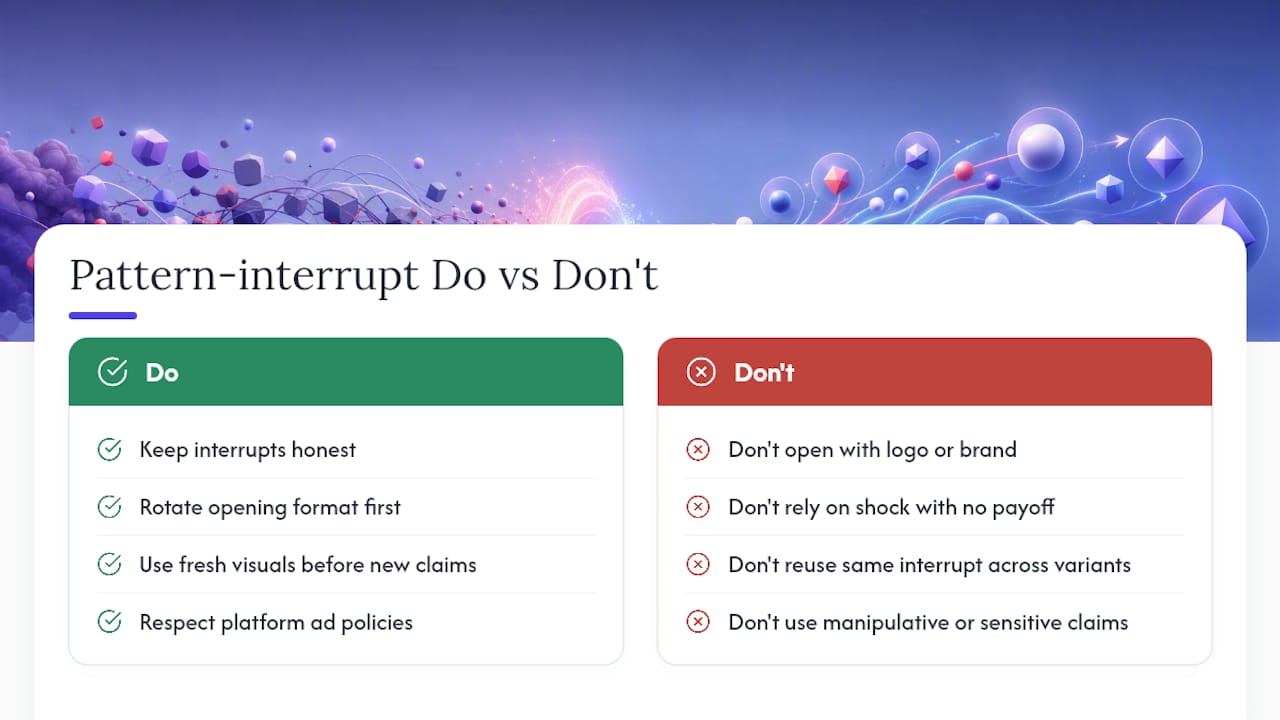
The most common mistake is opening on a logo or brand mention before the interrupt lands, which kills the surprise before it happens. A close second: leaning on shock value with no payoff, which trains audiences to distrust your ads. A third: reusing the exact same interrupt across every variant in a set, which burns novelty fast instead of stretching it.
Keep interrupts honest. Skip manipulative claims, steer clear of sensitive topics that could alienate or offend, and respect each platform's ad policies on shock content. Creative fatigue tends to hit the hook before it hits the offer, so rotate your opening format first and save message changes for later in the fatigue cycle. A fresh visual on an old claim often outperforms a fresh claim on a stale visual.
How a VA-Driven Workflow Turns One Clip Into a Dozen Tested Hooks
Testing five or six interrupt frameworks a week sounds simple until you count the editing hours it actually takes. That bottleneck is exactly why Jamesyee built its workflow around dedicated virtual assistants who turn one raw video into a batch of distinct ad variations within 24 to 48 hours, instead of the days a traditional agency needs to turn around a handful of cuts.
The process is straightforward:
- Submit one raw clip along with the hook frameworks you want tested (flinch, voice-led claim, reveal, and so on).
- A dedicated VA edits multiple variants from that single asset, applying different opening frames to the same core footage.
- Variants ship back inside the 24 to 48 hour window, ready to load into your ad account for testing.
Pro Tip: Feed your VA pipeline the winning framework from your last test cycle first. Compounding a proven hook across new footage beats starting every batch from a blank slate.
Get Fresh Interrupt Variants Without the Agency Wait
Jamesyee is the alternative to a traditional creative agency for marketers who need new pattern interrupt ads on a weekly cadence, not a monthly one. Instead of waiting days for a handful of cuts at agency rates, you send one raw clip and get back multiple tested hook variants in 24 to 48 hours, produced by a dedicated virtual assistant who already understands your creative fatigue checklist.
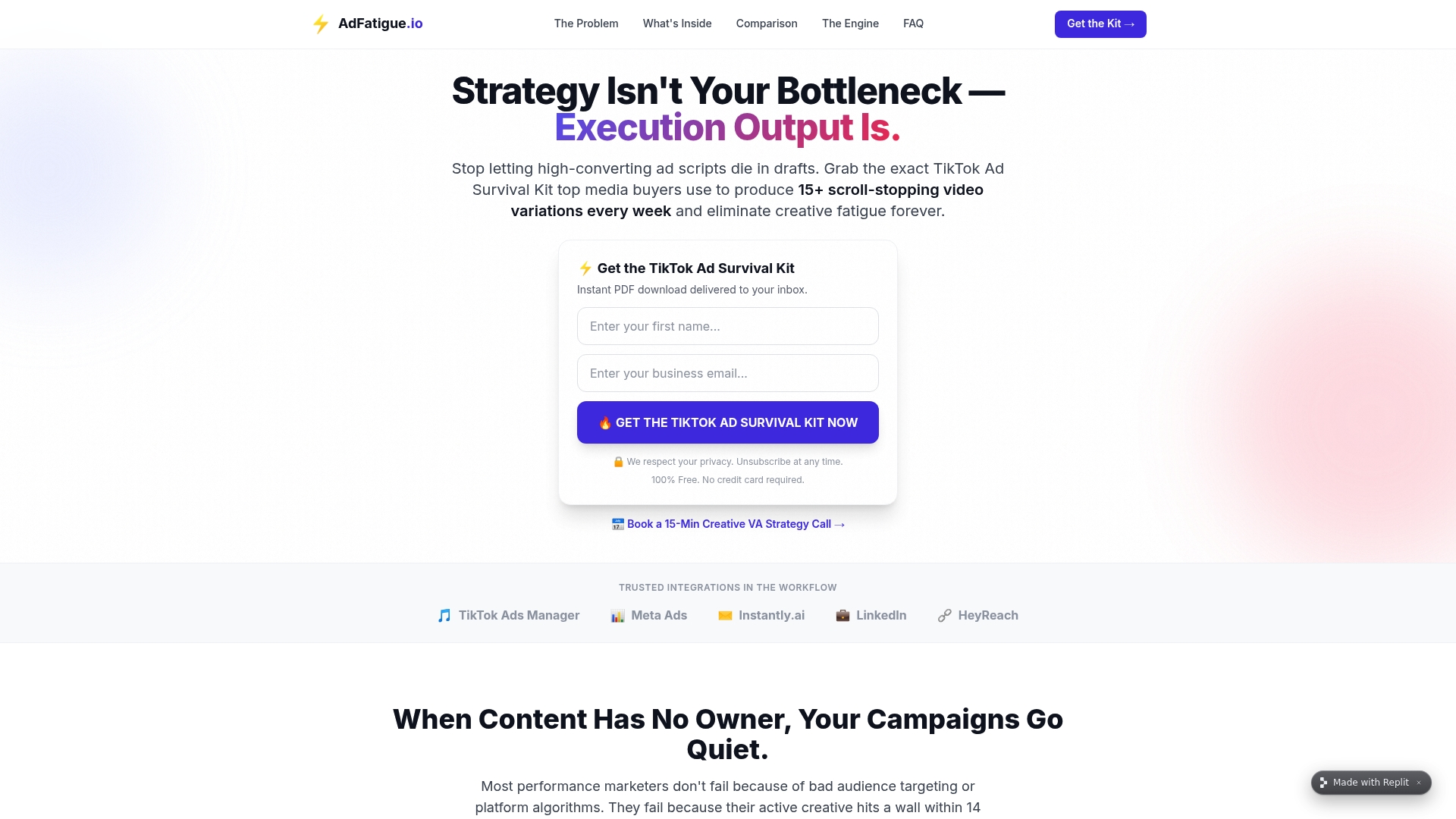
That speed is what makes the testing cadence in this guide realistic instead of aspirational. If your current rotation is stuck at one or two stale hooks, start a 4 day ad fatigue reset and get 15 or more fresh hook variants moving through your ad account this week.
Three Rules I Use for Interrupts, and Two Times I Skip Them
I deploy an interrupt when the offer is strong but the feed is crowded, when the last hook has run past four weeks, and when the brand's usual tone allows a little friction. I skip interrupts in high-trust categories like healthcare compliance messaging, where surprise reads as evasive, and in retargeting to warm audiences who already know the offer and just need a clear reminder. Novelty earns attention. It only earns revenue when the offer behind it deserves the extra second you bought.
— James
Sources
- Pattern Interrupt: meaning, examples, and how it works in ads — AdLibrary
- Pattern Interruption: Definition & Examples — AdSights
- Super Bowl ads boosted crypto app downloads by 279% — TechCrunch