
Yes. If your team needs weekly (or daily) ad variant volume, outsourcing video editing to a managed VA service beats hiring in-house or juggling a project-based agency. You get a dedicated editor, a 24 to 48 hour turnaround on hero cuts, and a steady stream of platform-ready variants instead of a handful of clips two weeks late.
Here's what that actually looks like once it's running:
- A dedicated assistant or editor assigned to your account, not a rotating pool
- Hero-cut delivery in 24 to 48 hours, with variants following at a faster clip
- Documented cases of a notable reduction in cost per acquisition after switching to this model
That CPA number isn't a fluke of better ad copy. It's what happens when a brand stops testing three creatives a month and starts testing fifteen.
Key Takeaways
Outsourcing video editing to a managed VA service works because it converts a single raw video into a steady pipeline of test-ready variants on a fixed SLA, not a variable agency timeline.
| Point | Details |
|---|---|
| Verdict | Outsourcing fits performance teams that need weekly or daily ad variants, not occasional one-off videos. |
| Turnaround expectations | Expect a 24 to 48 hour hero cut, then faster next-day delivery for variants. |
| Cost comparison | Calculate cost per variant, not just retainer total, when comparing to an in-house hire. |
| Rollout priority | Nail the first hero-cut approval and file naming convention before scaling variant volume. |
| Jamesyee's role | Jamesyee delivers a dedicated VA editor with 24 to 48 hour hero turnaround and a reported 31% CPA reduction for clients. |
Table of Contents
- What Outsourcing Video Editing Actually Means Here
- Why Performance Teams Are Outsourcing Ad Editing Now
- How Does a Managed Video Editing Service Work?
- How Do You Choose the Right Editing Partner?
- What Does a Managed Video Editing Retainer Cost?
- Your First 30 Days: A Practical Rollout Plan
- When Outsourcing Beats Keeping Editing In-House
- Stop Losing Campaigns to Creative Fatigue
- Sources
What Outsourcing Video Editing Actually Means Here
Outsourcing video editing, in the context this guide cares about, means handing raw ad footage to a managed team of virtual assistants who turn it into a library of test-ready variants. It's not a freelancer cutting a wedding highlight reel or an agency producing a brand documentary. This is ad-focused, performance-driven editing built for Meta, TikTok, and LinkedIn feeds.
The model itself is well established. Marketing virtual assistants operate inside structured, trained workflows rather than as one-off contractors, which is exactly why a managed service can promise consistent turnaround instead of "we'll try to get to it."
A typical deliverable set includes:
- One hero cut, edited and captioned for your primary platform
- Reframed versions in 9:16, 1:1, and 16:9 for cross-platform use
- Multiple hook and CTA variants pulled from the same footage
- Auto-generated captions and thumbnail options for each cut
Why Performance Teams Are Outsourcing Ad Editing Now
The honest answer is speed. Performance marketing runs on test volume, and volume is the one thing small in-house teams can't manufacture on demand. Adobe's State of Performance Marketing Report frames creative capacity as a direct performance lever, not a nice-to-have, and notes that the average organization already juggles eight martech tools without solving the actual bottleneck: getting new creative out the door fast enough to outrun fatigue.
Three things make outsourced editing worth the line item:
- Creative velocity. More variants in market means more chances to find a winner before an ad set burns out. Providers running retainer models regularly deliver 10 to 30-plus variants a month once a hero cut is approved.
- Predictable cost. A flat monthly retainer replaces the unpredictable swing of per-project agency invoices.
- Built-in quality control. Templates, brand guardrails, and human review catch the sloppy cuts that pure automation tends to miss, which matters given how uneven AI-generated creative adoption still is across marketing teams.
The point isn't "cheaper editing." It's buying test velocity you couldn't generate any other way.
How Does a Managed Video Editing Service Work?
The mechanics are simpler than most marketers expect once they see it in motion.
- Brief and handoff. You send raw footage plus a short brief through a shared tool like Frame.io, a Slack channel, or a spec sheet covering aspect ratio, tone, and CTA.
- Hero cut. Your dedicated editor builds the primary version first, typically within 24 to 48 hours.
- Approval. You review the hero cut once. Feedback here shapes every variant that follows.
- Variant generation. The team spins out hook swaps, CTA changes, aspect-ratio reframes, caption sets, and thumbnail options from the approved hero, usually landing next-day.
- Delivery. Files arrive platform-ready, named and versioned for your ad manager.
Retainer clients typically sit in a priority queue, which is why the 24 to 48 hour SLA holds even during high-volume months. Some of the industry's momentum here comes from agentic AI tools that generate creative variants at scale, but that speed only holds up when a human editor is reviewing output against your brand rules, not rubber-stamping it.
Pro Tip: Send your messiest, most "unfinished" raw footage for the first hero cut. It's the fastest way to stress-test how well the team handles imperfect source material before you commit real budget to it.

How Do You Choose the Right Editing Partner?
Vet the service the way you'd vet a hire, not a subscription.
Look for these signals before signing anything:
- A named, dedicated assistant or editor assigned to your account
- A written SLA with real turnaround numbers, not "fast" or "quick"
- Evidence of variant output at volume, not just a handful of sample reels
- Familiarity with platform specs across Meta, TikTok, and LinkedIn
- Clear file security and ownership terms for your raw footage
Ask these questions during discovery:
- What's your turnaround on a sample hero cut, and how many revisions does that include?
- Who owns the raw footage and master files once the engagement ends?
- What does your reporting cadence look like month to month?
- How many variants should we expect in a typical month at our tier?
Red flags are easy to spot once you know to look: no named editor, SLA language that dodges specifics, or a sales deck with zero mention of aspect ratios or platform specs. Expect month one to feel like calibration, month two to hit real rhythm, and month three to show up in your CPA numbers.
What Does a Managed Video Editing Retainer Cost?
Pricing in this space shapes up in three common ways: a flat monthly retainer covering a set variant volume, a base retainer plus per-variant overage fees, or tiered plans where higher tiers buy faster turnaround and priority queuing.
What moves the price:
- Number of ad platforms you need specs for
- Complexity of the edits (motion graphics, voiceover, subtitles in multiple languages)
- Turnaround speed, since rush SLAs cost more than standard ones
- Whether you get a fully dedicated editor or a shared resource pool
To compare fairly, calculate your cost per variant, not just the retainer total. A managed creative VA that delivers 20 variants a month for a flat fee often beats a full-time hire on cost per output, once you factor in salary, benefits, and software licenses. Before signing, check the minimum commitment length, whether a trial period exists, and what remedy you get if the SLA is missed.
Your First 30 Days: A Practical Rollout Plan
The first month determines whether this becomes a real system or a stalled experiment.
- Before day one: Audit your existing footage library, write a one-page brand guide covering tone and visual rules, and log your current CPA and CTR as your baseline.
- Week 1: Send your first raw footage batch and brief. Treat the hero cut as a pilot, not a final product.
- Week 2: Approve the hero, then track how the first variant batch performs in a live test.
- Weeks 3 to 4: Establish a weekly variant cadence and set up a fast feedback loop between your ad performance data and the editing team.
For measurement, isolate creative as the variable. Keep targeting and budget stable across your test set so any CPA or CTR movement is attributable to the new creative volume, not other campaign changes. Watch for early creative fatigue signals like a rising CPA on a static creative and a declining CTR-to-CVR ratio; that's the moment to route it back for a fresh variant.
Pro Tip: Lock a file naming convention (platform_date_version_hook) before the first delivery lands. Skipping this in month one is the single most common reason teams lose track of which variant actually performed best.
Keep a running QA checklist covering caption accuracy, safe-zone text placement, and audio levels. It's a small habit that saves a surprising number of relaunch cycles later, and it pairs well with staying current on short-form format trends that shift what "platform-ready" even means from quarter to quarter.
When Outsourcing Beats Keeping Editing In-House
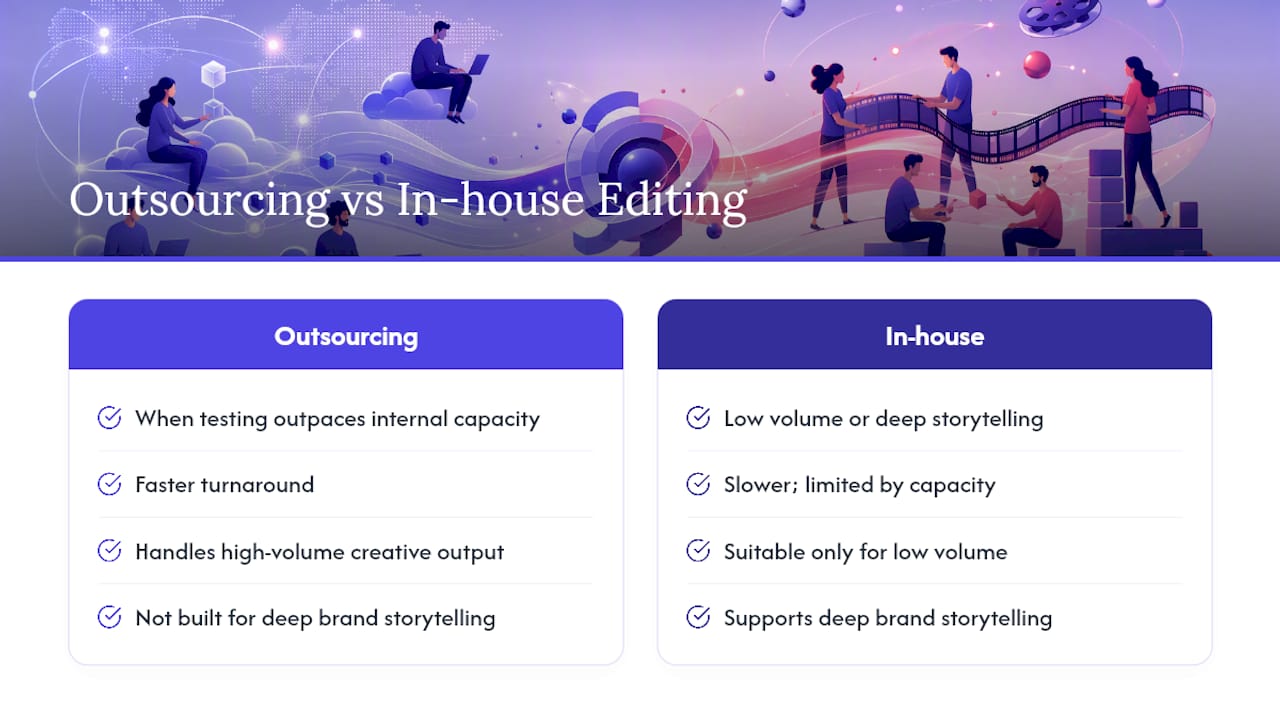
Outsourcing makes sense the moment your testing cadence outpaces your internal editing capacity, which for most performance teams happens faster than they expect. Keep editing in-house only if your volume is genuinely low or your creative needs deep brand storytelling that a fast-turnaround model isn't built for.
The real value isn't replacing your strategist. It's freeing them from the timeline to focus on the offer and the hook. The most common early mistake is treating the hero-cut review as a formality instead of the moment that shapes every variant after it. Get that first approval right.
— James
Stop Losing Campaigns to Creative Fatigue
Jamesyee is the direct alternative to hiring a full-time editor or negotiating project rates with an agency: a dedicated virtual assistant assigned to your account, hero cuts back in 24 to 48 hours, and a steady pipeline of variants built to outrun ad fatigue instead of chasing it.
The model maps directly to what this guide just walked through: a named editor who learns your brand, an SLA you can hold them to, and enough variant output that testing fifteen hooks a month stops sounding aspirational. Brands running this system have seen a significant drop in cost per acquisition, not because the ads got smarter, but because there were simply more of them in market at once.
If your current bottleneck is "we only have three ad variants running," that's the exact problem this solves. Start with Jamesyee's ad fatigue resource to see how a pilot hero cut and first variant batch would run for your account.
Sources
- State of Performance Marketing Report
- Online Video Ads Editing Services | Cut Pro Media
- What Is a Marketing Virtual Assistant? A Complete Guide | XAssure Blog