

Facebook creative testing is a structured process for running controlled experiments across ad variants to find repeatable winners, not just one-off lucky ads. The single rule that matters most: isolate one meaningful variable per test and hold off on any decision until the ad set logs at least 50 optimization events. This guide covers how to set that up in Ads Manager, which variables to prioritize, how to budget and staff a weekly testing cadence, and where most marketers blow it.
TL;DR:
- Testing one variable at a time and waiting for 50 optimization events ensures reliable insights, which can take several weeks depending on your CPA and budget.
- Prioritize testing core concepts first with 2 to 3 variants, then expand to 3 to 5 variations after a concept is validated, avoiding multiple changes in a single test.
- A weekly volume of 15 to 25 new creative variants is necessary to find enough winners, requiring high-frequency production that often exceeds in-house capacity.
- Creative fatigue signs include rising frequency, declining CTR, and increasing cost per result, which should be monitored weekly before performance drops significantly.
- Most costly mistakes involve testing multiple variables simultaneously, editing during learning, or prematurely declaring winners, all of which undermine test reliability and long-term success.
Table of Contents
- How Do You Set Up a Creative Test in Meta Ads Manager?
- Which Creative Variables Should You Test First?
- How Long Should a Facebook Ad Test Run Before You Call a Winner?
- How Much Budget Should You Spend on Testing Versus Scaling?
- How Do You Spot Creative Fatigue Before It Tanks Performance?
- What Mistakes Cost the Most Testing Wins?
- How Managed Creative Production Keeps a Testing Pipeline Full
- Why Creative Testing Has to Be a System, Not a One-Off Project
- Keep Your Testing Pipeline Fed Without Hiring an Editor
- Sources
- FAQ
How Do You Set Up a Creative Test in Meta Ads Manager?
Meta Ads Manager gives you two paths for testing creative: the native Creative Testing feature, which behaves like a formal A/B experiment, and the simpler route of loading multiple creatives into one ad set and letting the algorithm split spend based on early signal. Neither is universally better. The formal Experiments tool splits your audience so each variant gets a clean, non-overlapping sample. That is worth it when you're comparing two very different concepts and need a defensible answer. Running several creatives in a single ad set is faster and cheaper, but the algorithm decides winners based on early performance, which can bury a slow-starting ad that would have caught up.
Here is the practical setup flow inside Ads Manager:
- Open Ads Manager and start a new campaign, or select an existing one that has stable delivery.
- Choose "Create A/B Test" or build a new ad set with your creative variants loaded.
- Set an even budget split across variants so the comparison isn't skewed by spend.
- Pick your primary metric (cost per result, ROAS, or a mid-funnel event like landing page views).
- Set a runtime long enough to clear the 50-event threshold, covered in detail below.
Before any of this works, your measurement foundation has to be solid. That means the Meta Pixel and Conversions API are both firing, with deduplicated events so the platform isn't double counting. Weak measurement stretches out how long a test needs to run, because Meta can't attribute results it never sees.
- Do not touch targeting mid-test.
- Do not shift budgets by more than a small margin once the test starts.
- Do not change the optimization event, even if early numbers look rough.
Any of those moves resets learning phase, and you start the clock over.
Which Creative Variables Should You Test First?
Not every creative element carries the same weight, and testing them as if they do wastes budget. The rough hierarchy of impact runs concept first, then format, persona, or publisher identity, then hook, then copy and thumbnail details last.
- Concept (the core idea or angle) drives the biggest swings in thumb-stop rate and downstream CPA. A testimonial-style ad and a product-demo ad are different concepts, not variations of the same one.
- Format and persona (UGC versus polished studio footage, or a founder-led video versus an actor) shift CTR and engagement meaningfully, often 20 to 40 percent in raw click-through terms based on account history.
- Hook (the first three seconds) matters, but isolating it cleanly on Meta has gotten harder. Advantage+ delivery frequently treats hook-only variations as functionally the same underlying ad, which means your "test" may just be splitting the algorithm's attention rather than surfacing a real difference. This is a documented behavior shift worth knowing before you burn a testing cycle on five versions of the same opening line.
- Copy and thumbnail move the needle least on their own, and are best tested as refinements once a concept has already proven itself.
For concept-level tests, run 2 to 3 variants max, because more than that dilutes your budget below the point where any single variant hits meaningful spend. Once a concept is validated, you can widen to 3 to 5 execution variants (different hooks, different pacing, different CTAs) within that winning concept.
Pro Tip: If you're not sure whether you're testing a concept or just a variation, ask whether a stranger scrolling their feed would describe the two ads differently. If the answer is "not really," you're testing execution, not concept.
How Long Should a Facebook Ad Test Run Before You Call a Winner?
Meta's own guidance sets a floor: an ad set needs a minimum of roughly 50 optimization events in a week before its performance data is reliable enough to act on. Below that, you're reading noise, not signal.
To estimate how long that takes, work backward from your account's typical CPA and conversion rate. If your average cost per purchase runs $40 and your daily budget per variant is $100, it may take several weeks to clear 50 events, depending on your account's actual conversion volume and campaign performance. That is a long runway, and it's exactly why testing budget needs to be planned rather than squeezed out of whatever is left over.
Decision rules should be set before the test launches, not improvised once numbers start coming in:
- Kill rule: cut a variant once it has spent past a predetermined floor (often 2 to 3 times target CPA) with no sign of recovery, provided it also has cleared enough spend to be a real signal rather than a bad first day.
- Winner rule: declare a winner only after performance holds steady for 7 days following learning phase exit, not during it. Early wins during learning phase regularly regress once delivery stabilizes.
- Extend rule: if you're close to 50 events but not there, extend the runtime rather than force a decision. A test cut short to hit a deadline is worse than no test at all.
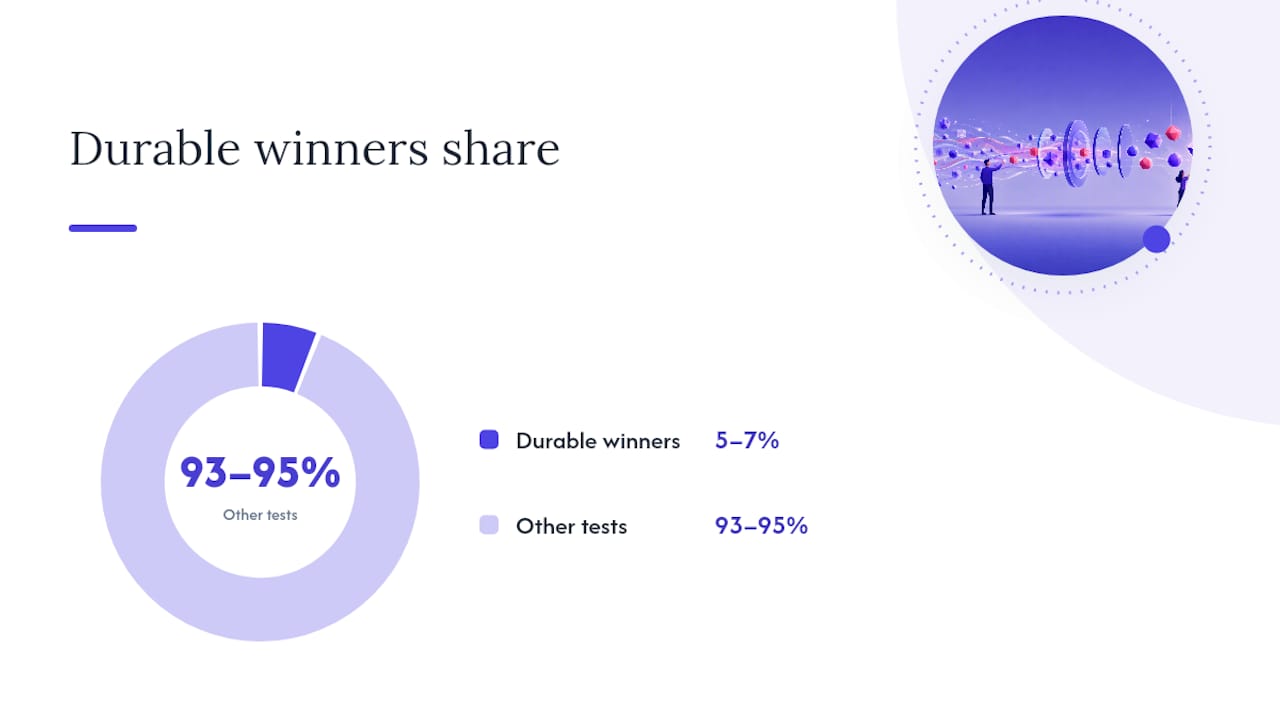
Practitioner audits across more than 200 accounts found that only 5 to 7 percent of tested creatives become durable winners. That low hit rate is the reason premature decisions are so costly. Cut a test two days early and you might be discarding one of the rare good ones based on noise.
How Much Budget Should You Spend on Testing Versus Scaling?
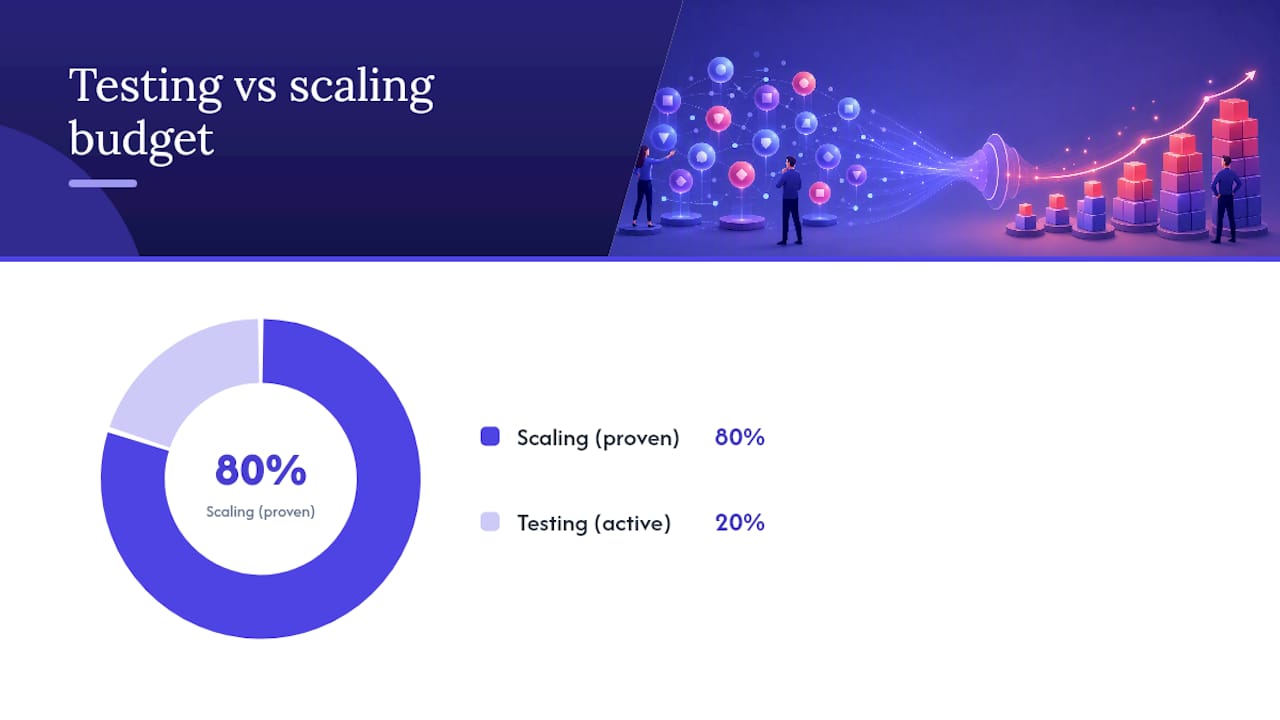
The widely cited split among agencies and in-house teams running high creative volume is roughly 80% of spend on proven winners and 20% on active testing, adjusted up for younger accounts still building a winner bench and down for mature accounts with a deep rotation already in place.
That 5 to 7 percent hit rate mentioned earlier has direct math attached to it. If you need 3 to 5 winners in rotation at any given time and only 1 in roughly 15 to 20 tested variants pans out, you need to be running a real volume of concepts continuously, not sporadically.
A common operating cadence looks like this:
| Weekly input | Target volume |
|---|---|
| New concepts tested | 5 to 10 |
| Variants per concept | 2 to 3 |
| Total new ad creatives per week | 15 to 25 |
| Expected new winners per week | 1 to 2 |
| Testing budget share | ~20% of total spend |
Hitting that volume weekly, week after week, is where most teams stall out. It's not a strategy problem, it's a production problem: someone has to shoot, edit, and format 15 to 25 ad variants every single week without fail. In-house teams often can't sustain that pace alongside their other work, agencies typically price per deliverable in a way that makes that volume expensive fast, and managed virtual assistant services built specifically for high-frequency ad editing have become a third option worth weighing against the first two.
How Do You Spot Creative Fatigue Before It Tanks Performance?
Creative fatigue rarely shows up as one metric crashing. It shows up as a compound pattern: frequency climbs, click-through rate slides, and cost per result creeps upward, usually in that order.
- Frequency pushing past 3.5 within a short window is an early warning sign, though the exact ceiling varies by funnel stage and audience size.
- A CTR drop of more than 25% week over week alongside rising frequency is a stronger signal than either metric alone.
- Cost per result climbing more than 40% day over day, especially paired with the two signals above, usually means the ad has run its course rather than hit a temporary dip.
Weekly decision sessions should pull four numbers for every active ad: 7-day trailing ROAS, 7-day CPA, current frequency, and delivery rate (how much of allocated budget is actually spending). Reviewing these on a fixed schedule, rather than reactively when something looks off, catches decay before it becomes a real budget drain.
Pro Tip: Retire a fatigued winner by pausing it and introducing its replacement in a new ad set rather than editing the existing one. Editing a live, proven ad resets its learning phase and throws away the performance history you built.
What Mistakes Cost the Most Testing Wins?
The most expensive mistake is testing more than one variable at once. Change the hook and the offer in the same test and you'll never know which one moved the number, which means you can't repeat the win.
Right behind that: editing a test mid-flight, calling a winner during learning phase instead of after it stabilizes, and running tests on accounts with measurement gaps that inflate the time needed to reach 50 events.
A short checklist before launching any test:
- Write down the hypothesis in one sentence: what you're changing and what you expect to happen.
- Confirm you're isolating a single variable, not several at once.
- Match budgets evenly across variants so spend differences don't skew the read.
- Set kill and winner thresholds before launch, not after you see early numbers.
- Document the result regardless of outcome. A failed hypothesis is still useful data for the next test.
When conversion volume is naturally low, stretch the test window and lean on proxy metrics like CTR and thumb-stop rate rather than forcing 50 conversion events on an unrealistic timeline. Once a winner is confirmed, move it to scale by increasing its own budget gradually rather than duplicating it into a fresh ad set, which avoids re-triggering learning phase on a creative that already proved itself.
How Managed Creative Production Keeps a Testing Pipeline Full
Hitting 15 to 25 new ad variants a week, every week, is a production math problem before it's a strategy problem. Most in-house teams have the strategic judgment to run good tests; what they lack is the editing bandwidth to keep feeding the pipeline without burning out a single video editor.
Managed creative production functions as the rate-limiting factor for high-throughput testing. Services that increase variant output directly accelerate how fast a team discovers its next winner, because more tested variants against a 5 to 7 percent hit rate simply means more shots at finding one.
That's the operational gap Wing Assistant's managed creative service is built around: turning one piece of raw footage into multiple ad-ready variations within a 24 to 48 hour turnaround window, which is fast enough to sustain a 5 to 10 concept weekly cadence without adding headcount. When previewing how a finished creative will actually render as a link post, a tool like Pingfloat's Open Graph checker is a quick way to confirm the thumbnail and preview text match what you built before it goes live.
Why Creative Testing Has to Be a System, Not a One-Off Project
Most teams treat creative testing like a task they get to when things slow down. That's backwards. The accounts with the deepest bench of winners treat testing like a fixed weekly obligation, the same way they treat payroll or reporting. It happens on schedule whether the week feels busy or not.
Protect the testing budget the same way. The moment testing spend becomes the first thing cut in a tight month is the moment your pipeline of future winners dries up, usually a full month before anyone notices the account is running stale creative.
Schedule a weekly test review, write down every hypothesis before launch, and log every result, wins and losses both. Six months of that discipline builds an internal playbook no competitor can copy.
— James
Keep Your Testing Pipeline Fed Without Hiring an Editor
Running the cadence this guide lays out, 15 to 25 fresh variants a week, is where most teams hit a wall. Not because the strategy is hard, but because production can't keep pace. Some managed creative production services turn a single piece of raw footage into multiple ad-ready variations within about 24 to 48 hours, which can help feed a real weekly testing calendar instead of a sporadic one.
That production speed is what lets performance marketers hit the volume this guide's math requires, without adding a full-time editor or paying agency rates for a handful of deliverables a month. If your testing pipeline has been running thin because footage output can't keep up, check out Wing Assistant's ad fatigue solution and see how a 24 to 48 hour turnaround changes what's realistic for your weekly cadence.
Sources
FAQ
What Is Meta's Creative Testing Tool?
It's a built-in feature inside Ads Manager that lets you run controlled experiments comparing creative variants against a chosen metric, with set budgets and a defined runtime. It's designed to give a cleaner read than simply loading several ads into one ad set and watching the algorithm pick a favorite.
Is $10 a Day Enough for Facebook Ads Testing?
For most accounts, no, not for a real creative test. At $10 a day you'll take weeks or months to clear the roughly 50 optimization events needed for a reliable read, so any decision made before that point is likely based on noise rather than signal.
Is A/B Testing Worth It on Facebook?
Yes, when it's run correctly: one variable isolated, matched budgets, and a decision held until the ad set clears enough events to be statistically meaningful. Native A/B experiments give a cleaner comparison than algorithmic ad-ranking within a single ad set, though they typically need more spend and time to be cost-effective for smaller accounts.
How Much Do 1,000 Clicks Cost on Facebook?
Cost per click varies widely by industry, audience, and creative quality, and there's no single reliable figure that applies across accounts. Rather than anchoring to click cost, most performance marketers track cost per result against their actual conversion goal, since that number reflects what the campaign is actually meant to deliver.
How Many Ad Variants Should You Test at Once?
For concept-level tests, keep it to 2 to 3 variants so each one gets enough budget to clear the significance threshold. Once a concept proves itself, you can widen to 3 to 5 execution variants (different hooks, pacing, or CTAs) within that already-validated concept.