

Run this: a 15-second video opens with "Stop scrolling if your ads look the same as last month," cuts to on screen text reading "Creative fatigue is real," shows a 5-second product demo, and closes with primary text "Fresh ad variations, every week" and a Shop Now CTA. Place it in Feed and Reels for cold audiences, keep it under 20 seconds, and test the hook line first, since a 3-second view rate tells you within days whether the opener earns attention.
TL;DR:
- Testing 8 to 12 hook variations grouped by mechanism allows you to identify the most attention-grabbing and relevant messaging before scaling.
- A strong hook rate over 3 seconds indicates attention is earned, but a weak hold rate suggests the message overpromises or misaligns with the body content.
- Creating a master vertical file aligned within the safe zone ensures your ad maintains clarity across Meta's automatic aspect ratio cropping.
- Tailoring scripts to audience type involves adjusting language and proof style, with cold traffic favoring curiosity hooks and retargeting needing urgency and explicit next steps.
- Automated production and quick turnaround from raw footage to multiple tested variations enable more efficient testing and faster optimization cycles.
Table of Contents
- What Is a Facebook Ad Script and Why Structure Beats Talent
- Six Plug-and-Play Facebook Ad Script Examples You Can Record Today
- How Do You Test Facebook Ad Hooks Before Scaling Spend?
- Production Rules That Survive Meta's Automatic Variants
- Matching Scripts to Cold, Warm, and Retargeting Audiences
- Practical Proof: Turning One Raw Video Into a Testable Ad Set
- What to Cover: Buyer Personas Change the Hook, Not the Structure
- Keeping Brand Voice Consistent Across Every Script Variant
- Writing CTAs That Actually Get Clicked
- Adapting Scripts Beyond Video: Carousel and Stories Formats
- A Practitioner's Note on the Mistakes That Actually Kill Performance
- Let Wing Assistant Handle the Cutting While You Handle the Strategy
- Sources
- FAQ
What Is a Facebook Ad Script and Why Structure Beats Talent
A facebook ad script is the written blueprint for a video or static ad, covering the spoken line, on screen text, pacing, and CTA before anyone hits record. Most people treat script writing like a creative writing exercise. It works better as a mechanical process, closer to assembling a checklist than composing a poem.
The reason structure wins over talent is simple: a proven 4 part shape (Hook, Introduction/Problem, Solution/Demo, Call to Action) removes the guesswork about pacing, and most effective ads demonstrate value within the first 7 seconds regardless of production budget. You don't need a gifted copywriter. You need a repeatable template and the discipline to test one variable at a time.
The 4-Part Structure, Timed Out
- Hook (0 to 3 seconds): A pattern interrupt, bold claim, or direct callout. This is the only job of these three seconds: stop the scroll. Example: "Your ad budget is bleeding money and you don't know why."
- Intro/Problem (3 to 10 seconds): Name the specific pain point in language the viewer already uses. Example: "Same 3 ad creatives running since Q1 means rising CPMs and dead reach."
- Solution/Demo (10 to 25 seconds): Show the product or service solving that exact problem. Keep it visual, not narrated. Example: a screen recording of raw footage turning into five different ad cuts in under a minute.
- CTA (25 to 45 seconds): One clear next step, repeated in text and voice. Example: "Tap Learn More to see how it works."
Every part must survive without sound. Meta reports most feed viewers watch with audio off by default, so burn-in captions or hard-overlay text aren't a nice extra, they're the primary way your message lands. Time captions to appear roughly 0.3 to 0.5 seconds before the spoken line so readers aren't racing the audio.
The rule that ties the four parts together is message match: whatever the hook promises, the CTA must deliver on the same promise, using the same words if possible. A hook about saving time that ends on a CTA about saving money creates the kind of disconnect that tanks conversion even when the hook rate looks great. This compact framework, popularized in Adam Erhart's 4-part framework, maps cleanly onto 15 to 30 second creatives, which remain the sweet spot for feed and reels placements.
Six Plug-and-Play Facebook Ad Script Examples You Can Record Today
Each template below works as a video script or a static caption. Swap in your product name and the specific number or outcome that applies to your offer.
- Cold curiosity hook. Opening line: "Nobody tells you this about [industry] until it's too late." Body: name the hidden cost, then reveal the fix in one sentence. On screen text: bold the hidden cost as a headline overlay. CTA: "See how it works." Best for Feed and Reels, 15 to 20 seconds, shot handheld for a native feel.
- Founder-led demo. Opening line: "I built this because [specific frustration] almost killed my last business." Body: show the founder using the product on camera, one clear before state and one after state. On screen text: name and title lower third. CTA: "Try it free." Best for Feed, 20 to 30 seconds, medium shot, conversational pace.
- Before/after. Opening line: "This is what our client's ad account looked like 30 days ago." Body: split screen or sequential cuts showing metric change, then a two-second explanation of what changed. On screen text: overlay the before and after numbers directly on screen. CTA: "Get your free audit." Best for Feed and Stories, 15 seconds, fast cut pace.
- Bold claim. Opening line: "Cut your cost per acquisition by a third without touching your ad spend." Body: one sentence on how, one sentence on proof. On screen text: repeat the claim as a headline in the first 2 seconds. CTA: "Learn how." Best for Reels, under 15 seconds, high energy delivery.
- Discount/urgency. Opening line: "48 hours left before this offer disappears." Body: state the discount, state what happens after the deadline. On screen text: countdown-style overlay or a static timer graphic. CTA: "Shop now before it's gone." Best for Feed and Stories, 10 to 15 seconds, direct-to-camera or product shots.
- Retargeting testimonial. Opening line: "You checked this out last week. Here's why 200 others didn't hesitate." Body: a short client quote or paraphrased result, then a specific offer detail. On screen text: quote overlay with attribution. CTA: "Complete your order." Best for Feed retargeting placements, 15 to 20 seconds, polished editing since this audience has already seen your brand once.
Recording style matters as much as the words. UGC style handheld footage tends to outperform polished studio shots for the cold curiosity and founder led templates, since it reads as native content rather than an ad. The before/after and retargeting testimonial templates can lean more polished, since that audience has already shown interest and responds better to credibility cues than to raw authenticity.
Pro Tip: Pick one variable to change between recordings of the same script, either the hook line or the delivery energy, never both. If you change the opening line and the camera distance in the same test, you won't know which one moved the needle.
How Do You Test Facebook Ad Hooks Before Scaling Spend?
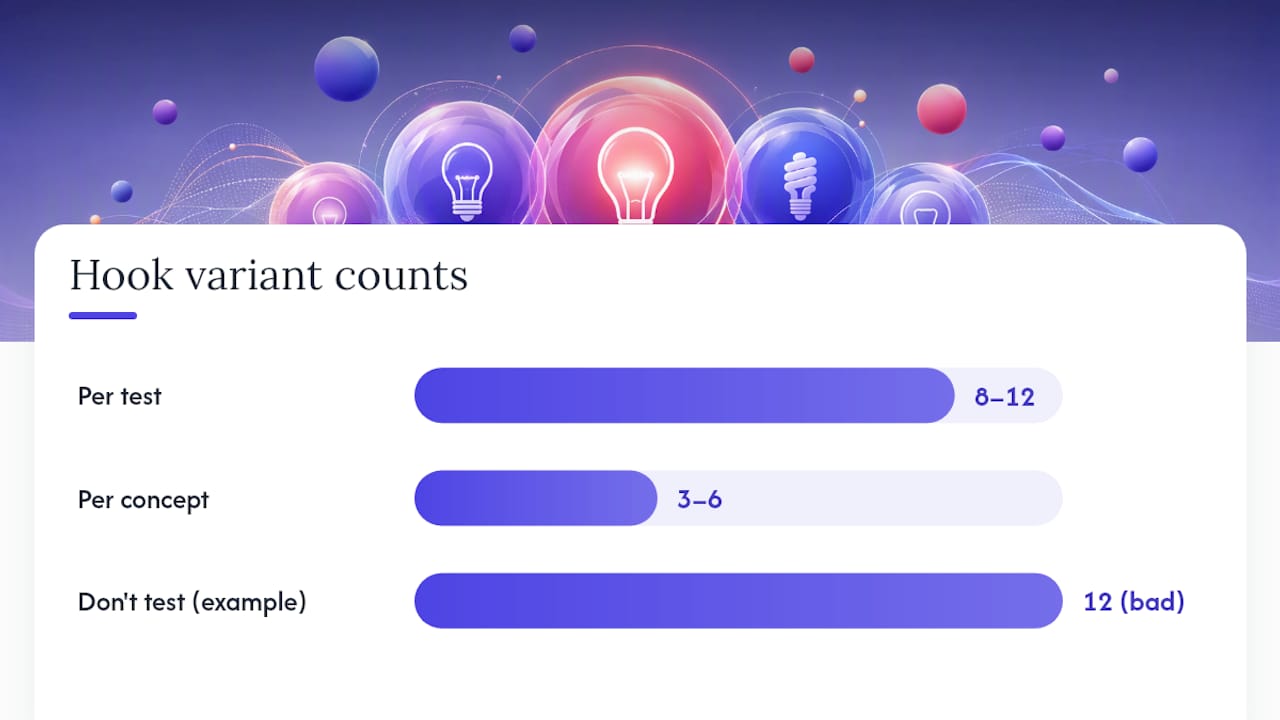
Build 8 to 12 hook variations before you touch the budget slider. Group them into families by mechanism (curiosity, bold claim, pattern interrupt, social proof) rather than treating each one as a random guess, then run them behind the same body and CTA so the hook is the only thing changing.
The primary metric to read first is hook rate, the percentage of viewers who watch past the first 3 seconds. A strong hook rate with a weak hold rate, meaning viewers bail between 3 and 10 seconds, almost always signals an overpromise. The hook wrote a check the intro couldn't cash. Fix that by tightening message match, not by writing a punchier hook.
- 3 second view (hook rate): measures whether the opener earns attention at all.
- Hold rate: measures whether viewers stay past the hook into the problem and solution.
- Click through rate: measures whether the CTA and offer are compelling enough to act on.
A widely used rule of thumb among performance marketers is to start with 3 to 6 hook variants per concept, which balances discovery against budget dilution. Testing 12 variants at once with a $20 daily budget just spreads spend too thin to reach statistical confidence on any single hook.
Sample size discipline matters more than most advertisers admit. Give each hook enough spend to reach at least a few thousand impressions before judging it, and resist the urge to kill a hook after two hours of soft performance. Early volatility is normal. What you're watching for is a consistent pattern across a full day or two, not a single dip.
When a hook produces high thumb-stop numbers but poor downstream conversion, the account tends to optimize toward cheap impressions that never convert, since Meta's delivery system chases the engagement signal it sees, not the sale you actually want. The fix lives in the hook line itself: sharpen the targeting language so curiosity and buyer intent point the same direction, instead of hoping a generic curiosity gap will filter itself out downstream.
Stop and scale rules should be set before the test starts, not decided in the moment. A common approach: kill any hook below half the average hook rate of the group after a set spend threshold, and double budget on whichever hook clears both a strong hook rate and a strong hold rate together, since a hook that only wins on one metric usually isn't a real winner.
Production Rules That Survive Meta's Automatic Variants
Meta's Advantage+ system reformats your creative into multiple aspect ratios automatically, which means a script written for one frame size can get cropped into something unrecognizable in another. The fix starts at the master file, not in the editing timeline.
Build a 9:16 master file and frame every critical element, faces, product, key text, inside the 4:5 safe zone in the center. That safe zone is what survives when Meta auto-crops your vertical master down to a square or horizontal placement. Supply your own 4:5 and 1:1 reframes when you have the resources, since manual reframes often outperform automatic ones on message clarity.
- Burn-in or hard-overlay captions should function as your primary audio, not a backup for the hearing impaired, since most feed viewers scroll with sound off.
- Time captions roughly 0.3 to 0.5 seconds ahead of the spoken line so text and voice don't feel out of sync.
- Keep feed and reels ads between 15 and 30 seconds; longer format works only for retargeting audiences who already trust the brand.
- Place the CTA as a dedicated end card lasting 1 to 2 seconds minimum, long enough to read but not so long it drags the pacing.
- Write CTA copy that names a specific action rather than a generic "Learn More," since specificity tends to outperform vague prompts.
Test both the automatic Advantage+ variants and your own manually cropped versions against each other. The auto-crop sometimes wins on convenience but loses on message clarity, particularly for ads where text placement is doing heavy lifting.
Matching Scripts to Cold, Warm, and Retargeting Audiences
Audience temperature changes everything about which hook mechanism works and how urgent your CTA should feel. A script that crushes it with cold traffic will often flop with a retargeting audience, and vice versa.
Cold audiences respond to curiosity and pattern interrupt hooks paired with a low-friction CTA like "Learn More" or "See How It Works." They don't know your brand yet, so anything that smells like a hard sell in the first 3 seconds gets scrolled past. Warm audiences, people who've engaged with your content or visited your site, respond better to social proof and a quantified offer, since they already trust the category and want proof this specific option is worth the switch. Retargeting audiences need urgency and an explicit next step, since they've already shown intent and just need a reason to finish what they started.
- Feed: slower cut pace works, since viewers are scrolling at their own speed and can absorb more text density.
- Reels: faster cuts and shorter total runtime perform better, matching the native short-form content around it.
- Stories: vertical full-screen framing with minimal text overlay, since the format rewards immediacy over explanation.
- In-stream: treat the first 2 seconds as non-skippable real estate and front-load the strongest visual.
Run a message-match check before publishing anything: does the hook's promise match the body's explanation, and does the landing page deliver exactly what the CTA claimed? A mismatch anywhere in that chain is where good hook rates turn into wasted spend.
Practical Proof: Turning One Raw Video Into a Testable Ad Set
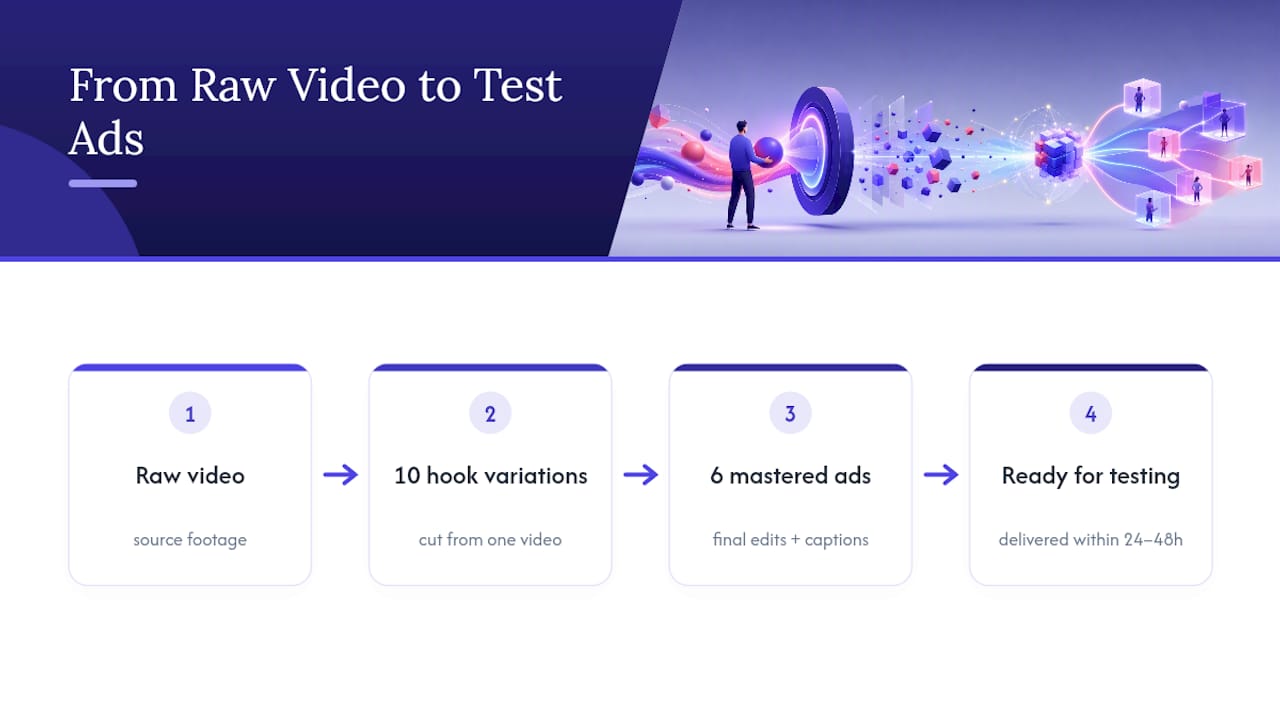
A common model assigns dedicated virtual assistants to take one piece of raw footage and cut it into multiple ad variations, which shortens the gap between shooting content and having enough creative to actually test hooks properly. Instead of waiting weeks for an agency to deliver three polished videos, turnaround times can run 24 to 48 hours for a full batch of variants.
Whether that exact number holds for your account depends on your baseline, but the mechanism behind it, more variants tested faster, aligns with everything the hook-testing math above suggests.
A realistic version of the workflow: one raw video goes in, a team cuts 10 hook variations from it, narrows those to 6 fully mastered ad versions with captions, and hands them off for ad set testing within two days.
What to Cover: Buyer Personas Change the Hook, Not the Structure
The 4-part structure stays fixed. What changes by persona is the language inside each part, particularly the hook and the proof style in the solution section.
A price-sensitive small business owner responds to a hook about cost or time savings, backed by a demo showing exactly how much effort the tool removes. An enterprise buyer skims past the same hook, since they're evaluating on reliability and scale, not sticker price, so the proof section should shift toward credibility markers like client logos or specific outcome numbers instead of a casual before/after.
Break your audience into two or three personas maximum before scripting anything, since more than that turns testing into guesswork with no clean signal. For each persona, write down the one sentence that describes their specific frustration in their own words, not your marketing language. That sentence becomes your Intro/Problem section almost verbatim.
The mistake most marketers make here is writing one hook and hoping it resonates broadly. A hook written for a solo founder ("stop doing this yourself") and a hook written for a marketing director at a 50-person company ("stop waiting on your agency") are different scripts even if the product being sold is identical. Test both against their intended persona rather than running one generic version everywhere and wondering why performance is mediocre.
Keeping Brand Voice Consistent Across Every Script Variant
Running six different script templates doesn't mean six different brand personalities. The words change, the tone doesn't.
Write a one-page voice reference before scripting: three adjectives that describe how the brand talks (direct, warm, no-nonsense, whatever fits), plus two or three phrases the brand never uses. This takes twenty minutes and saves you from a founder-led demo that sounds nothing like the discount urgency ad running next to it in the same campaign.
Consistency matters most in the CTA line and the closing tone, since that's the last impression before someone clicks or scrolls away. If your brand voice is casual everywhere else but the CTA suddenly reads like corporate legal copy, that shift breaks trust at the exact moment you're asking for action.
Every scriptwriter or VA producing content should work from the same one-page reference, not from memory of "how we usually sound." Memory drifts. A written reference doesn't.
Writing CTAs That Actually Get Clicked
The CTA line is not the place to get clever. Specific, concrete actions outperform vague prompts almost every time, since the viewer shouldn't have to guess what happens next.
"Shop Now" beats "Discover More" when there's an actual product to buy, because it removes ambiguity about the next step. "See How It Works" beats "Learn More" for a demo-driven offer, since it sets a concrete expectation for what clicking delivers. The best CTAs name the outcome, not the action, whenever possible, matching the tactics outlined in conversion-focused CTA writing.
Placement timing matters as much as wording. The CTA should appear both as spoken audio and as an on screen end card lasting at least 1 to 2 seconds, giving viewers time to actually read it rather than catching a flash of text before the video loops. Repeating the CTA once in the middle of the ad, then again at the end, tends to outperform mentioning it only once at the very close.
Match urgency level to audience temperature. A cold audience CTA should feel low-risk ("Learn More," "See How It Works"), while a retargeting CTA can carry more urgency ("Complete Your Order," "Claim Your Spot") since that audience has already shown intent.
Adapting Scripts Beyond Video: Carousel and Stories Formats
Not every ad needs to be a video, and the same 4-part logic still applies to static and carousel formats, just compressed differently.
For carousel ads, treat the first card as your hook, exactly like the first 3 seconds of a video script. It needs a bold claim or curiosity gap strong enough to make someone swipe to card two. Middle cards handle the Intro/Problem and Solution/Demo beats, often as one card each showing a specific feature or benefit. The final card carries your CTA, repeated in both the card's headline and the ad's primary text.
Stories ads compress the entire structure into a shorter window, since the format favors immediacy. A strong stories script often collapses Hook and Intro/Problem into the first 3 to 5 seconds combined, then moves straight to a quick demo and CTA, since attention spans in Stories run even shorter than in Feed.
Static image ads lose the ability to demonstrate motion, so the Solution/Demo section has to work through a single compelling image plus supporting copy underneath, often structured as a headline (Hook), a short paragraph (Problem/Solution combined), and a button (CTA). The 4-part thinking doesn't disappear with video, it just gets rearranged to fit the format's constraints.
A Practitioner's Note on the Mistakes That Actually Kill Performance
Three mistakes show up constantly. Opening with a logo or brand name burns the first 3 seconds on something nobody cares about yet. Overpromising in the hook, claiming a result the solution section can't back up, tanks hold rate even when the hook rate looks great. Testing five variables at once, hook and CTA and pacing and voice all changed simultaneously, means you learn nothing when a variant wins or loses.
The clearest improvement I've seen argued for in the testing data comes from isolating the hook and nothing else. Accounts that stop touching the body and CTA mid-test see cleaner reads within days, not weeks, because the noise drops out.
Pro Tip: Set a weekly refresh cadence and retire winning creatives before they show fatigue, rather than waiting for performance to visibly decline. By the time CPMs climb, you've already lost efficiency you can't get back.
— James
Let Wing Assistant Handle the Cutting While You Handle the Strategy
Wing Assistant exists for exactly the bottleneck this guide keeps circling back to: you can write ten strong hooks in an afternoon, but cutting ten matching video variants takes real production time most teams don't have. Dedicated virtual assistants can turn one raw video into multiple ready-to-test ad variations within 24 to 48 hours, so the testing plan above stops being theoretical and starts running in your ad account this week.
That turnaround matters because hook testing only works when you have enough variants in the account at once. Waiting weeks for an agency to deliver two or three videos means your test never reaches the sample size it needs to produce a clean read.
If you're ready to stop being the bottleneck in your own testing plan, visit the ad fatigue solution page to see how the weekly hook production workflow fits into your existing campaigns.
Sources
- Facebook Video Ads | Specs, Hooks and Editing Tactics 2026 - VidPros
- Facebook Video Ads | 4-part framework to write, script, and create - Adam Erhart
FAQ
What Are Some Good Scripts for Facebook Ads?
The strongest scripts follow the Hook, Intro/Problem, Solution/Demo, CTA structure and open with a specific claim rather than a brand introduction. The six templates above, cold curiosity, founder-led demo, before/after, bold claim, discount/urgency, and retargeting testimonial, cover most funnel stages and can be recorded with a phone camera.
Is $10 a Day Enough for Facebook Ads?
A $10 daily budget can generate learnings, but it limits how many hook variants you can test simultaneously with statistical confidence. Most performance marketers recommend testing 3 to 6 hook variants per concept, which usually needs a higher combined budget to reach meaningful impression volume within a few days.
What Are Some Good Facebook Ad Examples?
The strongest examples share one trait: the hook and the CTA make the same promise, with nothing lost in between. A before/after script showing a specific metric change, or a founder-led demo naming an exact frustration, tend to outperform generic brand-awareness style ads because they give viewers a concrete reason to keep watching.
What Is the 20% Text Rule for Facebook Ads?
Meta previously limited the amount of text allowed in image ads to 20% of the visual, though this rule has been relaxed over time and no longer strictly limits ad delivery. It's still smart practice to keep on-screen text minimal and let the image or video carry the message, since heavy text overlays often hurt readability more than they help.
How Do I Know If My Facebook Ad Hook Is Working?
Check your 3 second view rate first, since that's the direct measure of whether your opening line stops the scroll. If hook rate is strong but hold rate drops sharply in the next few seconds, the hook is overpromising relative to what the ad actually delivers, and the fix is tightening message match, not writing a punchier opener.