

Dynamic creative optimization (DCO) is the technology that assembles personalized ad creative in real time by combining templates, live data feeds, and audience signals, then serves the winning combination automatically. It works best when you have a structured product feed and enough conversion volume to let the system learn. Used well, it lifts engagement and ROAS by replacing one generic ad with hundreds of relevant variants.
TL;DR:
- A well-structured and frequently refreshed product feed is essential, especially for real-time pricing and inventory updates, to avoid breaking user trust.
- Combining contextual signals like weather, time of day, and regional holidays enhances relevance but is often underused in DCO campaigns.
- Campaigns require dedicated ownership of templates, data quality, media buying, and optimization to prevent performance issues and ensure coherence.
- DCO success depends on high-volume, quality data and creative variation; low-volume campaigns often perform better with simple A/B tests.
- Automation tools and AI-assisted creative production can accelerate testing cycles, reduce costs, and maintain fresh variations over time.
Table of Contents
- What Is Dynamic Creative Optimization?
- How Does DCO Work in Practice?
- What Signals and Assets Does a DCO Engine Need?
- How Do You Measure Whether DCO Is Working?
- Best Practices for Orchestrating DCO Campaigns
- Real Production Proof: What Feeds a Healthy DCO Testing Cycle
- Where DCO Breaks Down: Coherence, Data Quality, and Privacy
- What's Next for Dynamic Creative Optimization?
- DCO Across Retail, Automotive, CPG, and Finance
- Which Platforms and Tools Actually Run DCO?
- Common DCO Problems and How to Fix Them
- A Practical Readiness Checklist Before You Launch
- Turn Your Video Backlog Into a DCO Testing Pipeline
- Where to Go Deeper on DCO
- Sources
What Is Dynamic Creative Optimization?
Static creative shows the same image and headline to everyone. A/B testing improves on that by comparing two or three fixed versions and picking a winner over time. DCO skips both limitations by building ads from parts, then swapping those parts automatically based on who is looking, what they've done, and what's in stock.
The underlying mechanic is multivariate testing paired with real-time variable-driven assembly, which means the system isn't testing whole ads against each other. It's testing components, headline against headline, image against image, and recombining the winners on the fly.
A DCO setup has three moving parts:
- Templates — the layout skeleton that defines where each element lives (image, headline, price, logo, CTA button).
- Placeholders — dynamic fields inside that layout that swap content per impression.
- Feeds — the data source (usually a product catalog) that fills those placeholders with live information.
A furniture retailer running a retargeting campaign is the clearest example. Someone browses a specific sectional sofa, leaves the site, and later sees an ad showing that exact sofa, its current price, and a "still in stock" badge, pulled straight from the product feed with zero manual ad-building involved.
How Does DCO Work in Practice?
Underneath the personalization is a fairly mechanical pipeline, and understanding each stage matters if you're troubleshooting a campaign that isn't performing.
- Data collection. The system pulls from pixel events (browsing behavior, cart abandonment), product feeds (inventory, pricing, availability), CRM data (purchase history, loyalty tier), and contextual signals (device, location, time of day, weather).
- Matching logic. Orchestration rules decide which creative elements are eligible to pair together for a given user or context. This is where most of the strategic thinking happens, not in the design phase.
- Real-time assembly. When an ad opportunity appears, the ad server or DSP selects the template, populates it from the feed, and renders the final creative in milliseconds.
- Optimization loop. Machine learning models score combinations by performance and shift delivery toward higher performers, continuously, not on a weekly review cycle.
Modern platforms have pushed this further by folding predictive bidding and outcome-based optimization directly into the creative decision, so the system isn't just picking the prettiest ad. It's picking the combination most likely to produce a conversion at your target cost, provided your feed and conversion volume are large enough to give the model something to learn from.
On the technical side, you'll need your ad server or DSP connected to your product feed via API, your pixel firing correctly across the funnel, and your creative management platform speaking the same taxonomy as your media buying tools. Skip any one of these and the "real-time" part breaks down into a slow, manual patch job.
What Signals and Assets Does a DCO Engine Need?
Every DCO campaign is only as good as what you feed it. Garbage inputs produce garbage combinations, no matter how sophisticated the matching logic is.
Start with templates. Design flexible layouts that account for multiple ad sizes, varying text lengths, and dynamic field limits, because a headline that fits a 300x250 unit will often overflow a 160x600 unit. Build margin into every text field rather than assuming your longest product name is the average case.
Your product feed needs to be structured cleanly and refreshed frequently, ideally in real time for pricing and inventory, since a DCO ad showing a sold-out item or yesterday's price erodes trust fast. Audience and identity resolution should tie first-party CRM data to ad platform IDs wherever consent allows, so a returning customer sees relevant upsell creative instead of a generic acquisition message.
Contextual triggers add a layer most teams underuse: weather-based creative for a beverage brand, time-of-day messaging for a food delivery app, or a cultural moment campaign timed to a regional holiday.
Pro Tip: Build one "safe fallback" creative for every template in case a feed field comes back empty. A blank price field looks broken; a fallback that says "Shop Now" doesn't.
How Do You Measure Whether DCO Is Working?
The KPIs are familiar (CTR, CPA, ROAS, revenue lift) but the attribution work behind them is where most teams stumble.
- CTR tells you if the combination is grabbing attention, but it's a weak proxy for actual business value on its own.
- CPA and ROAS are the metrics that matter for budget decisions, and they should be tracked at the creative-combination level, not just the campaign level.
- Incrementality or holdout testing is the only reliable way to isolate what the creative itself contributed versus what the audience targeting or bidding strategy would have delivered anyway.
A common pitfall is crediting DCO for lift that actually came from better audience segmentation running alongside it. Set up a holdout group receiving static creative against the same audience and budget, and compare. Review performance on a weekly cadence at minimum, and retire underperforming creative elements once they've run long enough to gather statistically meaningful volume, not after a gut-feel glance at day three.
Best Practices for Orchestrating DCO Campaigns
Effective DCO isn't about maximizing the number of possible combinations. Industry practitioners increasingly emphasize orchestration and relevance over raw variation, with Flashtalking/Mediaocean's Therran Oliphant noting that connecting the right elements matters more than mechanically chasing CTR.
- Design brand-safe templates first. Lock down color palettes and logo placement so no data-driven combination can accidentally violate brand guidelines.
- Write orchestration rules that pair elements deliberately. A dark background image should never be eligible to pair with a dark-text headline; a summer promo shouldn't pair with a snow-themed background.
- Run a QA pass before launch. Check text length overflow, special character rendering, file size limits, and transparency on PNG assets across every size variant.
- Assign clear ownership. Someone owns the creative templates, someone owns the feed and data hygiene, someone owns media buying, and someone owns the optimization review. Without this, campaigns drift and nobody notices until performance drops.
Pro Tip: Screenshot every live combination in your top five templates once a week for the first month. It's the fastest way to catch a coherence problem before your media budget does.
Real Production Proof: What Feeds a Healthy DCO Testing Cycle
DCO is only as strong as the volume of fresh creative feeding it, and that's usually the bottleneck. Jamesyee's managed video editing service turns a single raw video into multiple ad variations within 24 to 48 hours, which means a performance team can keep feeding new hooks, angles, and CTAs into their DCO template library instead of running the same three assets until they fatigue.
The workflow is straightforward: a raw video comes in, Jamesyee's virtual assistants cut it into several variants, those variants populate the creative feed, and the DCO engine starts testing them immediately. Faster variant production means faster test cycles, and clients using this model report a 31% reduction in cost per acquisition.
Where DCO Breaks Down: Coherence, Data Quality, and Privacy
DCO fails in predictable ways. The most common is creative coherence risk: mismatched elements colliding into something unreadable or off-brand, which is why treating every element as an orchestration decision rather than a random swap matters so much.
Feed quality is the second failure point. Stale prices, broken image URLs, and inconsistent product naming all quietly degrade performance without throwing an obvious error.
- Monitor feed health with automated alerts for missing fields, broken links, and stale timestamps.
- Audit live combinations weekly, not just at campaign launch.
- Build identity strategies around first-party data, clean rooms, and contextual signals rather than third-party cookies, since DCO increasingly depends on this shift to keep personalization working as tracking restrictions tighten.
DCO isn't the right tool for every campaign. Low-volume, low-conversion accounts without a structured feed rarely have enough data to make the optimization loop worthwhile. A simple A/B test often serves those campaigns better.
What's Next for Dynamic Creative Optimization?
Generative AI is compressing the time it takes to produce raw creative assets, which raises the ceiling on how many variants a team can feed a DCO engine, but it also raises the orchestration burden since more raw material means more chances for mismatched combinations.
Dynamic video and CTV personalization are moving from experimental to mainstream as production and personalization costs continue to fall, letting brands run feed-driven variation on premium video inventory the way they already do on display. Team roles are shifting too: creative staff spend less time producing one-off assets and more time building the rules and templates that let automation do the assembly. Teams that haven't touched DCO yet should pilot AI-assisted creative production on a single campaign before scaling it across the account.
DCO Across Retail, Automotive, CPG, and Finance
Retail runs the most mature DCO playbooks, largely because product feeds already exist for ecommerce. A shopper who viewed a specific pair of running shoes sees that shoe, its current sale price, and a size-availability flag in the retargeting ad that follows them.
Automotive dealers use DCO to localize inventory ads by dealership location, swapping in the specific trim levels and lease offers available at the nearest lot rather than running one generic regional ad. This solves a real operational headache: national campaigns that used to ignore local inventory differences now route the right vehicle to the right shopper automatically.
CPG brands lean on contextual triggers more than personalized identity, since many grocery and beverage purchases don't involve a login or loyalty account. A weather-triggered campaign showing iced coffee messaging on a hot day, then switching to warm-drink messaging when temperatures drop, is a common execution.
Finance is the most constrained vertical because of compliance requirements around what claims can appear in an ad, but DCO still adds value through geo-based rate personalization (showing region-specific loan rates or account offers) and lifecycle-stage messaging that differs for a new prospect versus an existing customer being offered a second product. The templates need tighter legal review cycles than retail or CPG, but the underlying mechanics are the same.
Which Platforms and Tools Actually Run DCO?
Three categories of technology work together in a functioning DCO stack, and confusing their roles is a common setup mistake.
Demand-side platforms (DSPs) handle the media buying and real-time bidding decisions, determining which impression to bid on and at what price. Ad servers handle the creative rendering and delivery logic, deciding which creative variant actually shows once the impression is won. Creative management platforms (CMPs) are where templates get built, feeds get connected, and orchestration rules get written; this is the layer most marketing teams spend the most hands-on time in.
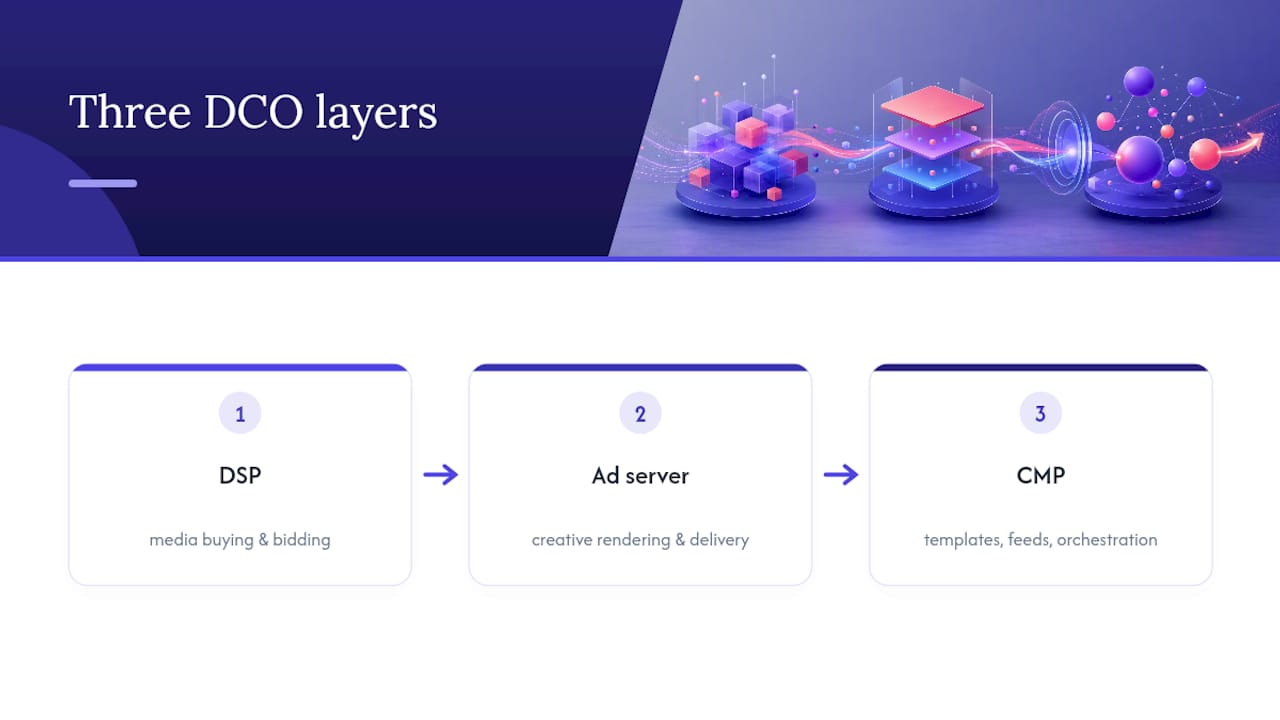
Some platforms bundle two or three of these functions together, which simplifies setup but can limit flexibility if you later want to swap one component without disrupting the others. A team running programmatic display, for instance, typically needs its DSP and ad server tightly integrated for bid and creative decisions to happen in the same real-time window, while the CMP layer can often operate somewhat independently since template design isn't a split-second decision.
Whatever combination you choose, verify that your product feed connects cleanly across all three layers before launch. A feed that syncs perfectly with your CMP but lags behind in your ad server is a frequent, quiet source of stale-price complaints.
Common DCO Problems and How to Fix Them
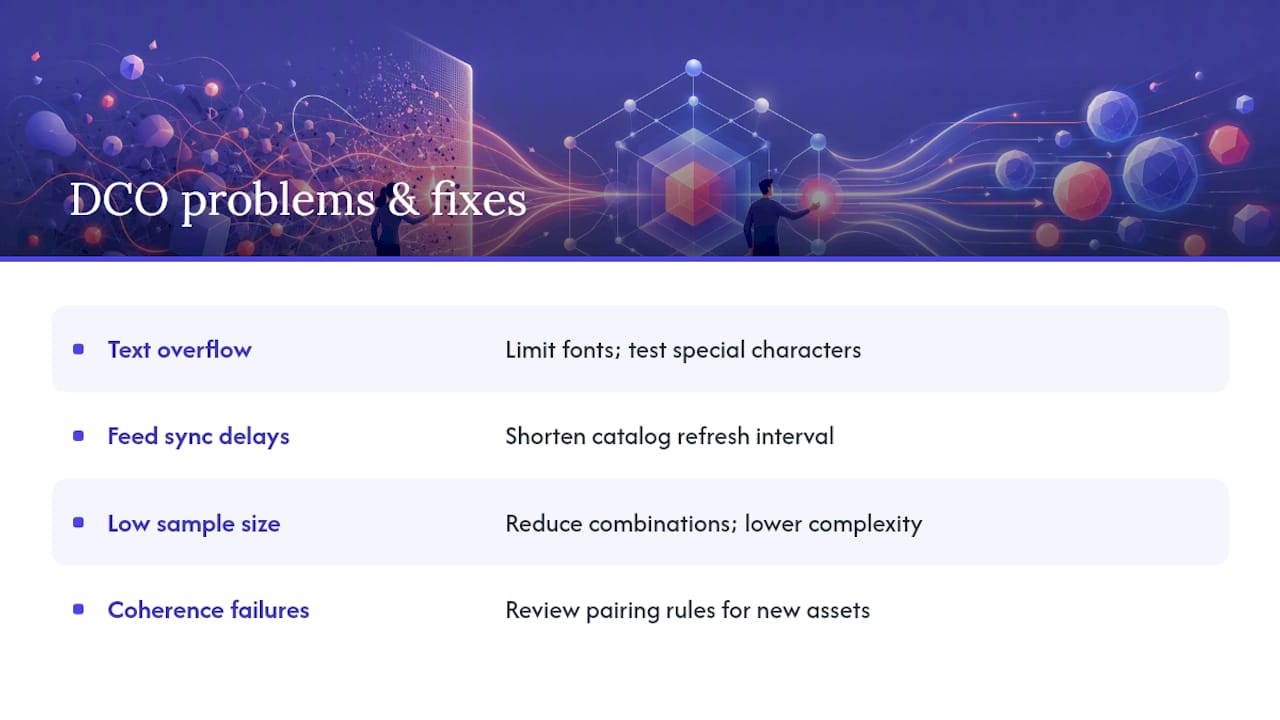
Most DCO troubleshooting falls into a handful of repeat offenders. Text overflow is the most visible one: a headline that fits a leaderboard unit spills over in a mobile banner, and testing special characters and limiting fonts across every size variant heads off a lot of this before launch.
Feed sync delays cause the second most common complaint, an ad showing a price or stock status that's already out of date. Fixing this usually comes down to shortening the refresh interval between your product catalog and your ad server rather than any change to the creative itself.
Low sample size is a subtler problem. Teams sometimes build 200 possible combinations for a campaign that only generates a few thousand impressions a day, which means no single combination ever gathers enough data to be declared a winner. The fix is to reduce combinatorial complexity until your volume can actually support statistically meaningful testing, then expand once volume grows.
Coherence failures, the dark-text-on-dark-background problem, show up most often when new template elements get added without re-running the orchestration rules that govern which pairings are eligible. Every new asset added to a template deserves a quick pairing review, not just a rendering check.
A Practical Readiness Checklist Before You Launch
Strategy and ad operations succeed together or fail together in DCO. Before greenlighting a pilot, confirm you have: clean data, a structured feed, flexible templates, a measurement plan, a holdout test design, a QA process, clear governance, and defined criteria for scaling. Run a 4 to 6 week pilot with a specific CPA or ROAS target before committing further budget.
— James
Turn Your Video Backlog Into a DCO Testing Pipeline
Jamesyee is the practical fix for the biggest bottleneck in any DCO rollout: not having enough fresh creative to feed the engine. Instead of waiting days on an agency for a handful of new cuts, Jamesyee's dedicated virtual assistants turn one raw video into multiple ad variations in 24 to 48 hours, ready to drop straight into your feed and start testing.
That speed compounds. More variants means more combinations for your DCO platform to test, faster identification of winning hooks, and a lower chance any single creative gets stale enough to drag down performance. If your team is managing the creative fatigue problem, see how the video-to-variant workflow works and check whether a pilot fits your current campaign volume.
Where to Go Deeper on DCO
For hands-on template and feed guidance, Google's rich media support documentation covers sizing and dynamic field rules directly. For a practitioner's view on orchestration over mechanical testing, the ANA event recap on DCO best practices is worth a full read.
Sources
- Google Studio — dynamic creatives and feeds (support doc)
- Dynamic Creative Optimization: Best Practices and Trends — ANA event recap