

A creative brief for ads has one job: define exactly what the ad must do, for whom, and how you'll know it worked. That means naming a single audience awareness level, one measurable KPI tied to a deadline, and one key message the creative has to prove. Everything else in the document exists to support those three decisions.
TL;DR:
- Clear, specific audience insights and proof points to eliminate revision guesswork significantly improve the relevance and speed of ad production.
- Using short, one-page briefs focused on a single message, KPI, and deadline allows faster turnaround and more variants for testing.
- Precise format constraints and explicit test variables are essential for platform-specific performance, especially in rapid TikTok testing cycles.
- A single decision-maker ownership streamline approval processes, reducing delays caused by conflicting feedback from multiple stakeholders.
- Outsourcing ad variant creation to managed teams can increase output volume and reduce CPA by enabling weekly testing with rapid turnaround times.
Table of Contents
- What Goes Into a Creative Brief for Ads
- A One-Page Template You Can Fill Out Today
- How to Adapt Briefs for Paid Social and Performance Testing
- Three Ad Brief Examples You Can Copy
- A Scoring Rubric for Reviewing Creative Against the Brief
- Common Brief Mistakes and a Pre-Production Checklist
- A Creative Lead's Workflow for One Brief, Many Variants
- Where This Format Comes From
- Where a Tight Brief Beats a Bigger Production Budget
- What Makes a Brief Actually Different From a Template
- Writing a CTA That Matches the Objective, Not the Format
- Who Owns What in the Briefing Process
- How Approval and Feedback Should Actually Work
- Why Most Creative Briefs Fail Before Production Even Starts
- When a Managed Creative Team Makes More Sense Than an In-House One
- Where to Learn More and Templates Worth Downloading
- Sources
What Goes Into a Creative Brief for Ads
Most creative briefs fail because they try to do too much. A one-page brief with a single job statement produces sharper creative than a five-page strategy deck, because ambiguity in a brief becomes ambiguity in the edit bay. Every field below should answer a specific question, not gesture at a general direction.
- Project title and single-job statement. One sentence: what should this ad make the viewer do?
- Objective with measurable KPI and timeframe. "Lower CPA on cold Meta traffic to under $18 by the end of Q2" beats "drive more conversions."
- Audience insight. Name the belief or tension the viewer holds, and their awareness level, problem-unaware, problem-aware, or product-aware. This single field decides how the ad opens.
- Single key message. One sentence, plus the proof that backs it. Vague requests like "add social proof" waste a production cycle; specify the exact quote, stat, or credential to use instead.
- Hook angle. The direction for the first one to three seconds, before any product shot or logo appears.
- Deliverables, formats, and placements. Exact specs: aspect ratio, caption safety, run time, platform.
- Mandatories and constraints. Legal disclaimers, brand lockups, claims that need substantiation.
- Timeline, owner, and budget. Who signs off, when it's due, what it costs to produce.
Skip any of these and you'll spend the review cycle asking questions the brief should have answered.
A One-Page Template You Can Fill Out Today
A brief that runs longer than a page usually signals the strategy itself is still unresolved, not that the ad needs more detail. Keep the template to eight or nine labeled fields and resist the urge to add narrative context nobody on the production side will read.
- Project/Ad name: Internal reference, dated.
- Objective + KPI: The metric and number that defines success.
- Audience insight: Who they are, what they believe, their awareness level.
- One thing to prove: The single claim the ad has to land.
- Hook direction: What happens in the first 1 to 3 seconds.
- Proof/assets: Exact quotes, stats, or footage to use, not "find some proof."
- Deliverables + specs: Format, ratio, length, placement.
- Timeline/owner/budget: Due date, decision maker, cost ceiling.
- Mandatories: Legal lines, logo rules, required disclaimers.
Filled example (9:16 paid social): Objective is a CPA reduction on TikTok cold traffic by the end of the month. Audience insight: busy parents who are problem-aware but skeptical of "miracle" claims. One thing to prove: this actually saves time, not just money. Hook: a parent visibly overwhelmed at 7 a.m., no dialogue, three seconds flat. Proof: a specific customer quote with a name and result. Deliverables: 9:16, caption-safe, 15 seconds, sound-off legible. KPI: CPA and 3-second hook rate.
Pro Tip: Keep a running "proof bank," specific quotes, stats, and footage clips already cleared, so every new brief can point to an asset instead of asking someone to go find one.
How to Adapt Briefs for Paid Social and Performance Testing
Paid social briefs need instructions a brand-awareness brief never has to include, because the feed punishes slow starts and format mismatches instantly.
- Hook timing changes by platform. TikTok creative needs to earn attention in the first 1 to 2 seconds; Meta gives you closer to 2 to 3 seconds before scroll-past.
- Define the test variable explicitly. Are you testing the hook, the offer, or the format? Brief three to five variants against one changed variable, not five unrelated concepts.
- Lock format constraints into the brief itself. Vertical 9:16, caption-safe text placement, and full legibility with sound off aren't optional notes, they're production requirements.
- Match briefing cadence to decay rate. TikTok creative often needs replacement on a weekly or biweekly cycle, while Meta assets can run longer but still benefit from frequent variant refreshes.
Two or three concrete reference ads, screenshotted with a note on why they worked, do more for a production team than a mood board ever will. Teams weighing platform-specific budget splits should also look at how Google Ads and social ads differ in testing structure before locking a brief's format list.
Three Ad Brief Examples You Can Copy
Different campaign types need different bones. Here's how the same template flexes across three common jobs.
Audience: problem-aware, skeptical of overhyped claims. Hook: a relatable failure moment in the first two seconds, no branding yet. KPI: 3-second hold rate plus CPA.
- Deliverables: three 9:16 variants, 15 to 20 seconds, caption-safe, sound-off legible.
- Proof: one named customer result, no generic testimonials.
Audience: product-aware, already considered buying. Offer: a specific discount code with an expiration date stated on the creative itself.
- Deliverables: single static image, 1:1 and 4:5 crops, clear price and CTA button copy.
- Landing expectation: the ad's offer must match the landing page headline exactly.
Product launch (multi-format). Objective: establish awareness and drive first 500 sign-ups in 10 days. Audience: mixed awareness, needs an explainer angle. Variant plan: one hero video (9:16 and 16:9 cuts) plus two static teasers testing different value props.
- Deliverables: video (30 seconds), two static variants, all with consistent brand lockup.
- Measurement window: 10 days, tracked against sign-up KPI, not impressions.
A Scoring Rubric for Reviewing Creative Against the Brief
Subjective feedback like "it feels off" wastes a revision cycle. A numeric rubric scored against the brief's original fields turns opinion into a specific fix.
Score each dimension from 1 to 10 and set a pass threshold, typically 7 out of 10 per dimension, before creative moves to media buying:
- Hook: Does it stop the scroll in the specified timeframe?
- Message clarity: Is the one key claim obvious within the first half of the ad?
- Offer alignment: Does the CTA match what the landing page actually delivers?
- Format fit: Does it meet the exact spec (ratio, caption safety, sound-off legibility)?
- Proof credibility: Is the proof specific and verifiable, not generic?
- CTA effectiveness: Is the next step obvious and singular?
Any dimension scoring below 7 becomes a specific revision note tied to that line item, not a vague "try again." That's the difference between a second draft and a fourth one.
Common Brief Mistakes and a Pre-Production Checklist
Most rework traces back to a handful of repeatable errors, not creative talent.
- Too many messages crammed into one ad. Pick one claim and cut the rest.
- No measurable KPI. "Improve performance" isn't a target; a number and date are.
- Missing exact specs. Vague format notes force the editor to guess and redo work.
- Vague mandatories. "Follow brand guidelines" means nothing without the actual lockup file attached.
- Wrong format for the platform. A horizontal cut submitted for a vertical placement is a rebrief, not a fix.
- No named owner. Without a single decision maker, approval stalls indefinitely.
Before production starts, confirm: owner is named, proof assets are collected and cleared, format specs are validated against the platform's current requirements, and legal has reviewed any claim that needs substantiation. If the objective or audience changes, rebrief. If only the execution missed the mark, iterate instead.
A Creative Lead's Workflow for One Brief, Many Variants
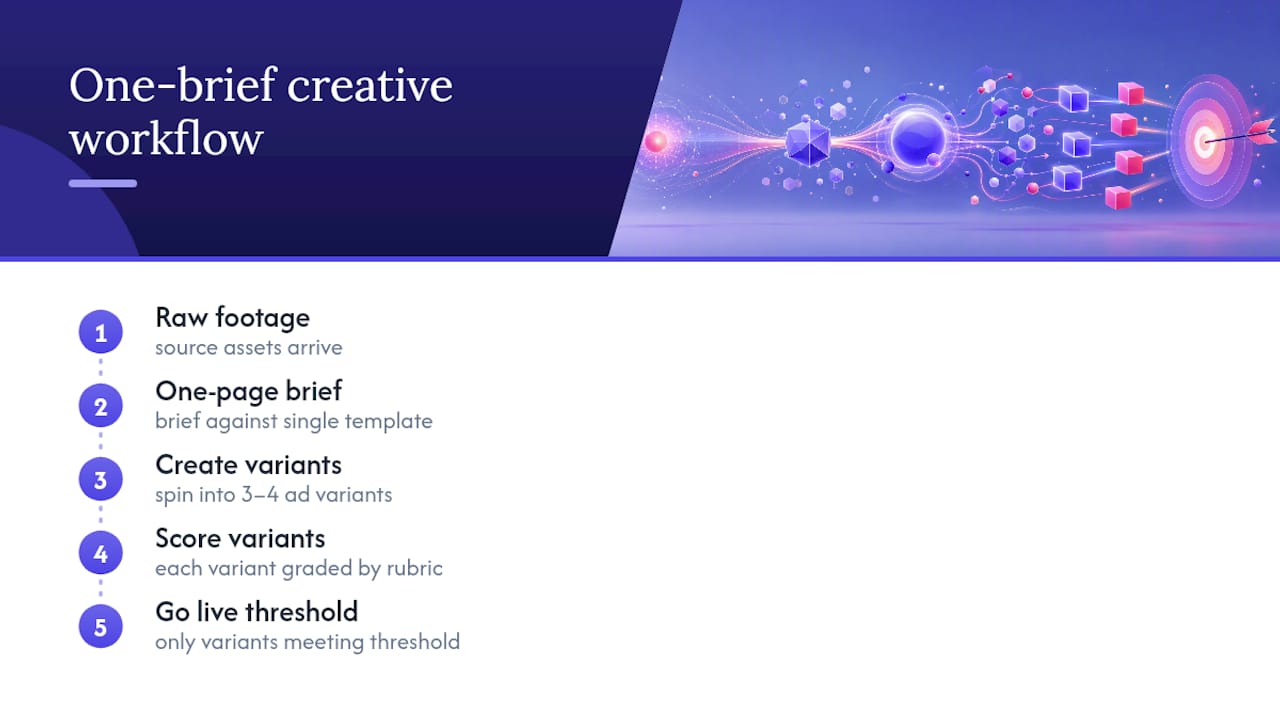
A tight brief cuts revision rounds because everyone starts from the same falsifiable claim instead of guessing at intent. The workflow that scales: raw footage comes in, gets briefed against the one-page template, spins into three or four variants, each gets scored against the rubric, and only the ones clearing threshold go live.
Where This Format Comes From
Most brief templates in circulation trace back to agency account-planning documents built for TV and print, where a single asset ran for months and revisions were expensive enough to justify a lengthy strategic document. Paid social flipped that economics. Creative now needs to turn over in days, not quarters, so the brief had to shrink to match the production cycle it serves.
That shift is recent. Ten years ago, a "creative brief" commonly meant a five-to-ten-page strategy document with mood boards, competitive teardown slides, and brand voice essays. Performance marketing teams stripped that down because none of it changed what an editor actually needed to cut a working ad. What survived, audience insight, one message, and exact specs, survived because it's the part production actually uses.
The brands that adapted fastest treated the brief as a production input rather than a strategic artifact. That distinction explains why some teams still write briefs nobody on the edit side finds useful: they never made the jump from planning document to production spec.
Where a Tight Brief Beats a Bigger Production Budget
Two teams with identical budgets can produce wildly different volumes of usable creative, and the gap usually comes down to briefing discipline, not talent or tools. A team that briefs clearly and rebriefs fast will out-produce a team burning budget on fewer, more polished assets that take weeks to greenlight.
The real competition for a marketing team's attention isn't another brand's ad copy, it's internal bottlenecks: slow approvals, unclear ownership, and briefs that require three rounds of clarifying questions before anyone touches an editing tool. Positioning in this category is less about creative quality and more about speed to a testable variant.
Teams that treat brief writing as a 20-to-60-minute focused task, rather than a multi-day strategy exercise, consistently ship more variants per week. That volume matters because paid social rewards frequency of fresh creative more than it rewards any single polished hero asset.
What Makes a Brief Actually Different From a Template
The template matters less than the discipline behind two fields: the single key message and the audience awareness level. Any brief can list deliverables and specs, that's mechanical. Few briefs force a real choice about what one claim the ad has to prove and who exactly is watching it.
That's the actual differentiator. A brief that names a specific belief the viewer holds, rather than a generic demographic, gives the editor something to react to. "Women 25 to 40" produces generic creative. "Parents who feel guilty outsourcing dinner but are tired of cooking" produces a specific opening shot.
The second differentiator is proof specificity. Naming the exact quote, stat, or footage clip to use, rather than asking someone to "find social proof," removes a full research step from production and keeps the brief's promise honest.
Writing a CTA That Matches the Objective, Not the Format
The call to action belongs in the brief as a specific instruction, not an afterthought bolted onto the deliverables field. The CTA has to match the objective stated at the top of the brief. If the KPI is sign-ups, the CTA says "Sign up," not "Learn more." If the objective is a purchase, the CTA names the action and, where possible, the urgency driving it.
Vague CTAs like "Shop now" work as a default, but a brief that specifies the exact next step, "Get your free trial," "Book a 15-minute call," "Claim your discount before Friday", removes the guesswork that causes a fourth revision round.
The CTA also needs to match what happens after the click. If the ad promises a discount, the landing page headline should state the same discount, in the same language, immediately. Briefs that separate ad copy from landing page copy as two disconnected workstreams routinely produce a mismatch that tanks conversion rate even when the ad itself performs well on click-through.
For remarketing and product-launch briefs especially, state the CTA's exact wording in the brief itself rather than leaving it to the editor's judgment. One sentence in the mandatories field, "CTA button must read 'Claim Offer,' not 'Shop Now,'", prevents an entire round of feedback.
Who Owns What in the Briefing Process
A brief with no named owner stalls, because nobody knows who has final say when feedback conflicts. Every brief needs a single decision maker listed by name, not by title or department.
Typical roles on a performance creative team: the marketer or media buyer supplies the objective, KPI, and audience insight, since they own the data. The creative lead or editor turns that insight into hook direction and format execution. Legal or compliance reviews mandatories before production starts, not after a draft is cut. A single stakeholder, usually the media buyer or marketing lead, has final approval authority and is the one name listed in the brief's owner field.
Ambiguity here causes more delay than any creative disagreement. When two people believe they have approval authority, revisions ping-pong between conflicting notes and nobody ships. Naming one owner up front, even if that person consults others before deciding, collapses that loop into a single feedback channel.
For teams working with outside editors or virtual assistants handling variant production, this ownership clarity matters even more. The person reviewing output needs full authority to approve or reject against the brief's rubric, without needing to loop in three other stakeholders for every round.
How Approval and Feedback Should Actually Work
Feedback that isn't tied to the brief's original fields turns into opinion warfare, "I don't love this," "can we make it feel more premium," notes that don't map to a specific fix. The rubric exists to prevent exactly this failure mode.
A workable approval loop looks like this: creative comes in, gets scored against the six rubric dimensions, and any dimension below the pass threshold generates one specific, written revision note tied to that field. "Hook scored 5, doesn't establish tension in the first two seconds" is actionable. "Doesn't feel right" is not.
Approval should happen in a single round wherever possible. If a variant clears every rubric dimension at or above threshold, it goes to media buying. If it fails on one or two dimensions, it gets a targeted rebrief on just those fields, not a full restart. Reserving a full rebrief for cases where the objective or audience itself was wrong, not for a hook that just needs another cut, keeps the loop fast.
Set a service-level expectation up front: how many hours a reviewer has to score and respond once a variant lands. Teams that let approval sit for days lose the speed advantage that a tight brief was supposed to buy them in the first place.
Why Most Creative Briefs Fail Before Production Even Starts
The conventional advice on creative briefs treats them as strategic documents first and production instructions second. That gets the order backwards for anyone running paid social. A brief's real job is to remove every decision an editor would otherwise have to guess at, and strategy that doesn't translate into a specific hook, format, or proof point is strategy the production team can't use.
The most overrated element in most brief templates is the mood board or tone-of-voice essay. It feels thorough and photographs well in a deck, but it rarely changes what actually gets cut. What changes output is naming the exact proof to use and the exact awareness level of the viewer, because those two fields eliminate the two biggest sources of revision: wrong message, wrong audience assumption.
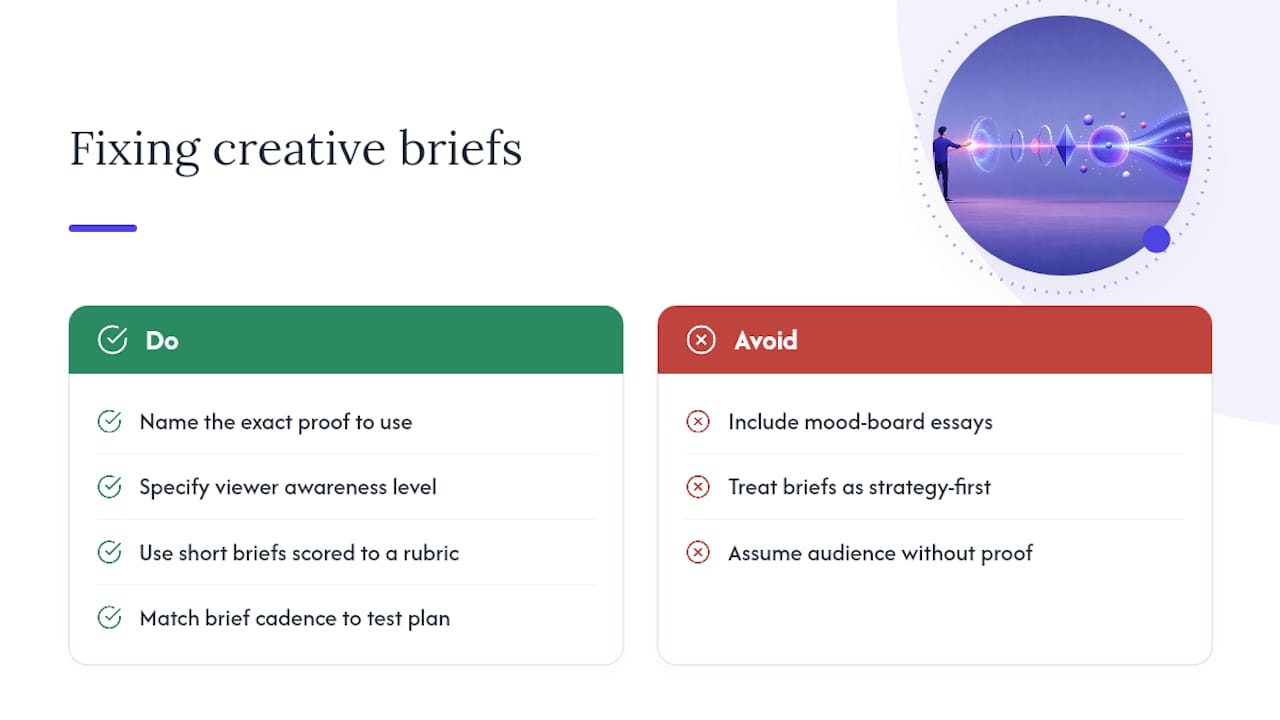
What the research actually supports is unglamorous: shorter briefs, scored against a fixed rubric, briefed at the same cadence as your testing plan, outperform longer strategic documents almost every time. If you're rebriefing weekly for TikTok and monthly for Meta, your brief template should already reflect that split before a single asset gets shot.
Prioritize the single key message and the proof bank first. Everything else, timeline, budget, stakeholder list, is administrative scaffolding around those two decisions.
— James
When a Managed Creative Team Makes More Sense Than an In-House One
A brief is only as useful as the team turning it into finished variants, and that's where a lot of internal teams hit a wall. If your bottleneck isn't strategy but production, limited editing bandwidth, slow turnaround on a growing testing calendar, that's the signal to bring in managed help rather than write a better brief for a team that's already at capacity.
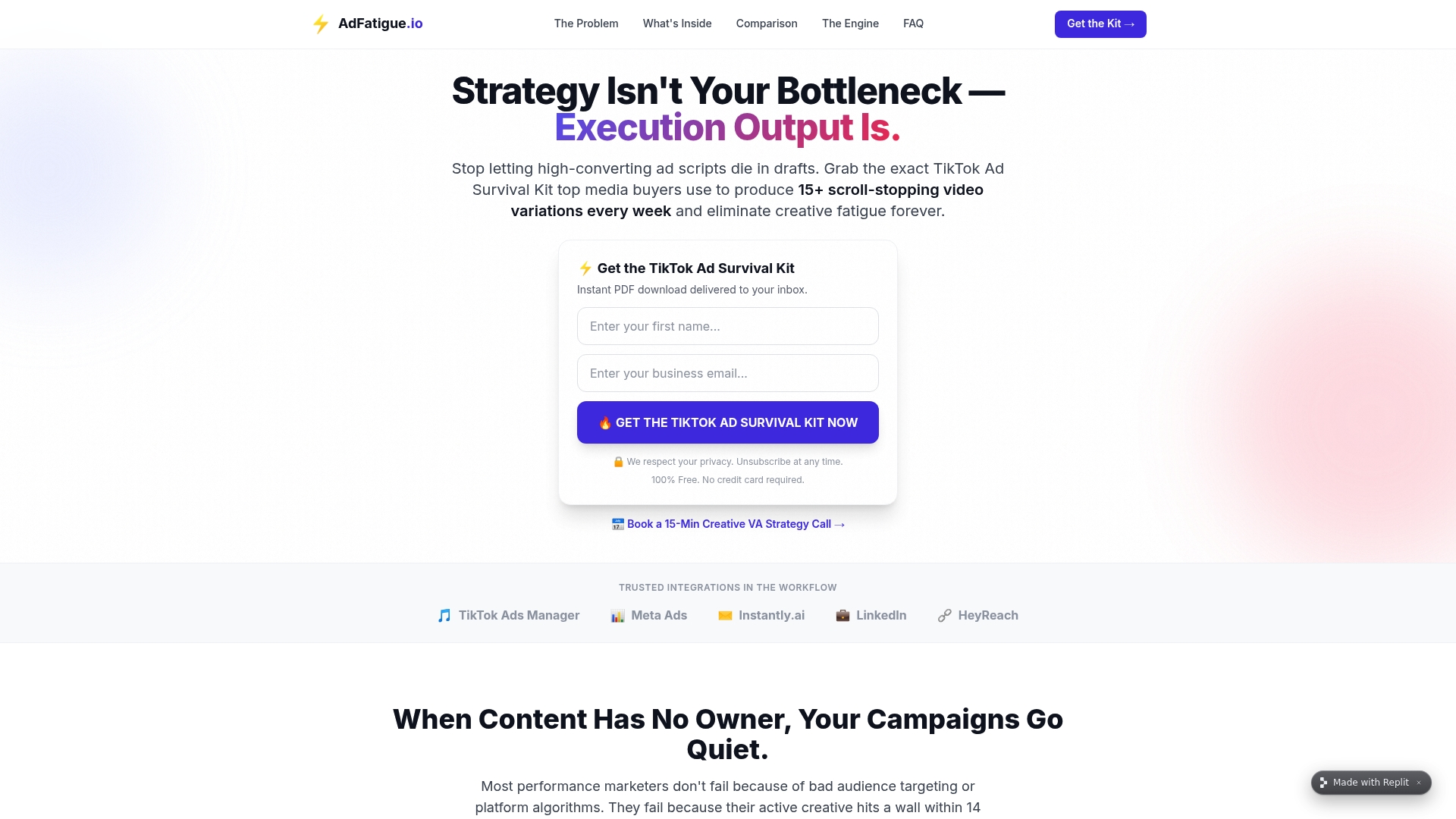
A managed team runs the brief-to-variant pipeline through dedicated virtual assistants who take one raw video and turn it into multiple ad-ready cuts, typically within 24 to 48 hours, instead of the days a traditional agency takes to deliver a handful. Teams using this approach have seen CPA drop by 31%, largely because fresh variants keep pace with ad fatigue instead of lagging behind it. You still write the brief; the managed team handles editing, formatting, and multi-cut turnaround so your creative lead can focus on strategy instead of timelines. If your testing calendar needs weekly hooks and your internal team can't keep up, check how the Wing workflow handles ad fatigue and see what fast turnaround times would do to your variant output this month.
Where to Learn More and Templates Worth Downloading
For deeper reading beyond this brief structure, the Asana creative brief guide and HubSpot's template cover standard fields well. For format specs, check Wrike's breakdown and measurement differences via Admoon's analytics comparison.
Sources
- How to write a creative brief that gets you ads worth running
- Creative Brief for Advertising: Template & Guide (2026)
- Creative Brief: How to Write One That Produces Better Ads | rule1