

Ad naming conventions are the fixed, fielded pattern you use to label every campaign, ad set, and creative so a machine and a human can both read it the same way. The canonical format looks like this: BRAND-GEO-LANG-AUD-FUNNEL-OFFER-CHANNEL-FORMAT-OBJECTIVE-YYYYMM-V#, giving you something like ACME-US-EN-RET-MOF-BF25-META-VID-CONV-202601-V2. Get this right and your UTMs, your BI dashboards, and your creative fatigue diagnosis all sync up automatically.
TL;DR:
- Accurate implementation of the canonical naming pattern ensures campaigns are easily grouped and analyzed, with each field limited to predefined values to prevent drift.
- Regex validation at intake and pre-launch thresholds prevents inconsistent naming that could break attribution, BI reporting, and platform rollups.
- Enforcing separate fields for each component and storing them as individual columns allows flexible renaming and maintains historical integrity.
- For each platform, including specific campaign type or creative context in the name improves ad management, but names should remain short and clear.
- Controlling naming expansion by limiting field options and appointing ownership prevents decay of the system as creative volume grows.
Table of Contents
- Why Ad Naming Conventions Matter for Performance Marketing
- The Canonical Naming Pattern: Fields, Codes, and a Regex to Enforce It
- Platform-Specific Naming Notes for Meta, Google, and TikTok
- How to Implement and Enforce Naming Rules Across Teams
- Copy-Paste Templates and a Naming QA Checklist
- Scaling Naming Conventions as Creative Volume Grows
- When Naming Is Solved but Creative Output Isn't
- Sources
Why Ad Naming Conventions Matter for Performance Marketing
Three terms get used interchangeably that shouldn't be. A taxonomy is the hierarchy of fields you track (geo, audience, funnel stage, and so on). A naming convention is the rule set that turns that taxonomy into a consistent, machine-readable label. A campaign name is just one instance of that rule applied to one specific campaign. Miss this distinction and teams end up building templates without an underlying structure, which is why so many naming systems fall apart after six months.
Sloppy names break more than aesthetics. They break attribution models that rely on pattern matching, they break automated rollups in your BI tool, and they turn every reporting request into a manual cleanup job.
The usual culprits:
- Inconsistent delimiters (underscores in one campaign, hyphens in the next)
- Mixed case with no rule (CamelCase here, lowercase there)
- Spaces inside names that break URL parameters and CSV exports
- Free-text fields where a picklist should live, producing five spellings of the same audience segment
The Canonical Naming Pattern: Fields, Codes, and a Regex to Enforce It
Order your fields broad to specific. That single choice lets alphabetical sorting in Meta Ads Manager or Google Ads group related campaigns together without any manual tagging, since names sharing a prefix stack next to each other automatically.
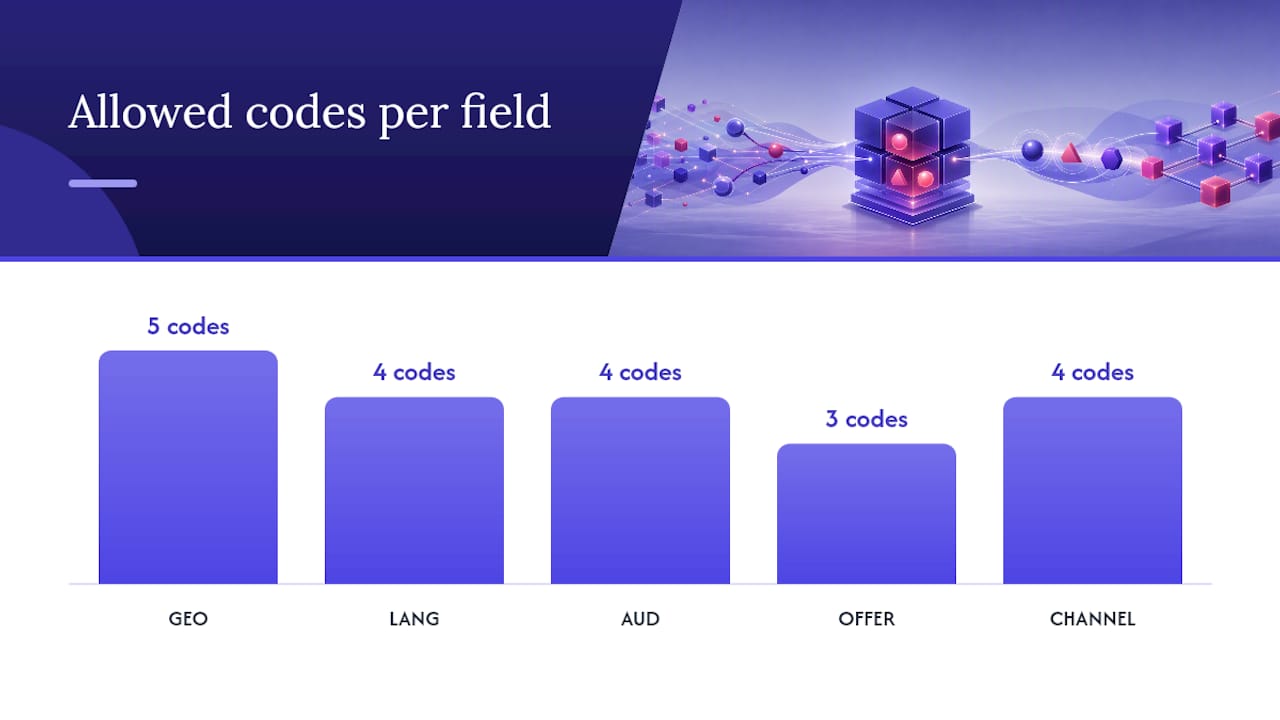
The pattern to adopt: BRAND-GEO-LANG-AUD-FUNNEL-OFFER-CHANNEL-FORMAT-OBJECTIVE-YYYYMM-V#. Each field carries a short, fixed set of allowed values so nobody invents a new code mid-quarter.
| Field | Purpose | Sample allowed values |
|---|---|---|
| GEO | Market or country | US, UK, CA, EU, APAC |
| LANG | Creative language | EN, ES, FR, DE |
| AUD | Audience segment | NEW, RET (retargeting), LAL (lookalike), VIP |
| FUNNEL | Funnel stage | TOF, MOF, BOF |
| OFFER | Promo or SKU code | BF25, SUM25, TRIAL |
| CHANNEL | Platform | META, GOOG, TIK, LI |
| FORMAT | Creative type | VID, STAT, CAR (carousel), UGC |
| OBJECTIVE | Campaign goal | CONV, TRAF, LEAD, AWR |
Two clean examples: ACME-US-EN-RET-BOF-BF25-META-VID-CONV-202601-V2 and ACME-UK-EN-NEW-TOF-TRIAL-GOOG-STAT-LEAD-202602-V1. A poor example looks like Acme Retargeting Video Campaign Jan!! — no delimiters, no fixed fields, and it will not survive a CSV export.
Enforce the pattern with a regex at intake, something close to ^[A-Z]+-[A-Z]{2}-[A-Z]{2}-[A-Z]{2,3}-[A-Z]{3}-[A-Z0-9]+-[A-Z]+-[A-Z]+-[A-Z]+-\d{6}-V\d+$. Reject anything that fails before it ever hits the ad platform.
Pro Tip: Store each field as its own column in your CRM or media plan and assemble the display name at render time. That way you can rename a field's display format later without breaking historical records.
Platform-Specific Naming Notes for Meta, Google, and TikTok
The canonical pattern holds across platforms, but each one has quirks worth building into your dictionary rather than fighting.
- Meta: campaign-level names should carry the objective (CONV, TRAF) and note the creative subtype (VID vs. STAT) at the ad level. When mapping to
utm_source, decide once whether you use "FB" or "META" as your token and never mix the two, since split values silently fracture your rollups. - Google Ads: for Performance Max and Search, include the campaign type in the name itself. Bid strategy (tCPA, tROAS) matters enough for optimization that it's worth a short code in the campaign field, since Google's own UI won't surface it at a glance the way ad set names do on Meta.
- TikTok: creative analysis lives at the ad level, so include hook type, a creator ID, and a flag for Spark Ads. TikTok's format churns faster than the other two platforms, and naming templates built for each channel show why the ad-level fields need to carry more creative context here than on Meta or Google.
As a rule, keep GEO, LANG, and FUNNEL at the campaign level, push AUD and OFFER to the ad set or ad group, and reserve FORMAT, hook, and creator codes for the individual ad.
How to Implement and Enforce Naming Rules Across Teams
- Build an intake form with picklists, not free text, for every field in your dictionary. Render the assembled name automatically once fields are selected, but store each field as a separate value.
- Add regex validation at two checkpoints: once at intake, once at QA before launch. Anything that doesn't match the pattern gets bounced back before it touches ad spend.
- Map fields to UTMs directly.
utm_campaignshould mirror the full campaign name,utm_contentshould carry the creative or ad identifier, andutm_source/utm_mediumshould pull from your CHANNEL and FORMAT fields so platform data lines up with your analytics without manual reconciliation. - Feed the same fields into BI dimensions so a rollup by GEO or FUNNEL works the same in your dashboard as it does in the ad platform.
- Assign an owner. Someone on the team needs final say on what gets added to the dictionary and what gets retired.
- Publish the dictionary somewhere every media buyer can see it before they launch, not after.
- Review quarterly. Start with a small set of six to twelve values per field and archive tokens nobody has used in two quarters.
One tradeoff worth flagging: some teams pass the campaign ID rather than the full name into tracking URLs to avoid exposing strategy details externally, which is worth considering if your naming reveals pricing or offer structure to competitors watching your URLs.
Pro Tip: Run a monthly export of every live campaign name through your regex validator outside the intake flow. Names get edited manually more often than teams admit, and drift creeps in fastest right after a rebrand or agency handoff.
Copy-Paste Templates and a Naming QA Checklist
Three quick templates to drop into your next campaign build:
- Campaign:
ACME-US-EN-RET-BOF-BF25-META-CONV-202601-V1 - Ad Set / Ad Group:
NEW-LAL3PCT-25to34-META-CONV - Ad:
VID-UGC-HOOK03-CREATOR12-SPARK-V2
Mapped to UTMs, that campaign feeds utm_campaign=ACME-US-EN-RET-BOF-BF25-META-CONV-202601-V1 and utm_content=VID-UGC-HOOK03-CREATOR12-SPARK-V2, so a BI query on hook or creator pulls clean every time.
Scaling Naming Conventions as Creative Volume Grows
The mistake most growth teams make is adding a new field every time a new use case shows up. A dictionary with sixty allowed values per field isn't rigor, it's decay. Keep the field list short and controlled until you have a real, recurring reason to expand it, and retire tokens nobody has touched in two review cycles.
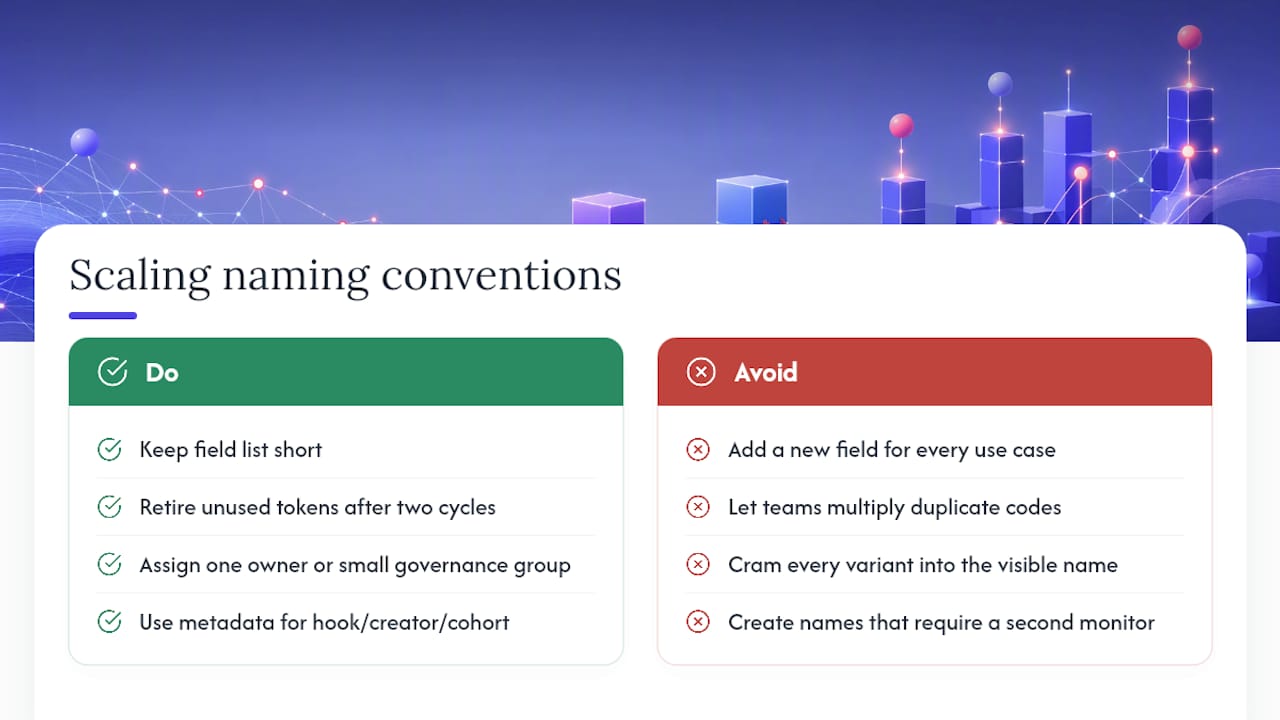
Ownership matters more than the schema itself. One person or a small governance group should sign off on every new value, with a quarterly review as the natural cadence, since anything looser lets duplicate codes multiply across teams within weeks.
When creative volume explodes, which happens fast once a team starts testing dozens of hooks a week, resist the urge to cram every variant detail into the name itself. Push hook number, creator, and test cohort into metadata fields your BI tool can query, and keep the visible name short enough to scan in a dropdown. A name that needs a second monitor to read has already failed its job.
— James
When Naming Is Solved but Creative Output Isn't
A tight naming system fixes your reporting. It doesn't fix a stalled creative pipeline, and that's a separate bottleneck entirely. If your naming dictionary is locked but your team is still waiting days for a new batch of ad variants, the constraint has shifted from structure to throughput.
A managed service with dedicated virtual assistants can help turn one raw video into multiple ready-to-launch ad variations with rapid turnaround times, so your naming pipeline never sits idle waiting on new creative to slot into it. If your naming system is solid and creative velocity is the real gap, check out the current turnaround setup and see whether a managed pipeline fits your next sprint of ad variants.
Sources
- How do I create campaign naming conventions that scale?
- Master Marketing Campaign Naming Conventions: The Real Guide
- Free Campaign Naming Convention Generator — Meta, Google & TikTok Ads | rule1