
An effective ad hook is a short opening line or shot that combines relevance with curiosity or a pattern interrupt, then promises a payoff the viewer wants to see resolved. Test demonstration, curiosity/pattern interrupt, and social proof first. They cover the widest range of products and consistently outperform generic openers. On short-form video, you have roughly 2 to 3 seconds before someone's thumb decides your fate.
TL;DR:
- Hooks that include specific numbers or claims tend to perform better because they provide clear proof points and reduce ambiguity.
- Pattern interrupts and social proof are highly effective, especially when they quickly disprove common assumptions or offer authoritative validation.
- Testing multiple hook variations from the same footage with fixed offer and audience parameters reveals which opening maximizes retention and conversion efficiently.
- Vertical video formats with captions and early branding improve engagement across TikTok, Shorts, and Reels, especially when hooks are tailored to platform behaviors.
- Outsourcing rapid production of multiple hook variants can significantly accelerate testing cycles and combat creative fatigue in ongoing campaigns.
Table of Contents
- Ad Hook Examples by Category (With Templates You Can Adapt Today)
- Platform Rules That Change How a Hook Performs
- How to Test Hooks Without Wasting Your Media Budget
- Turning a Template Into a Hook That Won't Get Flagged or Fall Flat
- A Quick Priority Guide for Performance Teams
- A Faster Route to Weekly Hook Variants
- Sources
- FAQ
Ad Hook Examples by Category (With Templates You Can Adapt Today)
Every strong hook works because it triggers a specific psychological reaction, not because the copy sounds clever. Below are seven categories worth testing, each with adaptable lines and a note on where they tend to perform best.
Curiosity gap. These hooks open a loop the viewer needs closed. "Don't buy [product category] until you watch this." "The one setting nobody tells you to check before you [outcome]." They work because unresolved questions create mild discomfort the brain wants to fix. Keep the gap specific. A vague "you won't believe this" line tests worse than one that names the comparison or metric involved. Use these when your product has a genuine counterintuitive angle. A cheaper option, a hidden defect in the category, a mistake most buyers make.
Pattern interrupts. Self-disqualifying statements and contrarian openers break the scroll rhythm because they don't sound like an ad. "If you're happy paying full price for X, skip this." "Everything you've heard about [category] is backwards." These rely on surprise rather than curiosity, so the payoff needs to arrive fast, ideally within the next two shots.
Demonstration hooks. Visual-first openings that show the product working, or failing, before any words land. Before and after transformations, stress tests, unboxing reveals. These need almost no copy because the footage carries the claim. "Watch what happens when I [action] with this."
Social proof and authority. Numbers and reversals build instant credibility. "12,000 people are on the waitlist for this." "A dermatologist told me to stop using [common product], here's why." Authority hooks work particularly well when a category expert appears to contradict conventional advice, since that combines social proof with a pattern interrupt.
Urgency and loss aversion. "This restock sells out in under six hours every time." "Most people lose [specific thing] doing this wrong." Loss framing tends to outperform gain framing when the stakes feel personal. Keep timeframes concrete rather than "limited time," which reads as filler.
Direct address and identity callouts. Naming the viewer's specific situation filters for relevance instantly. "If you have curly hair and hate frizz by noon, this is for you." "Small business owners who are tired of doing their own books, watch this."
UGC and authentic moments. Unscripted-feeling openings, a customer talking straight to camera, a founder answering a tough question, perform well because they read as testimony rather than advertising. Prompt these by asking creators to react honestly to a specific claim rather than reciting a script. According to Later's testing guidance, a hook that works raw as UGC on TikTok often needs a tighter demonstration-first edit before it performs on YouTube Shorts.
Practitioner libraries consistently point to these same categories, curiosity gap, pattern interrupt, direct pain point, demonstration, social proof, urgency, identity, and UGC, as the most testable structures across product types. Treat them as scaffolding, not scripts to copy word for word.
Platform Rules That Change How a Hook Performs
The category matters less than the execution once you factor in platform behavior. Google's research on app video ads found that successful creative averages two or more cut changes in the first five seconds, because static shots lose viewers before the message lands. YouTube's creative playbook echoes this, recommending an emerging story arc with the product or brand introduced within the first five seconds, fast pacing, and multiple shots early on.
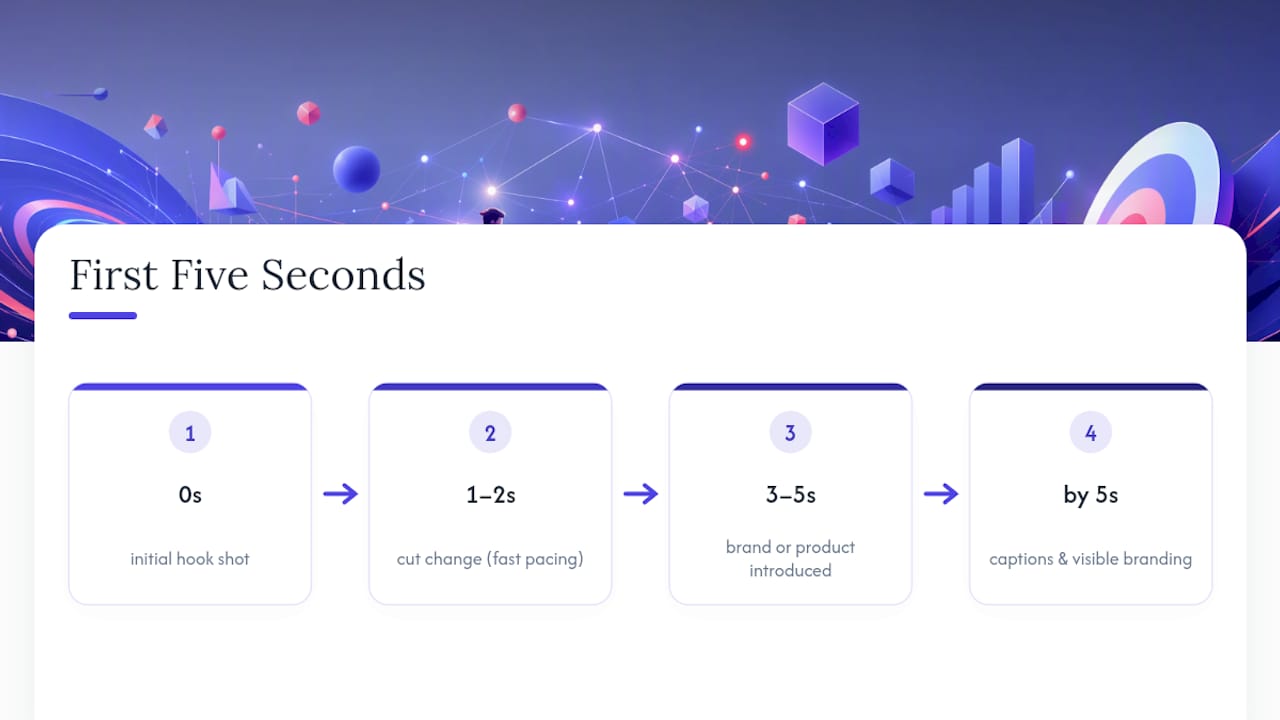
Orientation matters too. Vertical works for TikTok, Reels, and Shorts, but repurposing a horizontal asset without reframing usually buries the hook in dead space at the edges. Most viewers watch with sound off, so captions and on-screen text need to carry the hook's meaning independent of narration, with branding visible early rather than saved for the end.
Platform context shifts which category wins. TikTok tends to reward story and UGC-style pattern interrupts. YouTube Shorts leans toward how-to and demonstration openings. LinkedIn audiences respond better to contrarian or insight-driven hooks than to anything that looks like a consumer ad. This breakdown of TikTok-specific hooks is worth a look if you're building for that platform specifically.
How to Test Hooks Without Wasting Your Media Budget
Testing hooks well means isolating one variable while everything else stays fixed.
- Shoot or edit multiple openings from the same raw footage rather than producing entirely separate ads.
- Hold the body, offer, audience, and call to action constant across every variant.
- Measure hook rate, meaning retention through the first two to three seconds, alongside downstream conversion metrics like click-through rate, add-to-cart rate, or cost per acquisition.
- Let a variant run until it reaches a sample size large enough that the difference in performance is unlikely to be noise, not just until it "feels" like a winner.
- Group results by theme or style rather than treating each variant as a one-off, then scale the pattern, not just the single clip.
Google's own experimentation guidance frames this the same way: vary the creative theme, not the offer, and judge success by retention plus conversion together, never by views alone.
Pro Tip: A hook that wins on retention but loses on cost per acquisition usually means it attracted the wrong audience, not that the hook itself failed. Check who clicked before you kill the creative.
Turning a Template Into a Hook That Won't Get Flagged or Fall Flat
A generic template only becomes a working ad hook once you attach real numbers and make sure the promise matches what follows.
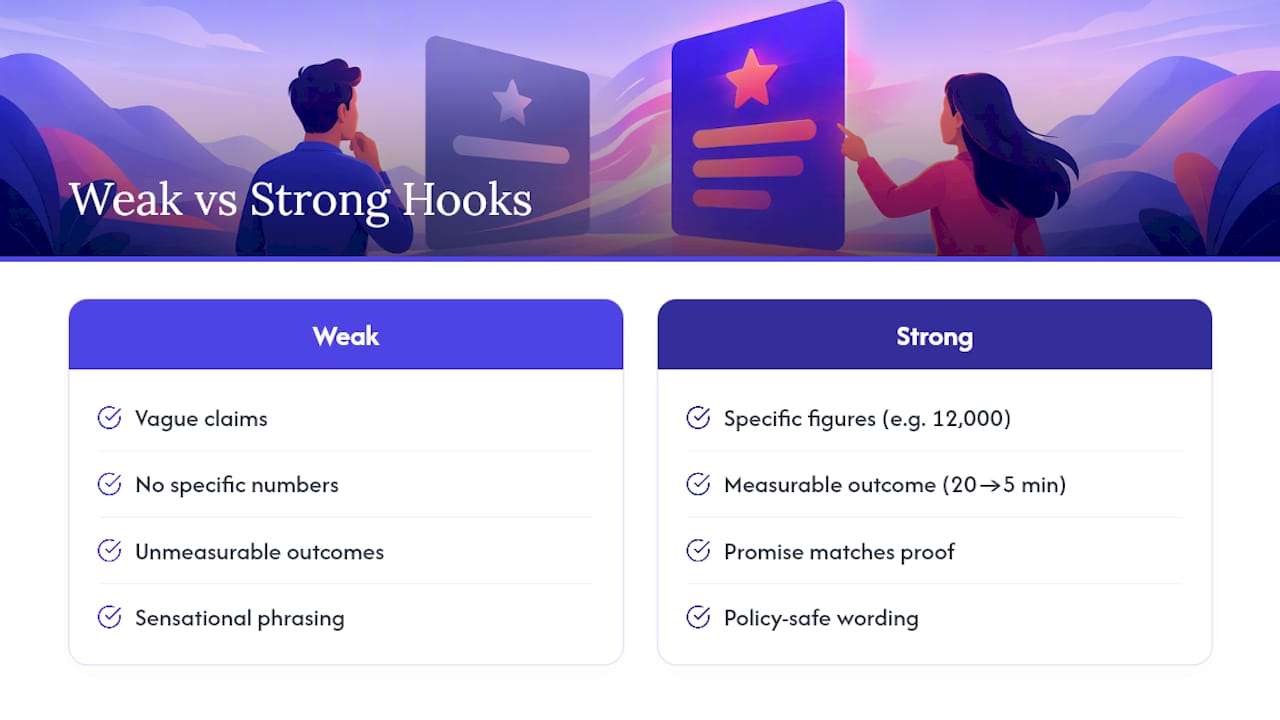
Weak: "Thousands trust us." Strong: "12,000 people are on our waitlist right now," a specific figure the ad body should be able to substantiate if asked. Weak: "This will change your life." Strong: "This cut my morning routine from 20 minutes to 5," a claim tied to a measurable outcome. Run every hook through one question: does the promise in the first three seconds match the proof shown by the end of the ad? A demonstration hook that opens with a dramatic result but never explains how creates the exact mismatch that tanks conversion even when the hook rate looks great.
Keep on-screen text under 20% of the visual frame and avoid sensationalized phrasing that platform policies restrict, since unsupported superlatives get creative rejected before it ever runs.
A Quick Priority Guide for Performance Teams
Volume beats polish in the early stage of testing. Ten rough openings cut from the same raw footage will teach you more in a week than one perfectly produced ad you're afraid to touch. Once a hook pattern proves itself on retention and conversion, that's the moment to invest in tighter editing, not before.
Outsource the cutting once your internal team is spending more time editing than strategizing. That's usually the signal that a managed creative partner will move faster than adding headcount. Keep brand tone consistent across variants even while testing aggressively. Short-term wins that damage long-term recognition aren't really wins.
— James
A Faster Route to Weekly Hook Variants
Building the library above by hand, shooting variants, cutting captions, checking platform specs, works, but it eats the same hours performance marketers need for strategy and media buying. Jamesyee's dedicated virtual assistants take one piece of raw footage and turn it into multiple ready-to-test ad variations in 24 to 48 hours, instead of the days a traditional agency typically needs to deliver a handful of edits. That turnaround matters most when creative fatigue is already eating into performance and your internal team doesn't have bandwidth to cut ten hook variants this week.
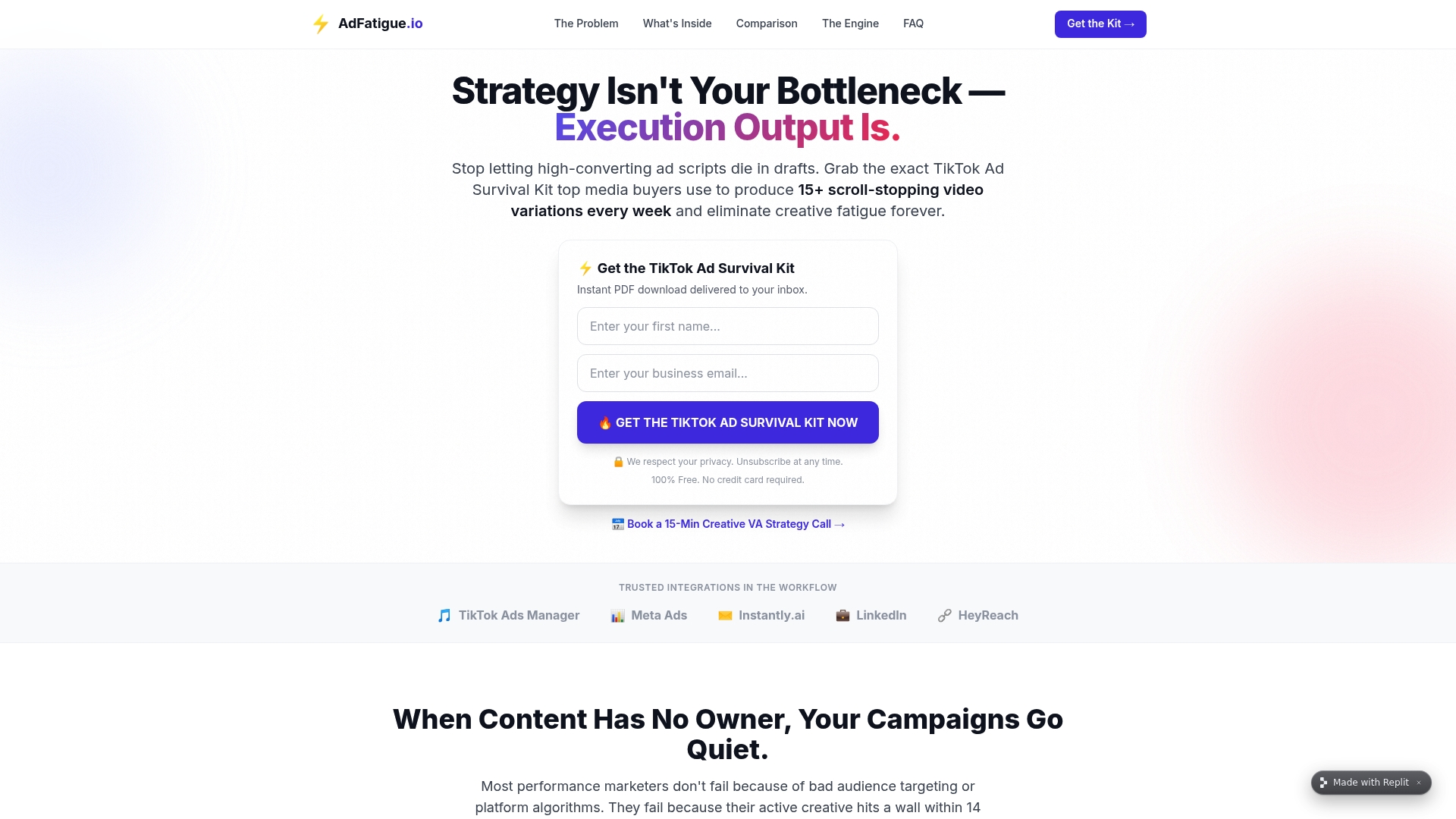
This approach fits teams running constant TikTok, Meta, or LinkedIn campaigns who need fresh hooks weekly rather than monthly. If ad fatigue is driving your cost per acquisition up, see how the weekly hook production system works and check what a batch of new variants would look like for your next campaign.
Sources
- Make better creative assets for App campaigns - Google Ads Help
- A playbook for building effective creative on YouTube
FAQ
What Is a Good Hook for an Ad?
A good hook combines relevance to a specific viewer with either curiosity or a pattern interrupt, and it delivers on that promise within the first few seconds. The strongest hooks are clear before they're clever, meaning the payoff is recognizable instantly rather than buried in cleverness the viewer has to decode.
What Are Some Good Hook Examples?
Strong examples include demonstration openers like showing a before-and-after result, curiosity lines like "don't buy this until you see what it does," and social proof statements naming a specific number of customers or a waitlist size. Direct address lines that call out a specific audience, like a job title or a shared frustration, also perform consistently well because they filter for relevance in the first frame.
Can You Give Examples of Advertisements That Use These Hooks?
Ads that open with a self-disqualifying statement ("skip this if you're happy paying full price") use a pattern interrupt, while ads that open with a customer talking straight to camera about a specific result use UGC and social proof together. Ads that cut between two shots in the first five seconds, one problem, one solution, follow the pacing pattern YouTube's creative playbook recommends for early retention.
What Makes a Hook Catchy Instead of Just Loud?
A catchy hook is specific, not just energetic. It names a real timeframe, comparison, or number instead of relying on vague excitement, since a specific claim is also what makes a hook testable afterward. Teams that struggle to produce enough catchy variants on their own often turn to a managed creative service that can generate a full batch of tested openings from one video shoot within a couple of days.