

Ad concept testing means showing a raw ad idea, script, or storyboard to real people before you shoot, edit, or spend a dollar on media, so you can see which concepts land and which ones die quietly in a room full of skeptical target buyers. The core purpose is to catch weak ideas while they're still cheap to kill. Production and media spend are the two most expensive ways to find out a concept doesn't work.
If you take one action from this article, make it this: before you greenlight full production, run a comparative test of two or three concepts with your actual target audience, not your internal team.
That single step catches most of the expensive mistakes:
- Concepts that confuse your product category
- Ideas your team loves but your buyers find irrelevant
- Emotional hooks that fall flat outside the conference room
- Messaging that fails to connect to your brand at all
Key Takeaways
Ad concept testing works when teams test two to three concepts on 150 to 200 matched respondents per concept, measure multiple dimensions, and confirm results with a live A/B test before scaling spend.
| Point | Details |
|---|---|
| Test before production | Validate scripts and storyboards with 2 to 3 concepts before committing to full production or media spend. |
| Match method to stage | Use qualitative or synthetic reads early for strategy, quant surveys later for execution details. |
| Measure multiple dimensions | Score comprehension, brand linkage, emotion, relevance, and intent separately to avoid false positives. |
| Size the sample properly | Aim for roughly 150 to 200 qualified respondents per concept for directional reliability. |
| Confirm with live data | Treat synthetic and survey scores as a hypothesis, and verify winners with a live A/B test tied to conversions. |
Table of Contents
- What Ad Concept Testing Actually Covers
- Why Ad Concept Testing Pays for Itself
- When to Test: Matching the Method to the Stage
- Choosing a Method: Surveys, Focus Groups, Software, AI, and A/B Tests
- What to Measure: Dimensions and Sample Survey Questions
- How to Design a Test That Actually Holds Up
- Turning Scores Into Decisions
- Sharper Tools: MaxDiff, Card Sorts, and Synthetic Screening
- A 6-Week Ad Concept Testing Roadmap
- Where Wing Assistant Fits Into a Faster Testing Cycle
- What Actually Matters in Ad Concept Testing
- Sources
What Ad Concept Testing Actually Covers
Ad concept testing happens before a camera rolls. You're testing scripts, storyboards, animatics, or rough cuts, not finished ads. Post-launch analytics, by contrast, tells you what happened after you already spent the money. Concept testing is the insurance policy; post-launch measurement is the autopsy.
The distinction matters because of what's called stimulus fidelity. A stick-figure storyboard and a polished animatic will get you different answers from the same audience, sometimes wildly different ones. Rough sketches are fine for testing a strategic direction (does this angle resonate at all?), but if you're deciding between two finished scripts with different jokes or different emotional beats, you need assets close enough to final that respondents react to the actual creative choice, not to the fact that one looks more finished than the other.
What you can still fix depends entirely on when you test:
- Concept stage: you can change the entire strategic angle, the core message, even the product benefit you're leading with
- Storyboard/script stage: you can rewrite dialogue, reorder beats, swap the hook
- Animatic/rough cut stage: you can trim pacing, adjust music, tweak the call to action, but the strategic bones are set
- Finished ad: you're now in optimization territory, not concept validation
Testing too late means you've locked in decisions that were actually cheap to change three weeks earlier. Testing too early with the wrong fidelity means you get feedback on production quality instead of the idea itself.
Why Ad Concept Testing Pays for Itself
The business case is simple: it's far cheaper to kill a bad concept in a Google Doc than in a finished $30,000 video. Every dollar spent on production and media against a concept that never had a shot is money you can't get back, and the opportunity cost compounds when that budget could have gone toward a concept that actually converts.
Three concrete benefits show up again and again once teams build concept testing into their process:
- Fewer wasted production cycles, because weak scripts get cut before storyboards turn into full shoots
- Stronger brand linkage, since testing surfaces whether people actually connect the ad to your brand or just remember a funny scene
- Defensible creative decisions, because you're choosing based on audience data instead of whoever argued loudest in the creative review
Statistic to watch: teams that run structured concept validation before launch consistently report better downstream performance, and brands using rapid iterative creative production report a 31% reduction in cost per acquisition tied directly to fresher, more frequently tested ad variations. Fatigue-driven CPA creep is one of the most common reasons performance marketers start testing concepts in the first place.
Concept testing also changes the internal conversation. Instead of "I think this ad is funnier," you get "concept B scored 18 points higher on purchase intent among our core segment." That shift alone reduces the political friction that kills good ideas and greenlights weak ones.
When to Test: Matching the Method to the Stage
Testing at the wrong moment wastes the exercise. Match your method to what's still changeable.
- Concept or storyboard stage. This is where you test strategic direction: which angle, which core promise, which emotional register. Use quick qualitative reads or a synthetic pre-test here. You want breadth, not precision, because you're deciding between fundamentally different ideas.
- Animatic or rough cut stage. Now you're testing execution, not strategy. Pacing, hook strength in the first three seconds, whether the call to action registers. A structured quant survey works well here because you're comparing specific, finished-enough variants.
- Post-launch. This isn't a substitute for pre-launch testing, it's confirmation and learning. You compare what people said they'd do against what they actually did, and you feed that gap back into your next round of concept development.
Attitudes toward categories and messages shift over time, so treat concept testing as a recurring checkpoint rather than a one-time gate you clear and forget. A concept that tested well eighteen months ago may not test well today if your category's competitive landscape has moved.
Choosing a Method: Surveys, Focus Groups, Software, AI, and A/B Tests
There's no single best method for ad concept testing. Each one trades off speed, depth, cost, and how confident you can be in the result. Here's how the main options actually compare in practice.
Quantitative surveys are the workhorse. You show respondents each concept, ask a structured set of questions, and get numbers you can compare across segments. Surveys scale well, they're relatively cheap per respondent, and they produce data you can defend in a stakeholder meeting. The catch is question design. A poorly worded scale question or a leading prompt will quietly corrupt your entire dataset, and most teams don't realize it until the results contradict everything they expected.
Qualitative interviews and focus groups get you somewhere surveys can't: the "why" behind a reaction. A focus group moderator can follow up on a confused expression or a hesitant laugh in a way no survey ever will. The trade-off is sample size. You're typically talking to eight to twelve people per group, which means you're hearing rich detail from a handful of voices, not a statistically representative slice of your audience. Use focus groups to generate hypotheses and catch confusion you didn't anticipate, not to make a final go/no-go call.
Software platforms built specifically for concept testing have gotten genuinely good. Many now run attention tasks and comprehension prompts alongside the standard questions, and they benchmark your results against category norms for branding, need, and emotion. That benchmarking is the real value: a raw score of "7.2 out of 10" means nothing on its own, but "above the 60th percentile for your category on emotional engagement" tells you something actionable.
AI and synthetic pre-tests are the newest entrant, and they've earned their spot faster than most marketers expected. These tools simulate audience reactions using models trained on prior response data, and when properly calibrated they can reach 80 to 95 percent agreement with historical human benchmarks. The appeal is obvious: you can screen a dozen concepts in an afternoon instead of two weeks. The catch is just as important. Synthetic results are a high-confidence hypothesis, not a verdict. Treat them as a screening layer that narrows your field before you spend real money confirming with live humans.
Live A/B tests are the final word. Real ads, real audiences, real conversions. Nothing else measures what people actually do rather than what they say they'd do. The downside is cost and time. You need live media budget and a large enough audience to reach significance, which makes A/B testing a confirmation tool for your finalists, not a way to screen ten rough concepts.
- Surveys: best for scalable, structured comparison across many respondents
- Focus groups: best for uncovering the "why" behind a reaction
- Software platforms: best for speed plus category benchmarking
- Synthetic/AI pre-tests: best for rapid screening of many variants
- Live A/B tests: best for final confirmation tied to real conversions
Pro Tip: Run synthetic screening first to cut your concept list from ten to three, then spend your real research budget on a proper quant survey or live A/B test for those finalists. You'll get the coverage of testing everything without the cost of testing everything.
What to Measure: Dimensions and Sample Survey Questions
A concept can pass on one dimension and completely fail on another, and that's exactly why teams get burned by testing only one metric. A script might be perfectly clear (high comprehension) while feeling utterly generic (low brand linkage), or it might generate strong emotion while nobody understands what's being sold. Testing a single dimension in isolation creates false positives that only surface after you've already spent the media budget.
Five dimensions cover the ground that matters for most campaigns:
- Comprehension: does the audience understand what you're actually saying?
- Brand linkage: would they attribute this ad to your brand without seeing the logo?
- Emotional reaction: what does the ad make them feel, and is that the feeling you intended?
- Relevance: does this speak to something they actually care about?
- Purchase or click intent: does it move behavior, even directionally?
| Dimension | Sample closed question | Sample open question |
|---|---|---|
| Comprehension | "In your own words, what is this ad telling you?" (coded response) | "What, if anything, was confusing about this ad?" |
| Brand linkage | "How likely is it that this ad is from [category] brand X?" (1-5 scale) | "What in this ad made you think of that brand, if anything?" |
| Emotional reaction | "Which of these words best describes how this ad made you feel?" (word list) | "Describe the feeling this ad gave you in one sentence." |
| Relevance | "How relevant is this message to your life right now?" (1-5 scale) | "Why does this feel relevant or irrelevant to you?" |
| Purchase intent | "How likely are you to consider this product after seeing this ad?" (1-5 scale) | "What would make you more likely to buy after seeing this?" |
A brand awareness push should weight emotional reaction and brand linkage heavily, since the job is memory and association, not immediate action. A direct-response campaign should weight comprehension and purchase intent, since a beautifully emotional ad that nobody understands won't move a conversion number. Decide your weighting before you field the test, not after you see which concept "won" on your favorite metric.
How to Design a Test That Actually Holds Up
A concept test is only as good as its design, and a few sloppy shortcuts will quietly invalidate results that look perfectly clean on a dashboard.
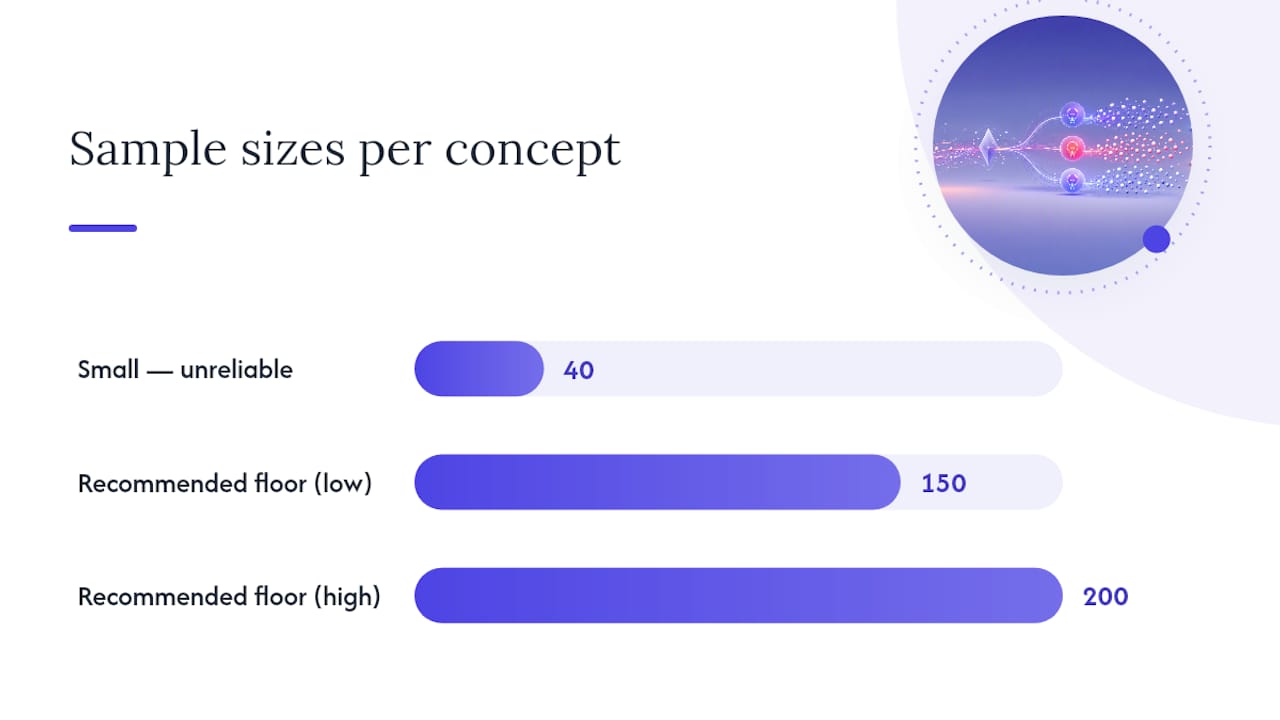
- Set your sample size before you field. A minimum of roughly 150 to 200 qualified respondents per concept generally provides directional reliability for typical campaign decisions. Smaller samples can still surface glaring problems, but you shouldn't trust close scores from a sample of 40.
- Cap your concept list at two or three. Testing more than three concepts in one sitting introduces fatigue, and respondents start giving lazier, less differentiated answers to the fourth and fifth option they see. Two to three concepts is the range that produces a clean comparative signal.
- Randomize presentation order. If every respondent sees concept A first, concept A gets an unfair primacy advantage (or disadvantage, depending on fatigue effects). Rotate the order across your sample so sequence bias cancels out.
- Recruit to match your actual target audience. A test run on a generic panel tells you what generic people think, not what your buyers think. If your product sells to working parents in their late thirties, your sample needs to look like working parents in their late thirties.
- Split segments into separate samples when you expect divergence. If you're testing a concept meant to work across two very different buyer types, don't blend them into one sample and average the results, that average can hide the fact that the concept crushed with one group and bombed with the other.
A number worth remembering: the 150 to 200 respondent floor per concept isn't a hard statistical law, it's a practical threshold that balances cost against reliability. Below it, you're often reading noise; above it, the marginal value of more respondents drops fast unless you're slicing into small subsegments.
Comparative testing, where two or three concepts sit side by side in the same study, gives richer signal than a single concept scored in isolation. A lone concept scoring "7 out of 10" tells you almost nothing on its own. The same concept scoring 7 against a competitor concept scoring 5.2 tells you exactly what you need to know.
Turning Scores Into Decisions
Raw scores are meaningless without context. A concept that scores 6.8 on purchase intent sounds mediocre until you learn your category benchmark is 5.5, at which point it's actually a strong performer. Always read scores relative to a benchmark or a competing concept in the same study, never in isolation.
Build your decisions around a three-way framework instead of a binary pass or fail:
- Proceed: the concept clears your pre-set thresholds on the dimensions that matter most for this campaign goal, and no segment shows a serious red flag
- Iterate: the concept shows promise on some dimensions but stumbles on a fixable one, like confusing dialogue or a weak call to action, so you revise and retest rather than scrapping it
- Drop: the concept underperforms across multiple dimensions or fails badly with your core segment, and no reasonable edit is going to save it
Segment divergence deserves special attention. A concept that scores brilliantly overall but bombs with your highest-value customer segment is not a win, it's a warning sign hiding behind a good topline number. Break results out by segment before you declare a winner.
The framework only works if you define pass and fail criteria before fielding, for instance, a concept passes if it beats the category benchmark on brand linkage and lifts intent by a set number of points. Decide that threshold in advance, or your team will find a reason to rationalize whatever the data says after the fact.
Pro Tip: Don't stop at the concept test score. Feed the winning concept into a live A/B test and track it against actual backend conversion data, not just click-through rate, since platform-reported CTR can be misattributed or inflated compared to what your own database shows.
Sharper Tools: MaxDiff, Card Sorts, and Synthetic Screening
Standard Likert scales ("rate this 1 to 5") have a well-known flaw: everyone clusters toward the middle, and small real differences between concepts get buried under a wall of 3s and 4s. When you need sharper discrimination, a few advanced techniques earn their complexity.
- MaxDiff forces respondents to choose their most and least preferred option from a small set, repeated across several rounds. It produces a clear ranked hierarchy of what actually drives preference, instead of a flat pile of "somewhat agree" responses.
- Card sorts ask people to physically group or rank messaging elements, which surfaces the language and priorities they'd never volunteer in a straight rating question.
- Willingness-to-pay tests anchor abstract preference to a real decision, closing some of the gap between what people say they'd do and what they'd actually do with money on the line.
- Synthetic audiences speed up the early screening round dramatically, but only after they've been calibrated against real historical results in your category.
MaxDiff and card-sort tasks force genuine trade-offs between options, which reveals which benefits truly drive preference in a way rating scales simply can't when messaging categories overlap.
That forced-choice mechanic is the whole point. When your ad concepts all cluster around similar promises, a straight rating scale will score them all "pretty good" and tell you nothing useful. A MaxDiff study makes people pick, and picking is where the real preference data lives.
Synthetic pre-tests fit into this toolkit as a funnel narrower, not a final judge. Their real value is screening widely and cheaply, cutting your list of ten rough concepts down to three worth spending real research budget on. Skip the live confirmation step and you're making media decisions on a hypothesis, not a result.
A 6-Week Ad Concept Testing Roadmap
Here's a schedule you can run start to finish, whether you're testing for a single campaign or building concept testing into a standing process.
- Week 1: Define hypotheses and pass criteria. Write down what each concept is betting on and what score, on which dimension, counts as a pass, before anyone sees the creative.
- Week 2: Build stimuli and design the study. Get scripts or storyboards to a consistent fidelity level and finalize your survey or moderator guide.
- Week 3: Run the synthetic or low-fidelity screen. Narrow your list to two or three finalists using AI pre-tests or quick qualitative reads.
- Week 4: Field the quantitative or qualitative test. Run the full survey or focus group study against your matched target sample.
- Week 5: Analyze and decide. Apply your proceed, iterate, or drop framework against the pre-set criteria from week one.
- Week 6: Launch a live A/B confirmation. Put your winning concept into market against a small live audience and track real conversions before scaling media spend.
Two paths through this roadmap depending on your resources:
- Speed option: synthetic screen plus a small live confirmation test, compressing the process into two or three weeks when timelines are tight
- Full-coverage option: synthetic screen, quantitative survey, qualitative follow-up, and live A/B confirmation, run in sequence for high-stakes campaigns where the media budget justifies the extra rigor
Write your hypothesis and pass-fail template once and reuse it every cycle. The teams that treat concept testing as a repeatable process, not a one-off project, are the ones who actually get faster at it over time.
Where Wing Assistant Fits Into a Faster Testing Cycle
Every recipe in this guide depends on one resource marketers chronically run short on: creative variants to actually test. You can't run a comparative study on two or three concepts if your team can only produce one polished video a month.

Jamesyee built its service around exactly that bottleneck. Dedicated virtual assistants take a single raw video and turn it into multiple engaging ad variations, which means you can feed your six-week testing roadmap with real stimuli instead of stalling at week two waiting on a production queue.
A few specifics worth knowing:
- Turnaround typically runs 24 to 48 hours per batch of variations, compared to the days or weeks a traditional agency often needs for a fraction of the output
- Faster, more frequent creative refresh directly combats creative fatigue, which is a major driver of rising CPA over a campaign's life
- Customers using this workflow report a 31% reduction in cost per acquisition, tied to having fresh, tested creative in rotation instead of running the same handful of ads until they burn out
If your testing program keeps stalling because production can't keep pace with your hypothesis list, that's a production problem, not a research problem, and it's worth solving separately from your testing methodology by working with an experienced AI marketing agency.
What Actually Matters in Ad Concept Testing
Most advice on this topic treats concept testing like a formality, a box to check between the creative brief and the media plan. That framing is backward. The research consistently shows that comparative testing against a benchmark, not isolated scoring, is what separates a useful test from a vanity exercise. A concept scored alone tells you almost nothing; a concept scored against two rivals tells you where you actually stand.
The conventional advice also oversells single-method testing. Teams that rely only on focus groups get rich stories and no statistical confidence. Teams that rely only on surveys get clean numbers and miss the emotional "why." The real unlock is sequencing: synthetic screening to cut the field, structured surveys or qualitative work to sharpen the finalists, and a live A/B test before real money moves.
If you take one thing from this guide, prioritize production capacity before methodology. The best testing framework is useless if you only have one concept to test. Solve the volume problem first, then get rigorous about how you score what you've made.
— James
Sources
A few sources worth bookmarking if you want to go deeper on any method covered above:
- Ad concept testing | Quirk's glossary
- AI message testing for ad copy and CTAs | neuroflash
- Ad concept testing: what it is and how it helps marketers | Behavio
- Ad concept testing survey explained | Zoho Insight